
A Laboratory Specification Guide for Nutmeg Buyers: Moisture, Oil Content, and Purity
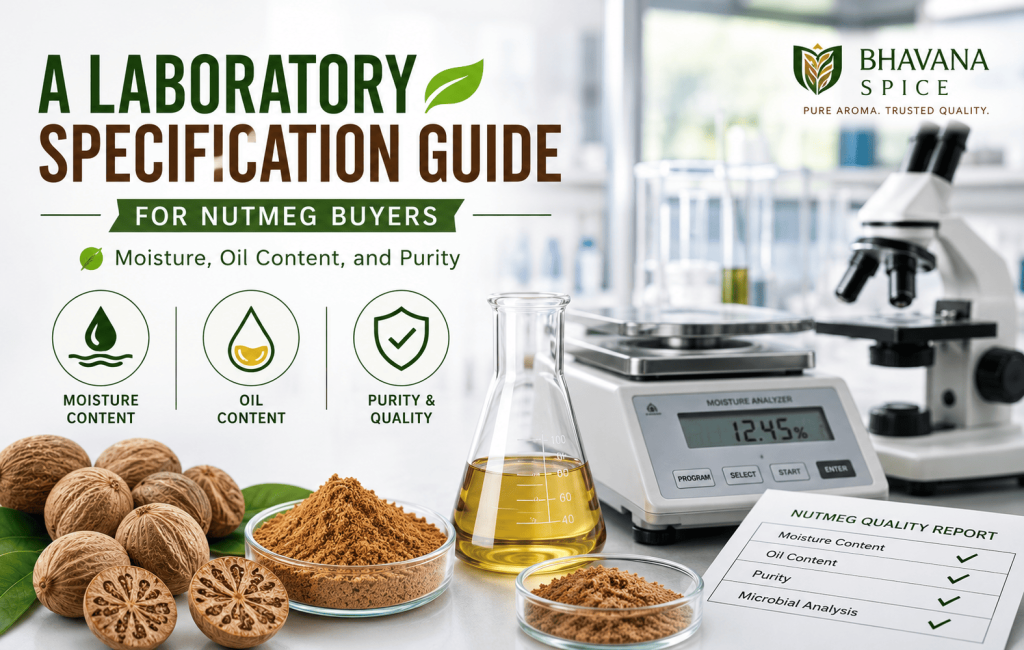
A Laboratory Specification Guide for Nutmeg Buyers: Moisture, Oil Content, and Purity
Specifically, in the B2B nutmeg trade, nutmeg quality testing specifications determine whether a shipment meets contract requirements, clears customs, and satisfies end-user expectations. Consequently, procurement managers and QA professionals must understand the key laboratory parameters that define premium nutmeg — because a container rejected at destination can cost tens of thousands of dollars in demurrage, re-testing, and lost sales. Furthermore, for a foundational understanding of nutmeg grades, see our complete guide to nutmeg grades for B2B buyers.
Moisture Content in Nutmeg Quality Testing Specifications
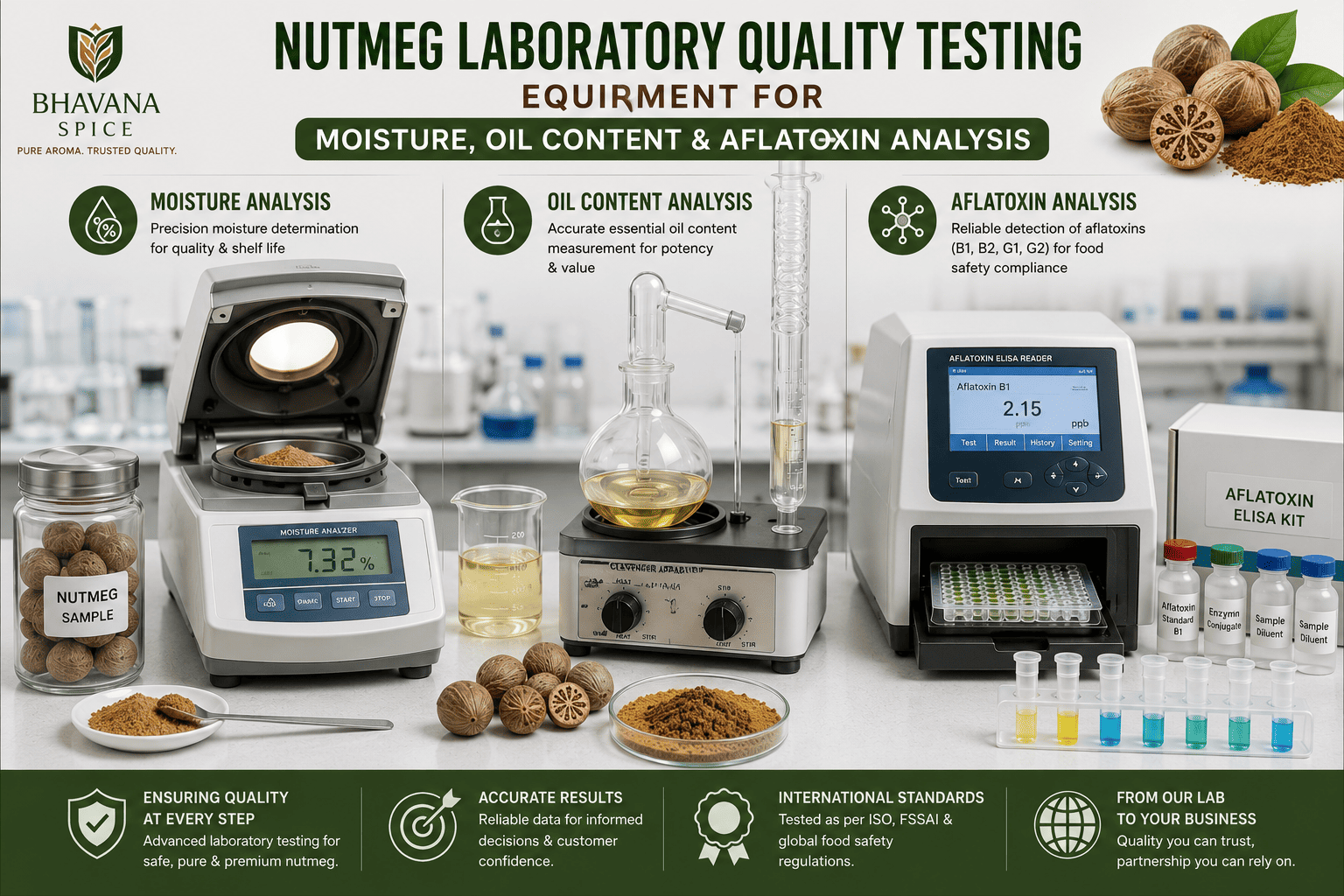
Consequently, moisture content is the single most important specification in nutmeg quality testing. Specifically, moisture directly affects mold growth, aflatoxin development, weight loss during storage, and the overall shelf life of the product.
Acceptable Moisture Standards
Specifically, regarding international standards, the generally accepted maximum moisture content for nutmeg is:
Additionally, EU import standards require maximum moisture of 10.0% tested by AOAC 925.40 oven drying at 105°C.
Similarly, US import standards set a maximum of 10.0% per AOAC 925.40.
Furthermore, the American Spice Trade Association specifies 10.0% maximum by the air oven method.
However, Bhavana Spice premium export grade targets 8–9% moisture using Karl Fischer titration plus oven drying for verification.
First, nutmeg with moisture above 10% is at high risk of mold and aflatoxin development during sea freight. Consequently, shipments exceeding this threshold may be rejected at destination or require costly fumigation.
Furthermore, moisture content above 10% increases shipping weight without adding value. Therefore, buyers pay ocean freight on water rather than product — a hidden cost that impacts total landed cost.
Notably, Bhavana Spice targets 8–9% moisture content for all exports, providing a safety margin below the 10% maximum. In addition, see our aflatoxin and mold prevention guide for a detailed explanation of our moisture control protocols.
Testing Methods for Moisture
Specifically, Karl Fischer titration uses a chemical reaction with water, achieving ±0.1% accuracy within 10–15 minutes. Consequently, this is the most precise method available.
Moreover, regarding oven drying (AOAC 925.40), it measures weight loss at 105°C with ±0.2% accuracy over 3–5 hours. However, it can also volatilize essential oils, leading to slightly inflated moisture readings.
Additionally, the infrared moisture analyzer uses IR absorption with ±0.3% accuracy in 5–10 minutes, offering a faster screening option.
Specifically, Karl Fischer titration is the gold standard for nutmeg moisture testing, as oven drying can also volatilize essential oils, leading to slightly inflated moisture readings. Therefore, high-quality suppliers use Karl Fischer as their primary method.
Volatile Oil Content in Nutmeg Quality Specifications
In addition, volatile oil content directly correlates with nutmeg’s sensory quality — the aroma, flavor, and essential oil yield that food manufacturers and spice blenders require.
Standard Volatile Oil Specifications
Specifically, concerning typical ranges, premium nutmeg should contain 8–15% volatile oil by weight:
| Grade & Oil Content | Significance |
|—|—|—|
| Consequently, premium ABCD nutmeg from Bhavana Spice delivers 10–15% volatile oil content. | Therefore, it provides superior aroma for essential oil extraction and premium food applications. |
| Accordingly, standard export grade nutmeg tests at 8–10% volatile oil. | Thus, this grade is acceptable for general food manufacturing. |
| However, sound shrivels (SS) yield only 7–9% due to kernel shrinkage. | In comparison, this grade has lower oil value for industrial use. |
| In contrast, BWP grade produces 5–8% volatile oil content. | Consequently, this grade offers significantly reduced oil value. |
First, oil content testing uses steam distillation (hydrodistillation) following the ASTA Method 5.0 or European Pharmacopoeia method. Specifically, a ground nutmeg sample is steam-distilled for 3–4 hours, and the volatile oil is collected and measured.
Therefore, buyers should always request volatile oil content data on the Certificate of Analysis. Consequently, this parameter directly impacts the value-in-use for your application — whether for food seasoning, essential oil extraction, or pharmaceutical compounding.
Aflatoxin Testing in Nutmeg Quality Specifications
Furthermore, aflatoxin contamination is the most common reason for nutmeg shipment rejection at international borders. Specifically, aflatoxins B1, B2, G1, and G2 are carcinogenic mycotoxins produced by Aspergillus mold species during improper drying or storage.
Regulatory Aflatoxin Limits
Specifically, concerning EU regulations, the maximum permitted aflatoxin levels are:
| Parameter | EU Limit | US FDA Limit |
|---|---|---|
| Consequently, aflatoxin B1 has a maximum limit of 5.0 ppb in the EU. | In contrast, the US FDA has no specific limit for nutmeg. | |
| Furthermore, total aflatoxins (B1+B2+G1+G2) cannot exceed 10.0 ppb in EU markets. | However, the US applies a 20 ppb general food limit across products. |
Furthermore, regarding testing methods, HPLC (High-Performance Liquid Chromatography) with fluorescence detection is the industry standard, with a detection limit of 0.1 ppb. Consequently, accredited laboratories can reliably quantify aflatoxins well below regulatory thresholds.
In addition, rapid test kits using ELISA (enzyme-linked immunosorbent assay) are used for preliminary screening. However, positive ELISA results must be confirmed by HPLC for regulatory acceptance.
Notably, Bhavana Spice tests every production batch for aflatoxins using ISO 17025-accredited laboratories, with results documented on each Certificate of Analysis. In addition, see our detailed aflatoxin prevention guide for comprehensive information on our testing protocols.
Physical Specifications in Nutmeg Quality Testing
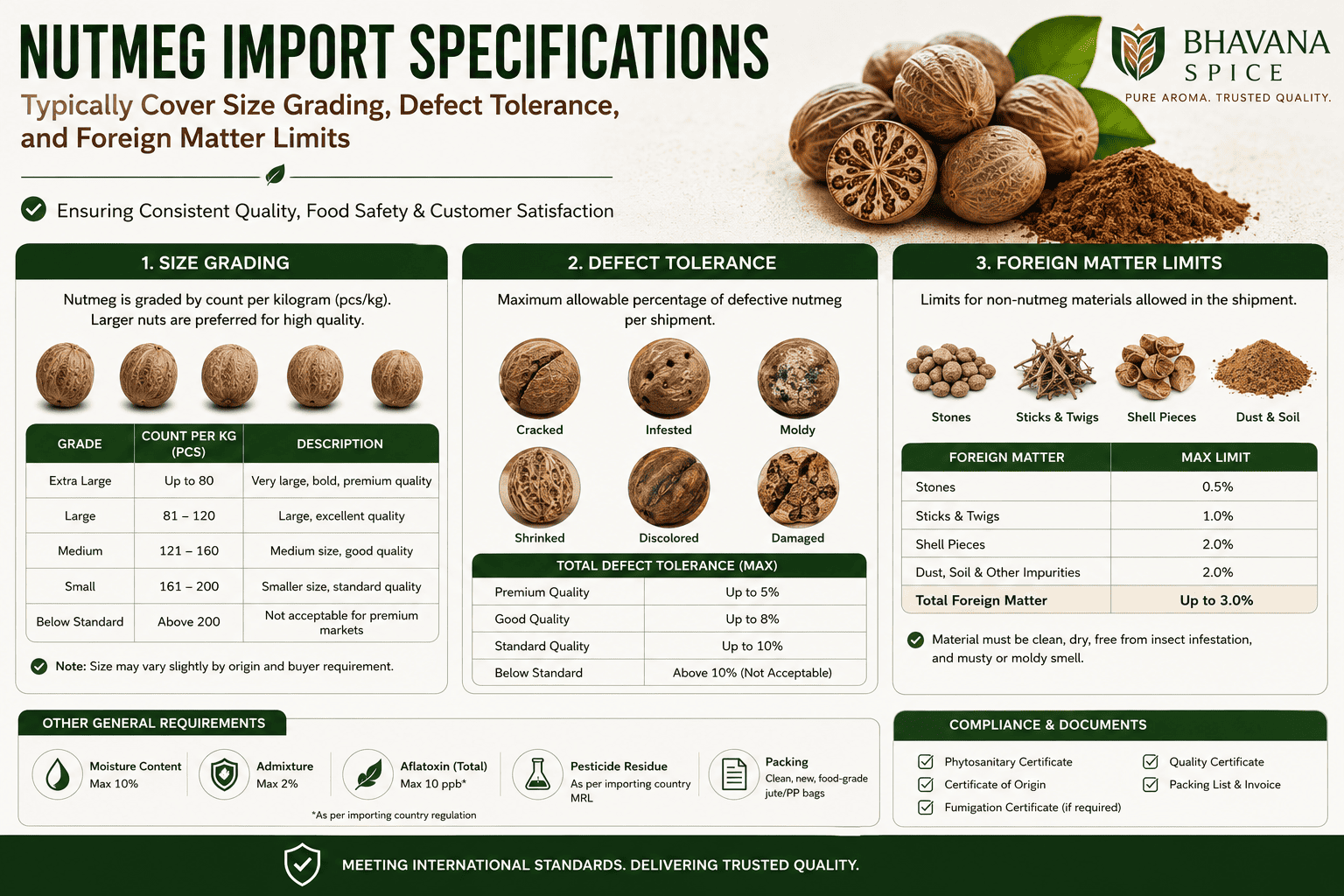
Notably, regarding physical quality, nutmeg import specifications typically cover size grading, defect tolerance, and foreign matter limits.
Size Grading Standards
Specifically, A-grade (large) nutmeg has a typical count of 60–80 kernels per 100g with a 22–26 mm diameter. Consequently, this grade commands premium pricing for whole-nutmeg applications.
Furthermore, B-grade (medium) has a standard of 80–110 kernels per 100g at 18–22 mm diameter, offering the most common specification for bulk processing.
In addition, C-grade (small) ranges from 110–140 kernels per 100g at 14–18 mm, typically used in grinding applications.
In contrast, sound shrivels (SS) have a variable kernel count with shrunken, lighter kernels and accordingly are priced lower for industrial processing.
Furthermore, concerning defect tolerance, premium ABCD-grade nutmeg typically allows: insect-damaged kernels at 2% maximum, moldy kernels at 1% maximum, foreign matter including stones, twigs, and metal at 0.5% maximum, and shrivels or immature kernels at 5% maximum.
Furthermore, foreign matter testing involves visual sorting of a representative sample (typically 500–1000g), with metal contamination checked via metal detection equipment.
Microbiological Testing in Nutmeg Quality Specifications
Specifically, microbiological testing ensures nutmeg meets food safety requirements. Consequently, acceptable limits include: Total Plate Count below 100,000 CFU/g per AOAC 966.23, Yeast & Mold below 1,000 CFU/g per ISO 21527, Salmonella absent in 25g per AOAC 967.26, and E. coli below 10 CFU/g per ISO 16649.
Consequently, suppliers who cannot provide microbiological testing data may expose buyers to regulatory action, product recalls, and reputational damage. Therefore, verifying complete nutmeg quality testing specifications including microbiological parameters is essential before approving any new supplier.
Reading a COA for Nutmeg Quality Testing Specifications
Nevertheless, receiving a Certificate of Analysis is only useful if you know how to interpret the data. Specifically, a complete COA for nutmeg should include:
First, product identification — Commodity name, batch number, origin, packing date, and supplier details.
Furthermore, moisture content — Results showing percentage moisture with testing method (Karl Fischer or oven drying) and the applicable limit.
In addition, volatile oil content — Percentage oil with distillation method, typically ASTA Method 5.0.
Moreover, aflatoxin results — Individual and total aflatoxin levels in ppb, with HPLC method reference and laboratory accreditation.
Additionally, microbiological results — TPC, yeast & mold, Salmonella, and E. coli with method references.
Finally, physical specifications — Count per 100g, defect percentages, and foreign matter content.
Notably, if any parameter exceeds the specified limit, the COA should include a corrective action note or the batch should be quarantined and reconditioned. Therefore, always compare COA results against your purchase contract specifications.
Red Flags on a COA
Specifically, QA professionals should watch for these warning signs:
- Specifically, missing aflatoxin data indicates the supplier may not test for mycotoxins
- Furthermore, results exactly at the limit raise questions about batch homogeneity and sampling
- In addition, no laboratory accreditation reference suggests testing may not be reliable
- However, inconsistent results across batches suggest variable quality control
- Moreover, no microbiological testing is a concern for food safety verification
Frequently Asked Questions About Nutmeg Quality Testing Specifications
What is the ideal moisture content for nutmeg in bulk shipments?
Specifically, the ideal moisture content is 8–9%, which provides a safety margin below the 10% maximum that most import regulations require. Consequently, nutmeg at 8–9% moisture has minimal risk of mold growth during 4–6 weeks of sea freight, while higher moisture levels significantly increase spoilage risk.
How is volatile oil content measured in nutmeg?
First, volatile oil content is measured by steam distillation using the ASTA Method 5.0. Specifically, a 20–50g ground nutmeg sample is steam-distilled for 3–4 hours, and the oil is collected in a graduated trap. Therefore, the percentage is calculated as oil volume divided by sample weight.
What aflatoxin level is acceptable for nutmeg imports into Europe?
Specifically, for EU imports, the maximum permitted level is 5.0 ppb for aflatoxin B1 and 10.0 ppb for total aflatoxins (B1+B2+G1+G2). Consequently, many B2B buyers set their contract specifications at 4.0 ppb B1 and 8.0 ppb total to provide a compliance margin.
Can I request additional testing beyond standard specifications?
Specifically, yes, most reputable suppliers can accommodate additional testing upon request, including pesticide residue analysis, heavy metals (lead, cadmium, mercury), and essential oil chemical profiling (GC-MS). However, additional testing may require extended lead time and incremental cost.
How does nutmeg quality testing support EUDR compliance?
In particular, laboratory testing documentation combined with batch traceability records provides the verification required for EU Deforestation Regulation compliance. Consequently, a complete COA linked to farm source data demonstrates due diligence throughout the supply chain.
What is the shelf life of properly stored nutmeg?
Furthermore, whole nutmeg stored below 10% moisture in hermetic containers at 20–25°C maintains quality for 24–36 months. In contrast, ground nutmeg has a shorter shelf life of 6–12 months due to volatile oil loss through increased surface area.
Source Nutmeg with Complete Quality Testing Specifications
Ultimately, for procurement managers and QA professionals who require verified nutmeg quality testing specifications for every shipment, Bhavana Spice provides complete laboratory documentation with all bulk nutmeg exports:
- Specifically, we provide a Certificate of Analysis with full testing data
- Furthermore, ISO 17025-accredited laboratory results confirm aflatoxin levels
- In addition, moisture content is verified by Karl Fischer titration
- Moreover, volatile oil percentage is tested per ASTA Method 5.0
- Additionally, microbiological testing follows international standards
- In particular, physical specifications include count per 100g and defect tolerance
- Finally, batch traceability links farm source to container
Furthermore, to request current specifications, sample COAs, or to discuss your quality requirements, please reach out through any channel below:
- Email: [email protected]
- WhatsApp B2B Helpline: +62 822-3332-2034
- Head Office & Export Coordination: Modinan RT 007/RW 021, Banyuraden, Gamping, Sleman, DIY – Indonesia
In conclusion, our QA team is ready to provide batch-specific Certificates of Analysis, organic certification documentation, and farm traceability records to support your supplier qualification process. Furthermore, explore our ISO 22000 and HACCP compliance overview for broader food safety assurance.