
Aflatoxin in Nutmeg: How Direct Indonesian Exporters Prevent Mold in Bulk Shipments
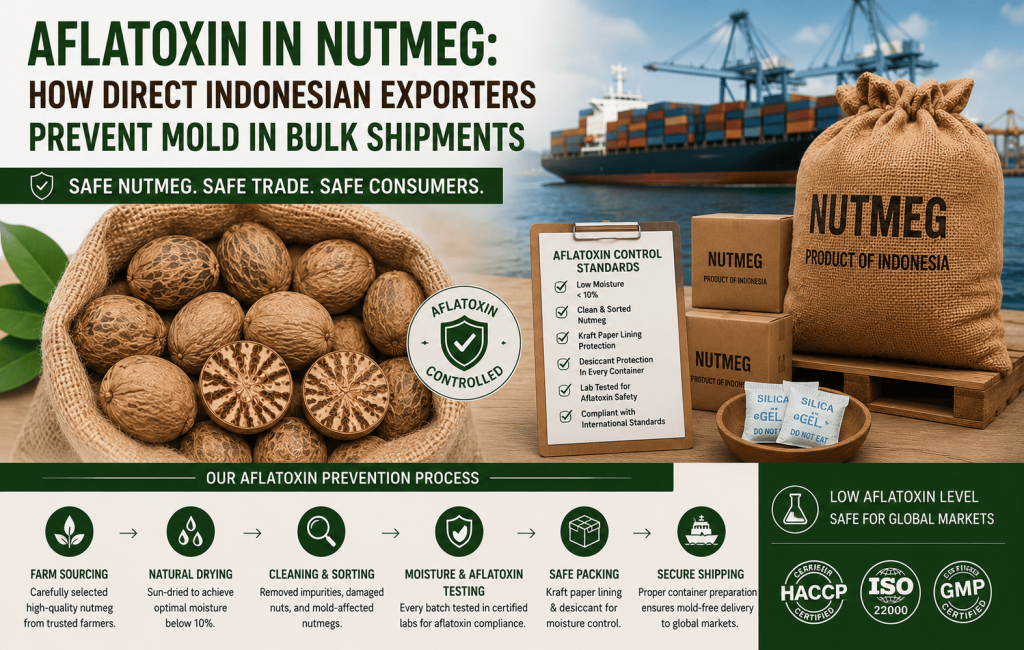
Aflatoxin in Nutmeg: How We Prevent Mold and Contamination in High-Volume Bulk Exports
For any QA Manager or Procurement Officer managing bulk spice imports, aflatoxin in nutmeg is not a theoretical risk — it is the single most financially catastrophic failure mode in the entire supply chain. Specifically, a single rejected container at the port of Rotterdam or Los Angeles can result in losses exceeding USD 80,000 to USD 120,000 per Full Container Load (FCL). Furthermore, this figure does not include the reputational damage, regulatory scrutiny, and delayed production line that follow.
Understanding how aflatoxin in nutmeg develops — and what a responsible direct Indonesian exporter does to eliminate that risk — is therefore essential knowledge. Specifically, this knowledge is critical for any procurement team sourcing bulk quantities of Indonesian spices.
This article provides a technical, end-to-end overview of aflatoxin and mold prevention in large-volume nutmeg export operations. Specifically, it covers moisture science, regulatory thresholds, pre-shipment testing protocols, and container logistics. We draw all information from the operating standards at Bhavana Spice, a direct-source nutmeg exporter from Indonesia.
1. What Is Aflatoxin in Nutmeg and Why Does It Appear?
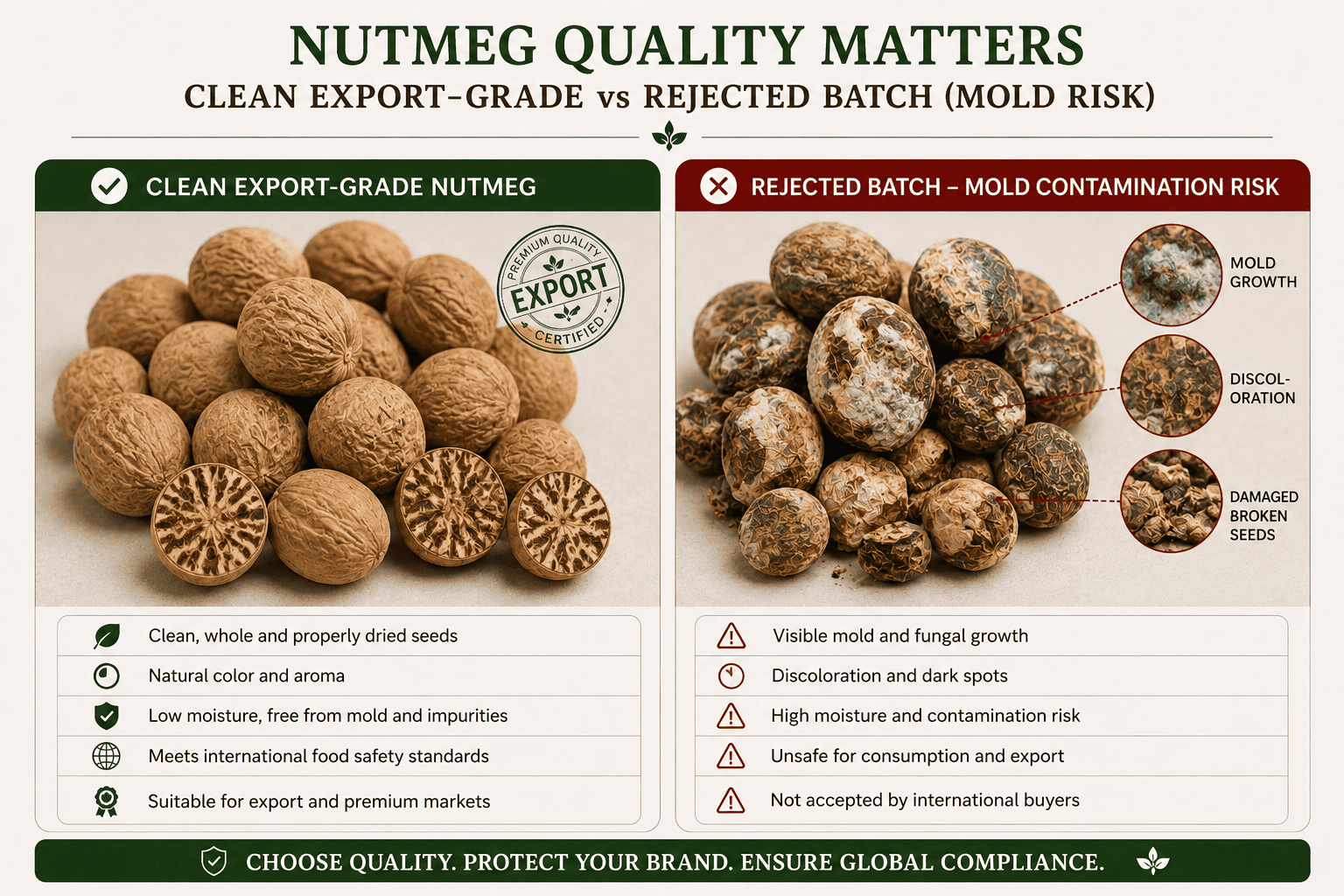
Aflatoxins are a family of highly toxic and carcinogenic mycotoxins produced primarily by two mold species: Aspergillus flavus and Aspergillus parasiticus. These microscopic fungi thrive in warm, humid environments and readily colonize dried agricultural commodities — particularly spices like nutmeg, pepper, and chili — when moisture conditions are not rigorously controlled throughout the entire post-harvest chain.
Among the aflatoxin variants, The International Agency for Research on Cancer (IARC) classifies Aflatoxin B1 (AFB1) as a Group 1 human carcinogen — a confirmed cause of hepatocellular carcinoma (liver cancer). Even trace contamination at single-digit parts-per-billion (ppb) levels is sufficient to trigger regulatory seizure in the European Union.
Why Nutmeg Is Vulnerable to Aflatoxin in Nutmeg Contamination
In practice, nutmeg presents a unique set of biological and logistical characteristics that make it more susceptible to aflatoxin contamination compared to other dried commodities:
- High Natural Fat Content: Nutmeg kernels contain 25% to 35% fixed oil (myristicin oil), which creates an energy-rich substrate that supports rapid fungal colony growth when moisture is present.
- Extended Drying Requirement: Achieving safe moisture levels in whole nutmeg requires 6 to 8 weeks of sun-drying under optimal tropical conditions. Rushing this process — a common commercial shortcut — leaves kernels with residual moisture pockets that are invisible externally but catastrophic internally.
- Complex Internal Structure: Unlike pepper or coriander, whole nutmeg kernels have a dense internal matrix. Moisture can be trapped within the endosperm even when the surface appears visually dry, creating an internal anaerobic environment ideal for Aspergillus colonization.
- Tropical Origin Logistics: Nutmeg grows primarily in high-humidity tropical environments (Maluku, Sulawesi, Sumatra). The transition from a hot, humid tropical port to a cold European import terminal creates severe thermal shock inside a sealed container — commonly known as “Container Sweat”.
2. The EU and FDA Regulatory Framework for Aflatoxin in Nutmeg
Before any bulk transaction concludes, international buyers must clearly understand the regulatory environment governing aflatoxin in nutmeg at their country of import. Importantly, non-compliance does not result in a product recall. Instead, it results in mandatory destruction or re-exportation of the entire container load at the importer’s expense.
European Union (EU) — Commission Regulation (EC) No 1881/2006
The EU operates the world’s most stringent aflatoxin limits for spices, and nutmeg falls squarely within its highest-scrutiny category:
| Aflatoxin Parameter | EU Maximum Limit | Consequence of Exceedance |
|---|---|---|
| Aflatoxin B1 (AFB1) | 5.0 µg/kg (ppb) | Immediate RASFF Alert, mandatory destruction or re-export |
| Total Aflatoxins (B1+B2+G1+G2) | 10.0 µg/kg (ppb) | Full container seizure and notification to all EU member states |
The EU’s Rapid Alert System for Food and Feed (RASFF) publishes weekly reports of seized shipments. Nutmeg from Indonesia regularly appears in RASFF notifications. Consequently, a single RASFF listing against a supplier’s country of origin will immediately trigger enhanced border checks — screening every subsequent shipment from that exporter with mandatory sampling.
United States — FDA (Food Safety Modernization Act / FSMA)
The US FDA enforces a 20 ppb total aflatoxin action level for spices intended for human consumption. While numerically higher than EU limits, FDA compliance equally demands documented pre-shipment testing via accredited third-party laboratories. Furthermore, importers operating under FSMA have Preventive Controls obligations. As a result, the burden of supplier verification lies explicitly with the US importing entity.
3. The Root Cause: How Moisture Triggers Aflatoxin in Nutmeg
The entire science of preventing aflatoxin in nutmeg ultimately distills to a single operating principle: control the water activity. Indeed, aflatoxin contamination is almost never present in freshly harvested, correctly dried nutmeg. Instead, it develops overwhelmingly because of moisture mismanagement at one or more stages of the post-harvest chain.
Water Activity (Aw) vs. Moisture Content: The Critical Distinction
To begin, QA managers must understand the difference between Moisture Content (MC) — a percentage measurement — and Water Activity (Aw) — a thermodynamic measure of available (free) water in the food system:
- Water Activity (Aw) is measured on a scale of 0 to 1.0.
- Aspergillus flavus requires a minimum Aw of approximately 0.82 to germinate and produce aflatoxin.
- For whole nutmeg, the critical safe threshold corresponds to a moisture content of approximately 10%.
- At moisture content > 12%, Aw rises above 0.82, and the risk of active aflatoxin biosynthesis during maritime transit increases exponentially.
Therefore, this is the scientific reason why Bhavana Spice enforces a strict <10% moisture content specification across all grades. Specifically, this is not an arbitrary internal policy — it represents the evidence-based threshold below which aflatoxin biosynthesis effectively halts.
The Container Sweat Cascade: A Step-by-Step Failure Scenario
In fact, the most common aflatoxin contamination pathway in nutmeg exports is not pre-shipment mold — it is in-transit mold development driven by container sweat. Therefore, understanding this failure cascade is essential for procurement risk assessment:
         CONTAINER SWEAT: IN-TRANSIT AFLATOXIN DEVELOPMENT CASCADE

  STEP 1: HIGH-MOISTURE NUTMEG LOADED
  ┌─────────────────────────────────────────────────────────────────────┐
  │  Nutmeg loaded at Surabaya or Makassar at 14%–15% moisture content  │
  │  Surface appears dry. Internal moisture pockets are invisible.       │
  └───────────────────────────────────┬─────────────────────────────────┘
                                      │
  STEP 2: EQUATORIAL TRANSIT (HOT ZONE)
  ┌───────────────────────────────────▼─────────────────────────────────┐
  │  Container traverses Indian Ocean. External temps reach 38°C–42°C.  │
  │  Cargo heats up. Moisture vaporizes and rises to the container roof. │
  └───────────────────────────────────┬─────────────────────────────────┘
                                      │
  STEP 3: COOLING ZONE (NORTHERN HEMISPHERE)
  ┌───────────────────────────────────▼─────────────────────────────────┐
  │  Container enters cooler waters near Europe. Roof temperature drops. │
  │  Water vapor condenses on the metal ceiling. Liquid water drips back │
  │  onto top-layer nutmeg bags. Aw in top 20cm of cargo spikes to >0.90│
  └───────────────────────────────────┬─────────────────────────────────┘
                                      │
  STEP 4: MOLD COLONY ESTABLISHMENT
  ┌───────────────────────────────────▼─────────────────────────────────┐
  │  Dormant Aspergillus flavus spores (naturally present on nutmeg      │
  │  shells at harvest) germinate in the newly wetted top-layer cargo.  │
  │  After 5–7 days of active growth, aflatoxin B1 biosynthesis begins. │
  └───────────────────────────────────┬─────────────────────────────────┘
                                      │
  STEP 5: PORT ARRIVAL & RASFF ALERT
  ┌───────────────────────────────────▼─────────────────────────────────┐
  │  Routine port sampling detects AFB1 > 5ppb (EU limit). Container    │
  │  quarantined. RASFF notification issued. Container destroyed or      │
  │  returned at importer's cost. Total loss: USD 80,000–120,000.        │
  └─────────────────────────────────────────────────────────────────────┘
This is the failure scenario that Bhavana Spice’s entire post-harvest quality control system works to prevent.
4. How We Prevent Aflatoxin in Nutmeg: Bhavana Spice’s Five-Layer Protocol
Preventing aflatoxin in nutmeg at the scale of multiple Full Container Load shipments per month requires a systematic, multi-stage protocol — not a single intervention. Consequently, at Bhavana Spice, we operate a Five-Layer Aflatoxin Prevention System applied across every batch we process and export.
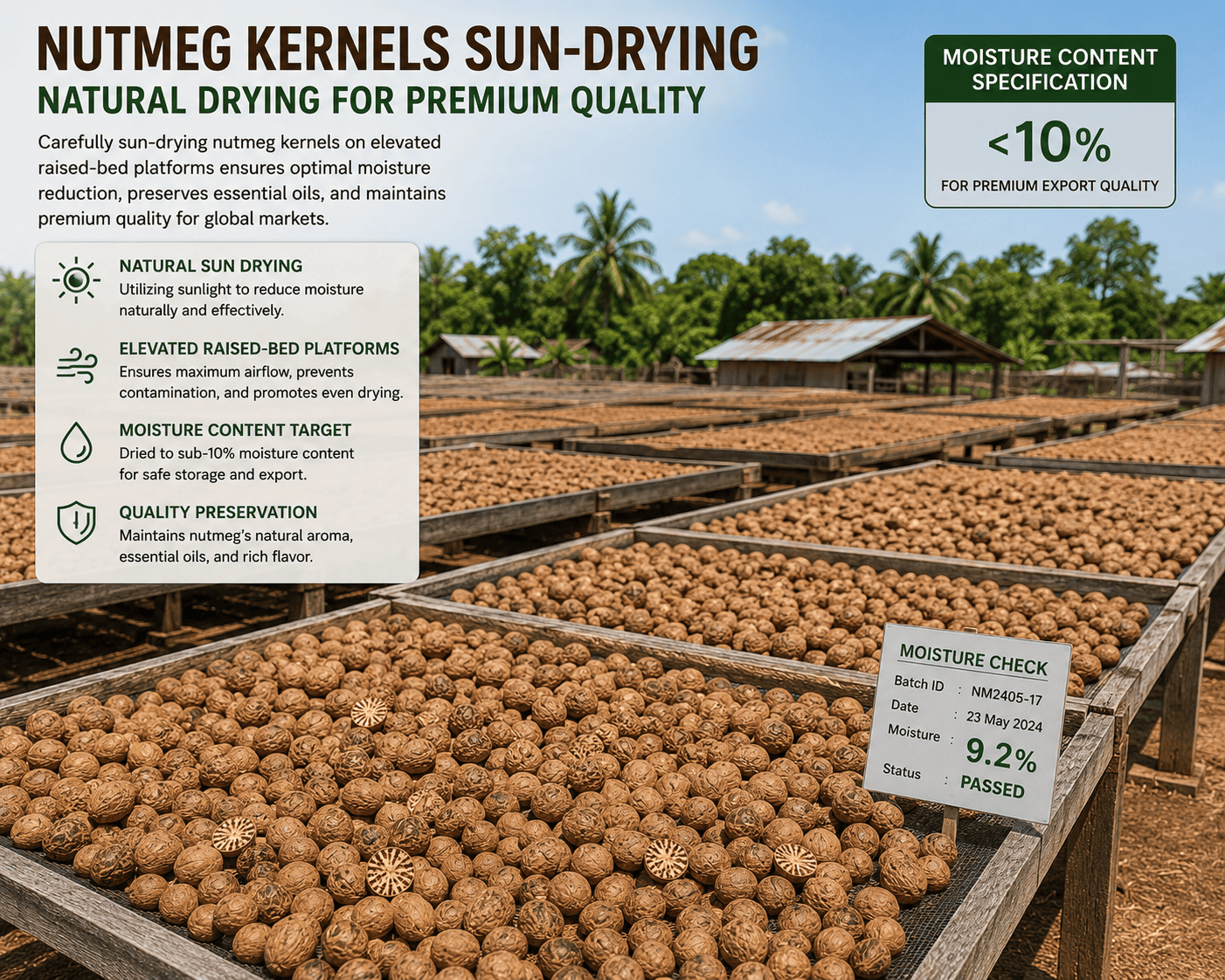
Layer 1 — Extended Sun-Drying Under Climate-Controlled Conditions
Our nutmeg undergoes a minimum 6-week sun-drying cycle on elevated raised-bed drying platforms. Specifically, elevating the drying beds off the ground ensures full airflow beneath the nutmeg layer. Consequently, this prevents humidity absorption from the soil — a common contamination vector in ground-level drying operations.
During the rainy season (October–April), we integrate mechanical dehumidification during the nighttime hours to compensate for elevated ambient humidity, ensuring the drying process remains uninterrupted and moisture levels trend consistently downward to our target threshold.
Target: Kernels reach <10% moisture content before any further processing, storage, or grading.
Layer 2 — Moisture Meter Verification at Every Processing Stage
In practice, moisture content is not tested just once at the point of loading. Instead, at Bhavana Spice, we measure moisture content at four distinct checkpoints using calibrated electronic moisture meters (NIR-based grain analyzers):
- Post-Sun-Drying: Batch is not moved to storage until MC < 10% is confirmed across multiple random sub-samples.
- Pre-Grading: Before sortation begins, batch moisture is re-verified to detect any uptake during staging.
- Pre-Bagging: Final check before nutmeg is sealed into export bags. Any batch reading > 9.5% is returned for supplementary drying.
- Pre-Container Loading: Spot-check on a per-bag random sample basis at the loading dock.
This four-checkpoint system ensures that no individual batch — regardless of its pre-processing readings — reaches the container with moisture above our operating threshold.
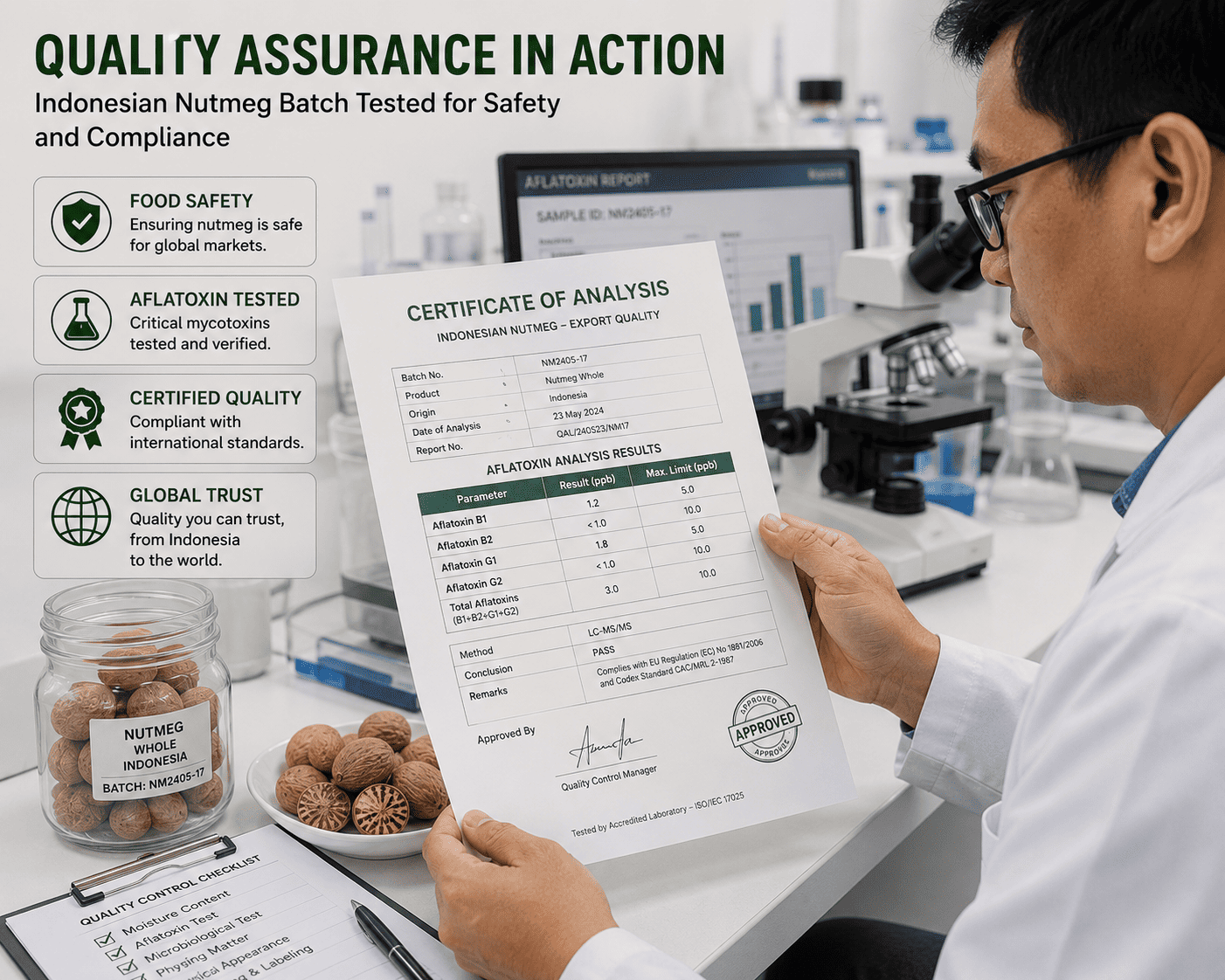
Layer 3 — Testing for Aflatoxin in Nutmeg via Accredited Third Parties
Importantly, no shipment from Bhavana Spice is dispatched without a pre-shipment Certificate of Analysis (COA) from an internationally accredited third-party laboratory. Our current accredited laboratory partners include:
- Sucofindo (PT Superintending Company of Indonesia): Government-affiliated, ISO/IEC 17025 accredited, internationally recognized for commodity testing.
- SGS Group: Global leader in inspection and testing, with EU and FDA-recognized accreditation for food safety contaminants.
- Intertek Group: Accredited for HACCP and food safety laboratory analysis for regulated commodity export.
In addition, the COA issued for every batch explicitly documents:
| Test Parameter | Test Method | Bhavana Standard | EU/FDA Limit |
|---|---|---|---|
| Aflatoxin B1 | HPLC-MS/MS | < 2.0 µg/kg | Max 5.0 µg/kg (EU) |
| Total Aflatoxins (B1+B2+G1+G2) | HPLC-MS/MS | < 4.0 µg/kg | Max 10.0 µg/kg (EU) |
| Moisture Content | Oven-drying / NIR | < 10% | Max 10% (Industry Safe) |
| Volatile Oil Content | Hydro-distillation | Grade-specific (≥5.5%) | N/A (Trade Spec) |
| Salmonella | ISO 6579 | Not Detected / 25g | Not Detected |
| Mould Count | ISO 21527 | < 10,000 CFU/g | Varies by market |
Notably, we intentionally set our internal specifications significantly below regulatory limits — not merely to meet compliance, but to build an auditable margin of safety that absorbs any variability introduced during maritime transit.
Layer 4 — Anti-Moisture Packaging and Container Preparation
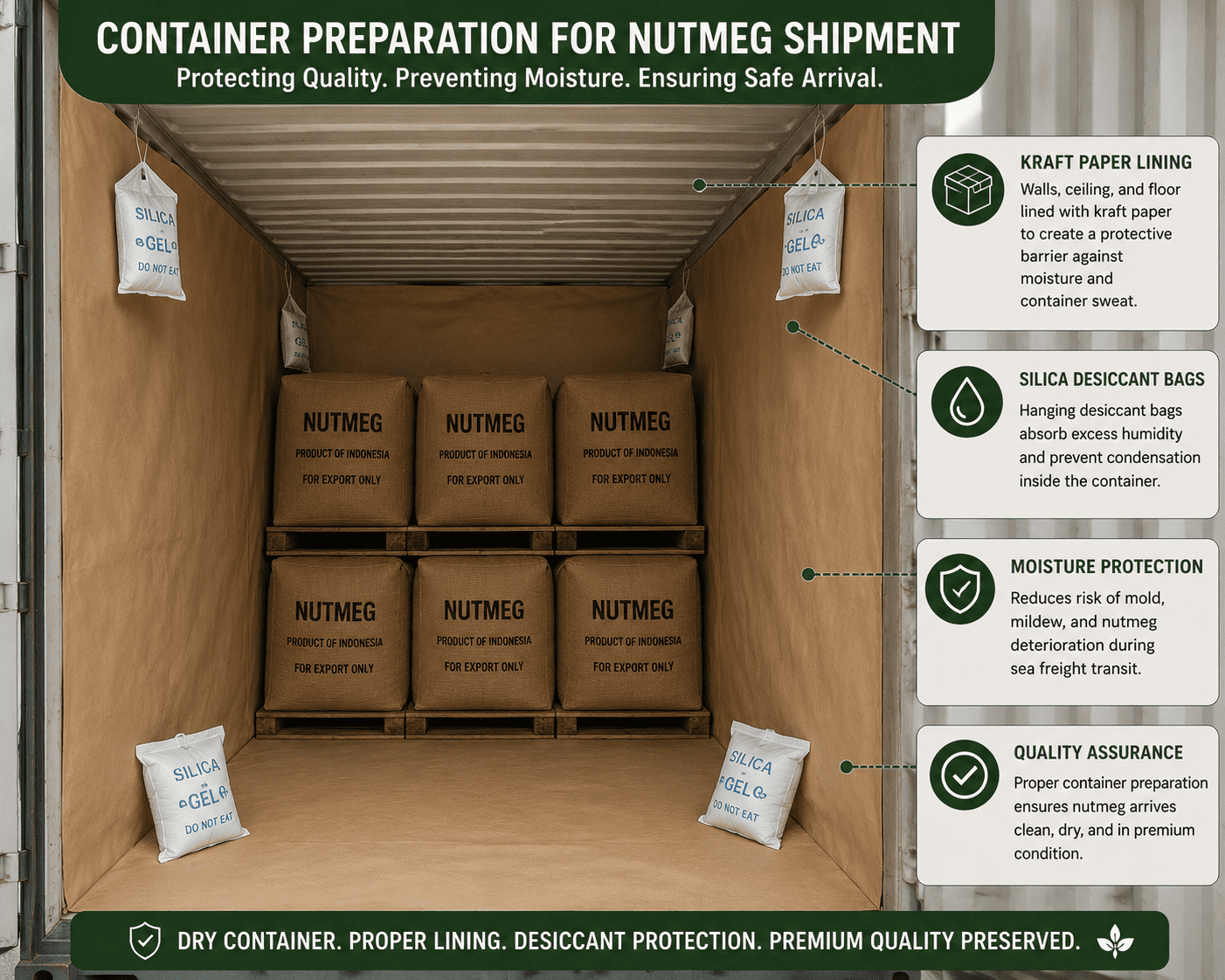
Furthermore, even nutritionally safe, low-moisture nutmeg can become contaminated if the container environment is not actively managed during sea freight. Therefore, at Bhavana Spice, our container preparation protocol includes:
- Food-Grade Double-Layered Woven PP Bags with Inner Polyethylene Liner: The inner PE liner creates a moisture-barrier membrane that prevents ambient humidity from entering the bag from the outside.
- Heavy-Duty Kraft Paper Liner on Container Walls: A full cardboard kraft paper liner is installed on all six interior surfaces of the container (floor, ceiling, and four walls) before loading begins. This absorbs minor condensation that forms on the steel container walls.
- Silica Desiccant Gel Packs — Container Grade: A minimum of 8 to 10 bags of 1.5 kg silica gel desiccants are suspended at the ceiling level of every 20-foot container loaded. These hygroscopic packs absorb atmospheric moisture inside the sealed container throughout the entire sea voyage, actively depressing the internal container RH% during the critical equatorial and sub-tropical transit zones.
- Dedicated Spice Containers Only: We never co-load nutmeg with wet agricultural goods, chemicals, or strongly odorous commodities. Dedicated reefer-grade containers are available on request for premium ABCD grade consignments.
Layer 5 — Climate-Controlled Warehouse Storage Before Dispatch
We store nutmeg that we process and bag for export in our temperature and humidity-controlled warehouse facility. Specifically, maintaining a storage environment of 18°C–22°C with relative humidity (RH) below 65% prevents any re-absorption of atmospheric moisture between processing completion and container loading. Notably, this is a vulnerability commonly overlooked by smaller trading-house exporters who store finished goods in open sheds.
5. Evaluating Your Supplier’s Aflatoxin in Nutmeg Risk Profile
If your current nutmeg supplier has not provided documentation addressing the following points, your supply chain is operating with unquantified aflatoxin risk. Specifically, look for these critical items:
Supplier Risk Evaluation Checklist
- ☐Does your supplier provide a COA from an ISO/IEC 17025 accredited independent laboratory for each batch? (Not an internal test — a signed, accredited third-party document.)
- ☐Does the COA explicitly state the batch-specific Aflatoxin B1 result in µg/kg (ppb)? (Not just “Complies with EU regulations” — the actual numeric result.)
- ☐Is your supplier’s declared moisture content specification below 10%? (Any supplier specifying 12% or 15% is operating outside the aflatoxin-safe zone for ocean freight.)
- ☐Does your supplier describe their container preparation protocol, including desiccant type and placement? (A supplier with no protocol is relying on luck.)
- ☐Can your supplier provide batch traceability documentation showing the specific growing region and processing date? (Required for EUDR compliance and supports COA validity verification.)
Finally, if you answered No to two or more of these questions, we strongly recommend requesting updated documentation from your current supplier before the next shipment. Alternatively, consider initiating a parallel sourcing evaluation with a compliant supplier.
6. The Business Case: Why Preventing Aflatoxin in Nutmeg Pays Off
In addition, a recurring objection in bulk spice procurement is the assumption that stricter aflatoxin controls translate to a higher per-kilogram FOB price. While a marginally higher unit cost may apply, the financial mathematics of risk management argue decisively in favor of prevention. Specifically, consider the comparison below:
| Scenario | Unit Cost | Risk Outcome | Total Cost (20 MT shipment) |
|---|---|---|---|
| Low-cost supplier, 14% moisture, no COA | USD 3.20/kg | 1 in 5 chance of RASFF rejection | Expected cost: USD 96,000+ (loss + freight + origin re-export) |
| Quality supplier, <10% moisture, accredited COA | USD 3.65/kg | Near-zero RASFF risk | Predictable cost: USD 73,000 (FCL landed) |
The additional USD 0.45/kg premium for verified quality control generates an expected value saving of over USD 23,000 per container. Furthermore, this figure does not yet account for operational disruption and regulatory relationship damage with local customs authorities.
7. Source Aflatoxin-Safe Bulk Nutmeg from Bhavana Spice
In summary, at Bhavana Spice, we have built our entire export operation around the single premise that quality assurance is not a cost — it is the product. Specifically, every metric ton of nutmeg we ship to Europe, the United States, and Asia-Pacific is backed by:
- A <10% moisture content guarantee, verified at four processing checkpoints and documented on the COA.
- Pre-shipment aflatoxin testing by Sucofindo, SGS, or Intertek — with results available to buyers before the container is sealed.
- A full container preparation protocol including food-grade PP + PE bags, kraft paper lining, and silica desiccant placement.
- Batch-level traceability from cooperative farming clusters in volcanic-soil growing regions of Maluku and Sulawesi.
- Comprehensive export documentation including Phytosanitary Certificates, Health Certificates, Certificate of Origin, and Fumigation Certificates where required.
Whether you are an EU food manufacturer operating under strict HACCP audit requirements, a US importer navigating FSMA Preventive Controls obligations, or an Asian spice trader scaling up your B2B volume, Bhavana Spice provides the documented assurance your procurement team requires to approve a new supplier with confidence. Learn more about our wholesale nutmeg grades and quality specifications to make your procurement decision with full technical insight.
Request a Pre-Shipment COA Sample and B2B Inquiry
To get started, request the most recent Certificate of Analysis from our active production batch, discuss Full Container Load (FCL) or Less-than-Container Load (LCL) pricing, or arrange for a physical evaluation sample to be sent to your QA laboratory, contact our B2B export division directly:
- Email: [email protected] (COA documents and product specification sheets dispatched within 24 business hours)
- WhatsApp B2B Direct Line: +62 822-3332-2034 (Instant response for procurement inquiries, stock availability, and loading schedule confirmation)
- Export Coordination Office:
Modinan RT 007/RW 021, Banyuraden, Gamping, Sleman, DIY – Indonesia
Our QA team is on standby to share gas chromatography profiles, microbiological test results, and moisture verification reports — giving your procurement decision the technical foundation it deserves.