
Why ISO 22000 and HACCP Matter for Global Spice Import Safety
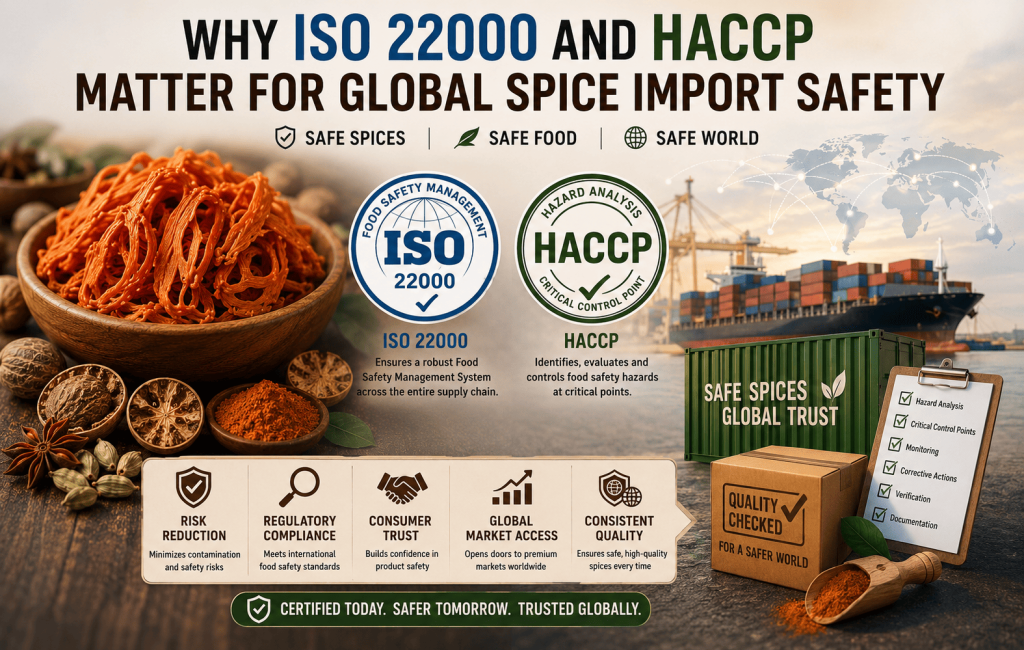
Why ISO 22000 and HACCP Matter for Global Spice Import Safety: A B2B Buyer’s Guide
In the increasingly regulated world of global spice trade, ISO 22000 and HACCP for spice import safety are non-negotiable requirements for responsible B2B buyers. Accordingly, every year, thousands of metric tons of nutmeg, mace, and other spices cross international borders, passing through multiple handling points where contamination risks emerge. Therefore, understanding these food safety management standards is essential for procurement managers and QA professionals who need to verify supplier compliance and protect their supply chains from costly safety failures. Furthermore, for deeper insight into contamination prevention, see our guide on aflatoxin prevention in bulk nutmeg shipments.
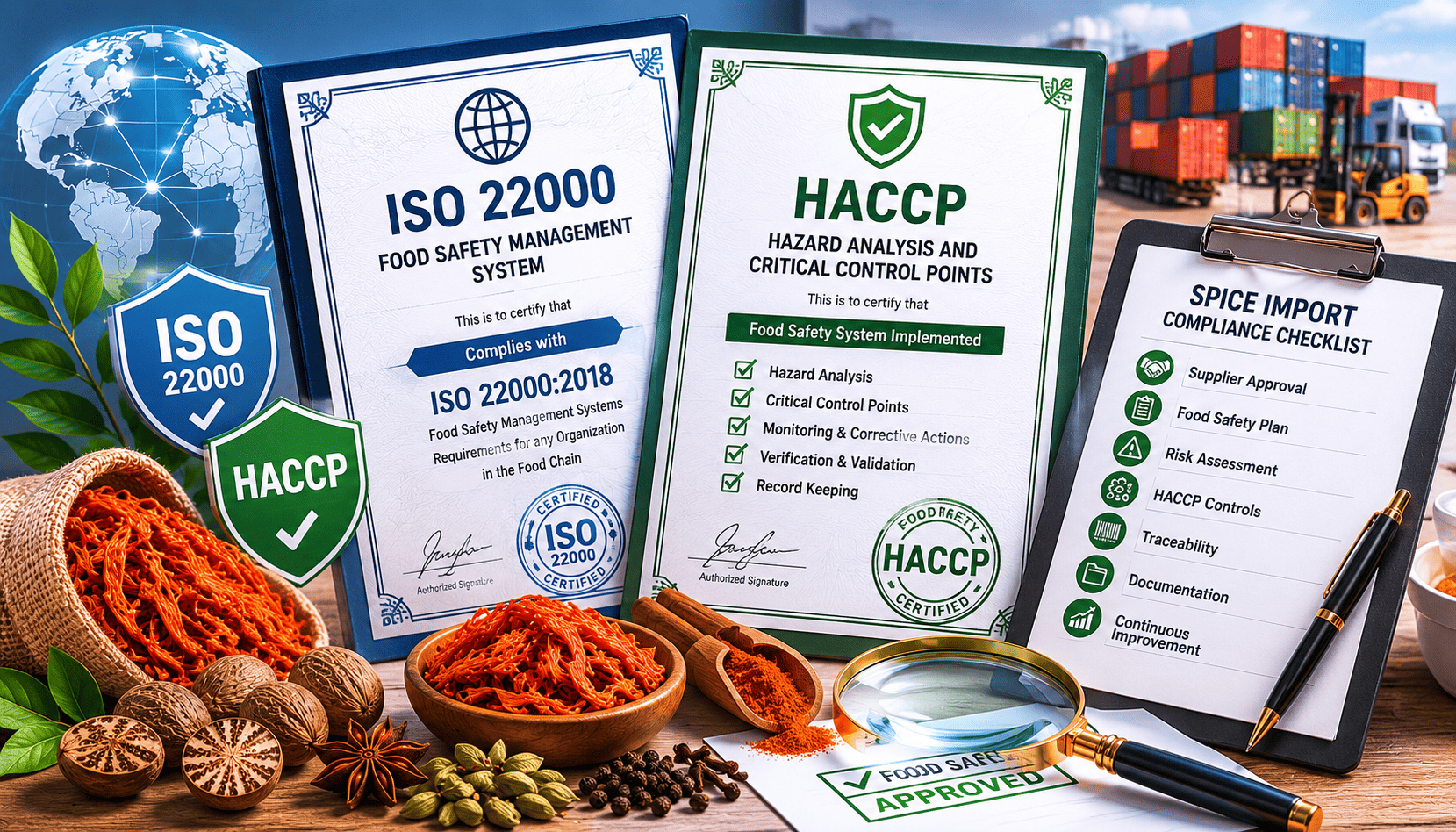
What Are ISO 22000 and HACCP for Spice Industry Safety?
Firstly, to understand ISO 22000 and HACCP for spice import safety, buyers must recognize that these are complementary but distinct food safety frameworks. In fact, they work together to create comprehensive protection throughout the spice supply chain.
HACCP: Hazard Analysis and Critical Control Points
In particular, HACCP (Hazard Analysis and Critical Control Points) is a systematic preventive approach to food safety that identifies, evaluates, and controls significant hazards throughout the production process. Specifically, NASA and the Pillsbury Company originally developed HACCP for astronaut food safety in the 1960s, and it has become the global benchmark for food safety management — the Codex Alimentarius Commission recognizes it — across all food sectors, including spice processing and export.
Consequently, HACCP focuses on seven core principles that work together to prevent contamination:
First, conduct a hazard analysis identifying all potential biological, chemical, and physical hazards. For instance, this means detecting aflatoxin contamination risks at drying stages and foreign matter during sorting.
Next, identify CCPs or Critical Control Points where you must control hazards. For example, moisture monitoring during sun-drying and metal detection after grinding.
Then, establish critical limits with measurable safety boundaries. For instance, maximum moisture below 10% and aflatoxin B1 below 5 ppb per EU standards.
Furthermore, define monitoring procedures that measure and record each CCP. Notably, this includes daily moisture testing and batch-level aflatoxin analysis via HPLC.
In addition, specify corrective actions that activate when batches breach critical limits. Consequently, re-drying protocols and contaminated batch segregation procedures prevent unsafe products from reaching buyers.
Moreover, conduct verification to confirm the HACCP system works effectively. Therefore, third-party lab audits and COA verification provide independent assurance.
Finally, maintain documentation of all procedures and monitoring data. As a result, batch traceability records and temperature logs preserve safety data for every shipment.
ISO 22000: Food Safety Management System
In addition, ISO 22000 is an international standard published by the International Organization for Standardization (ISO) that specifies requirements for a comprehensive Food Safety Management System (FSMS). Notably, ISO 22000 integrates the HACCP principles with prerequisite programs (PRPs) and management system requirements, creating a unified framework that covers the entire food chain from farm to fork.
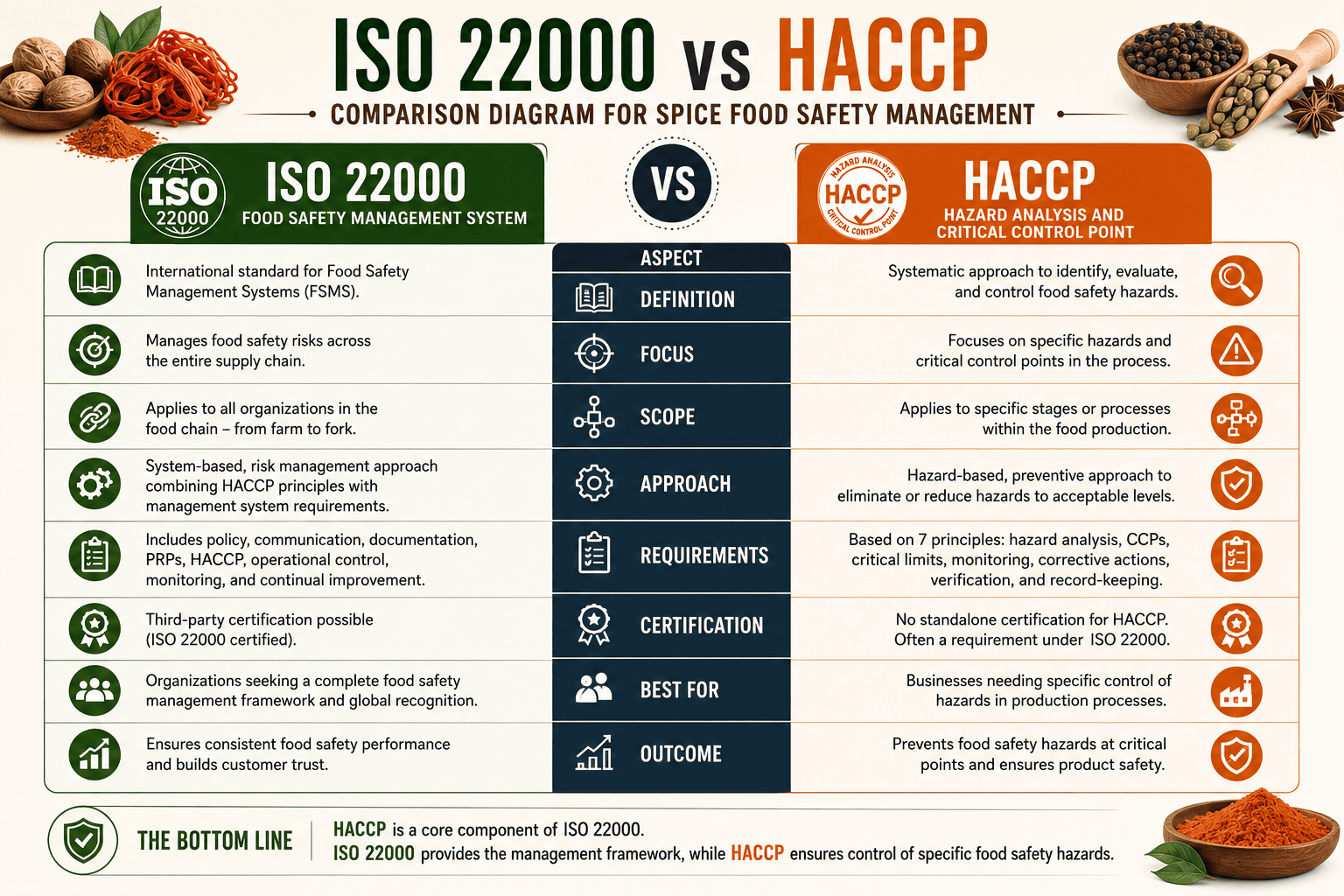
Therefore, the key difference is that ISO 22000 provides the management system infrastructure (policies, documentation, internal audits, management review) while HACCP provides the technical hazard control methodology. Notably, while ISO 22000 certification automatically includes HACCP compliance, HACCP certification alone does not fulfill ISO 22000 requirements.
Why ISO 22000 and HACCP Are Critical for Spice Import Safety in Global Trade
Specifically, the spice industry presents unique food safety challenges that make robust certification systems essential. Moreover, unlike processed foods with standardized manufacturing environments, spices are agricultural products subject to variable growing conditions, handling practices, and contamination risks.
Key Contamination Risks in Spice Imports
Specifically, spice importers must guard against five main hazard categories:
Concerning mycotoxins, aflatoxin B1, B2, G1, G2, and ochratoxin A are carcinogenic compounds that cause liver damage. Therefore, EU regulations limit aflatoxin B1 to below 5 ppb and total aflatoxins to below 10 ppb.
Regarding microbiological hazards, salmonella, E. coli, and listeria monocytogenes can cause food poisoning and hospitalization. Consequently, import regulations require salmonella to be absent in 25g samples.
For physical contaminants, stones, metal fragments, and insect parts can cause injury and product recalls. Thus, importers enforce zero tolerance for glass and metal contamination.
With chemical residues, pesticides and heavy metals such as lead and cadmium pose chronic toxicity risks. Accordingly, maximum residue limits per EC Regulation 396/2005 apply to all spice imports.
On adulteration, foreign seeds, colored starch, and artificial dyes represent fraud and allergic reaction risks. Therefore, zero tolerance for undeclared additives is the industry standard.
How ISO 22000 and HACCP Mitigate These Risks
Consequently, a supplier with both ISO 22000 certification and HACCP implementation provides importers with multiple layers of protection:
-
Preventive control systems: Instead of relying on final product testing alone, certified suppliers identify and control hazards at every production stage. Thus, they dramatically reduce the risk of contaminated shipments before they reach the container.
-
Batch traceability: ISO 22000 requires full traceability systems that can track each batch from farm source to final shipment. For instance, if certified suppliers discover a contamination issue, they can isolate and recall specific batches within 24 hours, minimizing importer liability.
-
Third-party verification: ISO 22000 certification requires annual surveillance audits by accredited certification bodies. Therefore, importers have independent verification that suppliers maintain food safety systems, not just documents.
-
Regulatory compliance alignment: ISO 22000 and HACCP frameworks align with major global regulatory requirements including the FDA Food Safety Modernization Act (FSMA), EU Food Law (EC 178/2002), and Codex Alimentarius guidelines. Consequently, importing from certified suppliers simplifies customs clearance and reduces port detention risks.
-
Continuous improvement: ISO 22000 mandates periodic management review, internal audits, and system updates based on emerging hazards. Thus, the food safety system evolves with changing regulations and scientific understanding.
What B2B Spice Importers Should Look for in Supplier Certifications
Nevertheless, not all “certified” suppliers provide the same level of assurance. Specifically, QA managers evaluating potential spice suppliers should verify specific elements when assessing ISO 22000 and HACCP credentials.
Verification Checklist for B2B Buyers
Specifically, QA managers evaluating potential spice suppliers should verify these points:
First, verify the certification scope to ensure it covers specific products you are importing, such as nutmeg and mace. Consequently, generic “food processing” scopes without spice-specific coverage may not provide adequate assurance.
In addition, check the certification body to confirm it is an IAF-recognized body like SGS, BSI, TÜV, or Sucofindo. Therefore, reject any self-declared “certification” without third-party audit.
Furthermore, validate certification validity by confirming the certificate is current with annual surveillance audit stamps. Notably, expired certificates or missing surveillance records indicate lapses in food safety management.
Moreover, request HACCP plan availability as the supplier should be willing to share excerpts confidentially. For this reason, refusal to demonstrate any documentation is a significant red flag.
Additionally, confirm COA traceability by verifying each batch has a Certificate of Analysis linked to HACCP records. Subsequently, batch numbers that do not match production records suggest traceability gaps.
Similarly, review the recall history to ensure a documented recall procedure with zero major incidents. However, unwillingness to discuss recall capability indicates potential food safety weaknesses.
Finally, examine audit reports to confirm recent surveillance audit findings are available. In contrast, no audit history or multiple non-conformances warrant further investigation.
Questions to Ask Potential Spice Suppliers
Therefore, when vetting suppliers, procurement teams should ask these specific questions:
-
Consequently, ask suppliers to identify their HACCP critical control points for nutmeg processing — drying/moisture control, metal detection, and aflatoxin testing are key areas to verify.
-
Furthermore, request documentation on how suppliers handle batches exceeding critical limits at a CCP — proper suppliers will have documented corrective actions with batch traceability and segregation procedures.
-
In addition, verify the ISO 22000 certification scope and IAF-accredited certification body — the scope should explicitly cover the product categories you are importing.
-
For example, inquire about aflatoxin testing frequency per production batch — high-quality suppliers test each batch, while commodity traders may only test per container.
ISO 22000 vs HACCP: Which Certification Do You Need as an Importer?
Subsequently, B2B buyers often ask which certification is more important for spice import safety. Ultimately, the answer depends on your risk profile, regulatory requirements, and supplier relationship.
Comparison for B2B Importers
Subsequently, B2B buyers must weigh several factors when choosing between ISO 22000 and HACCP-certified suppliers:
| Factor | ISO 22000 | HACCP |
|---|---|---|
| Scope | Consequently, ISO 22000 covers the full management system for broader systemic coverage. | In contrast, HACCP focuses on technical hazard control at CCPs only. |
| Management commitment | Specifically, ISO 22000 mandates formal policy, management review, and internal audits. | In comparison, HACCP implies these practices but does not formally require them. |
| Documentation requirements | Furthermore, ISO 22000 requires a comprehensive 4-tier document system. | However, HACCP documentation focuses solely on CCP records. |
| Prerequisite programs | Notably, ISO 22000 formally requires GMP, GHP, and pest control programs. | Meanwhile, HACCP expects these programs but does not standardize them. |
| Third-party audit frequency | Moreover, ISO 22000 mandates annual surveillance audits by accredited bodies. | In comparison, HACCP audit frequency varies depending on the certification body. |
| Global recognition | Additionally, ISO 22000 operates in over 170 countries. | As well as, HACCP is universal across the food industry. |
| Cost to supplier | However, ISO 22000 has higher costs due to management system overhead. | In contrast, HACCP is less expensive but provides narrower coverage. |
| Risk reduction for importers | Ultimately, ISO 22000 offers comprehensive, systemic risk reduction. | Nevertheless, HACCP still provides good hazard-focused protection. |
| Recommendation | Therefore, ISO 22000 suits primary processors, exporters, and co-packers best. | However, standalone HACCP still demonstrates meaningful commitment for smaller facilities. |
Therefore, for high-volume B2B spice imports, ISO 22000 certification provides the strongest assurance because it integrates HACCP within a comprehensive management system. Nevertheless, standalone HACCP certification from a reputable third party still demonstrates meaningful food safety commitment.
How Bhavana Spice Implements ISO 22000 and HACCP Standards for Spice Import Compliance
Furthermore, as an Indonesian nutmeg and mace exporter serving global B2B buyers, Bhavana Spice operates with food safety management systems aligned to ISO 22000 and HACCP principles. Consequently, our quality assurance framework addresses the specific contamination risks inherent in spice export.
Our Food Safety Management Framework
Specifically, Bhavana Spice implements food safety controls at every stage of the supply chain:
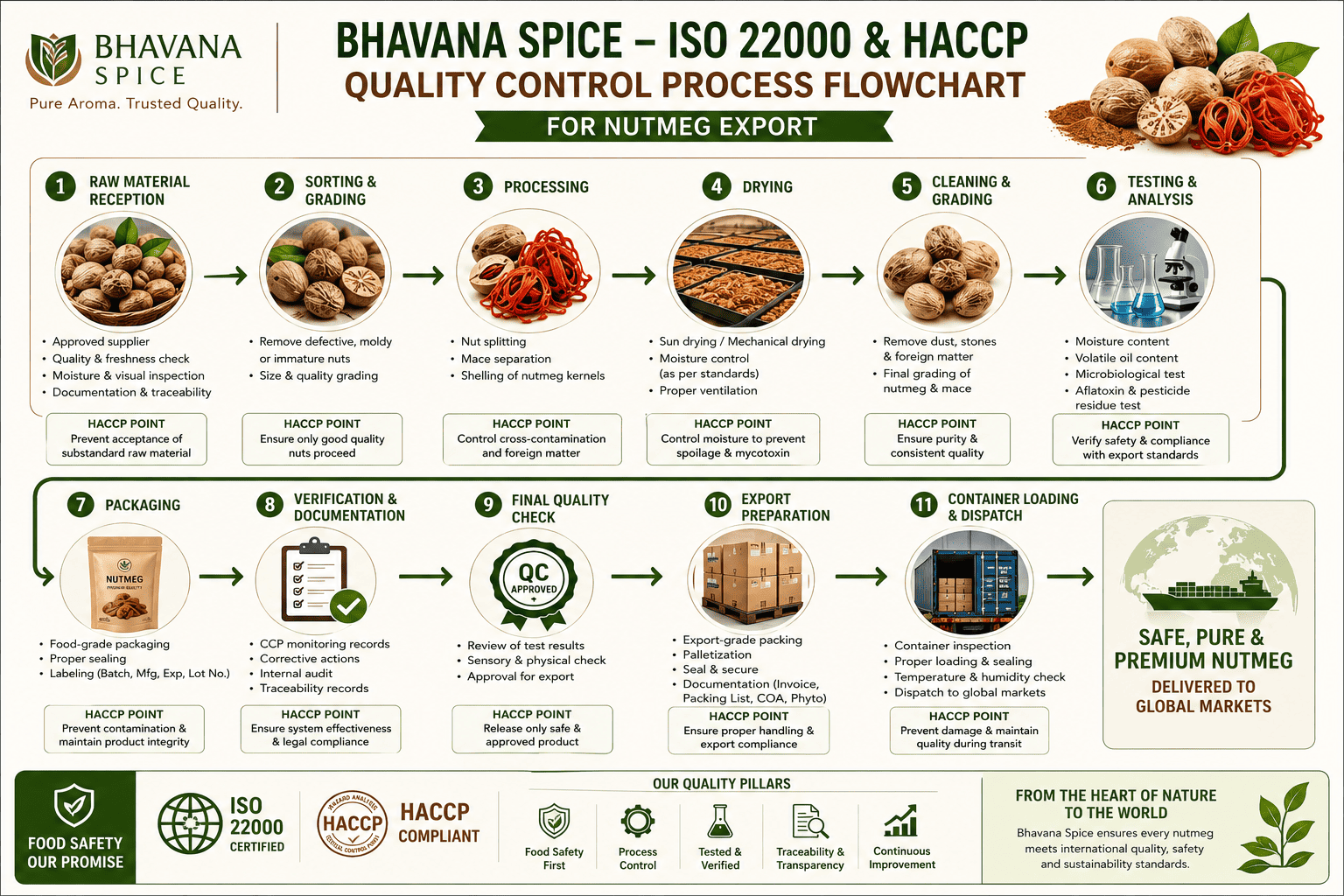
First, comprehensive hazard analysis identifies CCPs for drying, sorting, packing, and loading, ensuring systematic risk reduction across the supply chain.
For moisture control at CCP 1, monitor sun-drying to maintain below 10% moisture with daily Karl Fischer testing. Consequently, this prevents mold and aflatoxin growth during sea freight.
For physical contaminant control at CCP 2, multi-stage visual sorting combined with magnetic separation keeps foreign matter below 0.5% maximum.
For microbiological control at CCP 3, GMP-compliant handling surfaces and pest control programs ensure salmonella and E. coli are absent per batch.
In terms of aflatoxin verification, batch-level HPLC testing via accredited laboratories guarantees full compliance with EU and US limits.
Regarding traceability, farm-to-container batch coding enables 24-hour batch recall capability.
Finally, complete documentation accompanies every shipment with a Certificate of Analysis and full export documentation, simplifying customs clearance for importers.
Specifically, our quality control process begins at the raw material sourcing stage, where we work directly with trusted nutmeg farming communities to ensure proper post-harvest handling. Subsequently, every production batch undergoes systematic monitoring at each critical control point, with results documented in batch-specific production records.
Quality Documentation Provided with Every Shipment
Therefore, with every FCL shipment, Bhavana Spice provides comprehensive documentation that demonstrates ISO 22000 and HACCP compliance:
- Certificate of Analysis (COA) — Moisture content, volatile oil percentage, aflatoxin levels (B1, B2, G1, G2, total), microbiological results (TPC, yeast & mold, Salmonella, E. coli)
- Batch traceability report — Farm source, drying date, processing batch number, packing date, container loading records
- Phytosanitary Certificate — Issued by Indonesian Agricultural Quarantine Agency
- Certificate of Origin — For preferential tariff treatment
- Packing list and weight certificate — Independent surveyor verification
Frequently Asked Questions About ISO 22000 and HACCP for Spice Import Safety
What is the difference between ISO 22000 and HACCP for spice importers?
Specifically, HACCP is a hazard control methodology focusing on seven principles to identify and manage food safety risks at Critical Control Points. In contrast, ISO 22000 is a comprehensive Food Safety Management System that incorporates HACCP principles alongside management system requirements, prerequisite programs, and continuous improvement processes. Therefore, ISO 22000 certification includes HACCP compliance but provides broader systemic assurance for B2B importers.
Is ISO 22000 certification mandatory for importing spices?
Generally, ISO 22000 certification is not legally mandatory for spice imports into most markets. However, the FDA Food Safety Modernization Act (FSMA) requires importers to verify that foreign suppliers have adequate preventive controls in place, and the EU Food Law (EC 178/2002) mandates traceability and safety accountability throughout the supply chain. Consequently, while ISO 22000 carries no legal mandate, many leading importers now require it as a condition of supplier approval because it significantly simplifies their own regulatory compliance burden.
How do I verify a spice supplier’s ISO 22000 certification is genuine?
First, request the certificate directly from the supplier and verify the following: (1) the certification body holds IAF accreditation valid in your destination market, (2) the certificate scope explicitly covers the spice products you are importing, (3) validity dates remain current with surveillance audit stamps, and (4) the certificate number matches records on the certification body’s public database. Additionally, many reputable certification bodies publish certified organization lists on their websites.
Can a small spice exporter have ISO 22000 certification?
Specifically, ISO 22000 applies to organizations of all sizes. Moreover, the standard includes provisions for “external development” and “small organization” considerations that make certification achievable for smaller exporters. Furthermore, many Indonesian spice exporters serving European and North American clients have obtained ISO 22000 certification through structured implementation support from organizations like SGS Indonesia, TÜV Rheinland, and Sucofindo.
What other certifications complement ISO 22000 and HACCP for spice imports?
In addition, the following certifications work alongside ISO 22000 and HACCP to provide comprehensive assurance:
– Organic certification (EU Organic, USDA NOP, SNI Organic) — verifies no synthetic pesticides or fertilizers
– FSSC 22000 — GFSI-benchmarked scheme based on ISO 22000
– BRCGS Food Safety — Global Food Safety Initiative (GFSI) standard
– Halal certification — Required for OIC member country imports
– Kosher certification — Required for Jewish dietary law compliance
– Rainforest Alliance / Fair Trade — Social and environmental sustainability verification
How does ISO 22000 help with aflatoxin control in nutmeg?
Notably, ISO 22000’s preventive approach is particularly effective for aflatoxin management. Consequently, by integrating HACCP-based CCP identification with systematic monitoring and corrective action procedures, ISO 22000 ensures suppliers control aflatoxin risks at the drying and storage stages rather than detecting them only at final testing. For a detailed breakdown of our aflatoxin prevention protocols, refer to our comprehensive guide on aflatoxin and mold prevention in bulk nutmeg shipments.
Source Certified Nutmeg and Mace from a Food Safety-Compliant Supplier
Ultimately, for procurement managers and QA professionals seeking reliable spice suppliers with robust food safety management, Bhavana Spice provides nutmeg and mace sourced through ISO 22000 and HACCP-aligned quality systems. In particular, our comprehensive documentation, batch traceability, and third-party verified testing give importers the confidence to build long-term sourcing relationships.
To receive detailed product specifications, certification documentation, or current pricing and availability:
- Email: [email protected]
- WhatsApp B2B Helpline: +62 822-3332-2034
- Head Office & Export Coordination: Modinan RT 007/RW 021, Banyuraden, Gamping, Sleman, DIY – Indonesia
In conclusion, our QA team is ready to provide HACCP plan excerpts (under NDA), ISO 22000 certification documentation, and batch-specific Certificates of Analysis to support your supplier qualification process. Furthermore, we invite you to explore our complete guide to sourcing Indonesian nutmeg for a broader understanding of our export capabilities.