
Industrial Uses of Premium Mace in Food Processing and Spiced Blends

Industrial Uses of Premium Mace in Food Processing and Spiced Blends: A Comprehensive Guide for B2B Buyers
In essence, what is premium mace for food processing and why do industrial buyers prioritize it? Essentially, premium mace — the dried aril of Myristica fragrans — is one of the most versatile yet underutilized spices in industrial food manufacturing. Specifically, for B2B procurement teams and product development managers, understanding the full range of mace applications is essential for optimizing formulations, reducing costs, and differentiating products in competitive markets. As a result, this comprehensive guide examines the industrial uses of premium mace across processed meats, spiced blends, bakery, and confectionery applications, providing technical specifications and sourcing recommendations. Additionally, for related insights, see our guide on wholesale nutmeg quality standards.
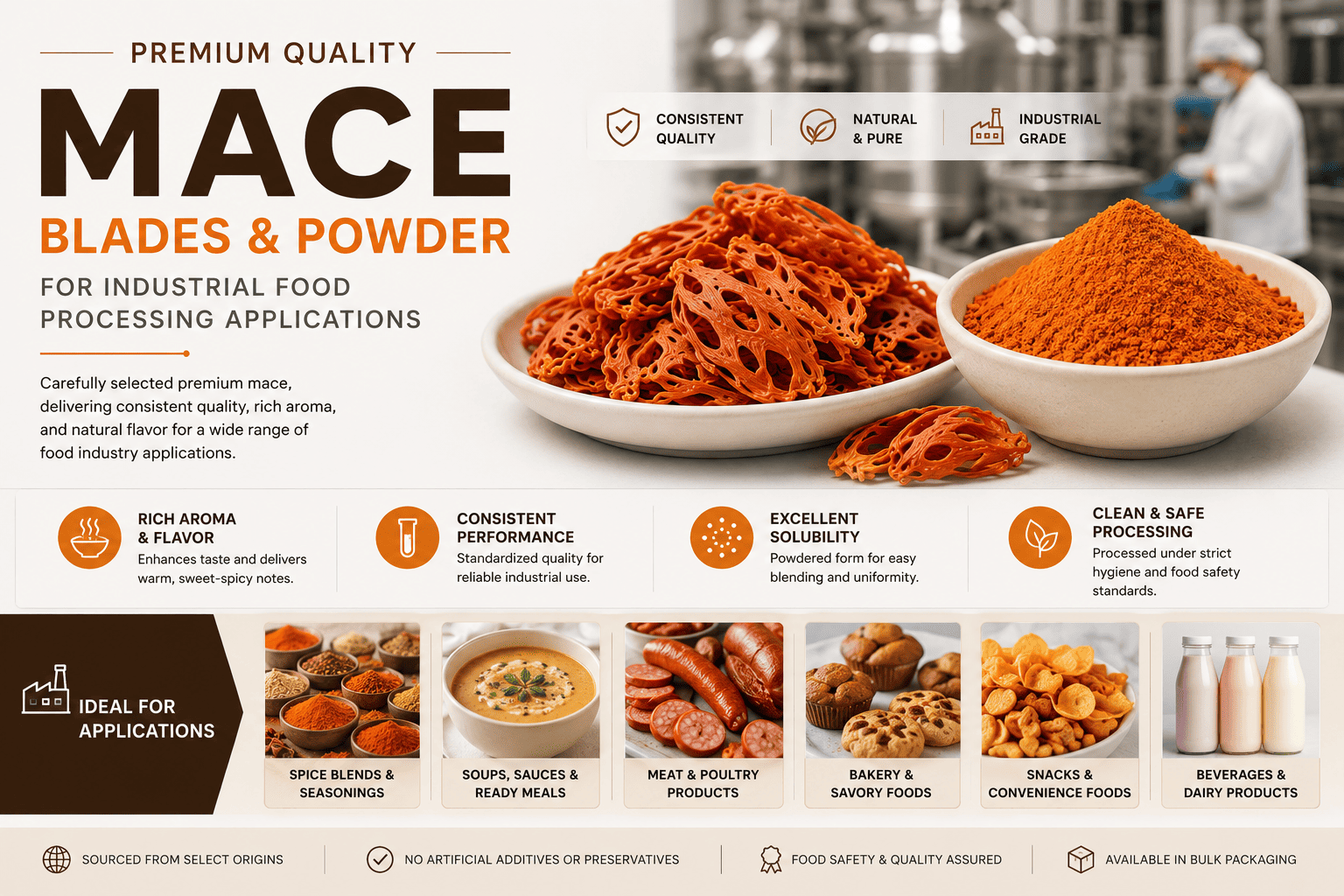
What Makes Premium Mace for Food Processing So Valuable?
Indeed, when sourcing premium mace for food processing, buyers benefit from unique chemical and functional properties that standard mace grades cannot match. In particular, premium mace offers distinct advantages over other spices in industrial applications due to its chemical composition and functional properties. Furthermore, these properties directly impact manufacturing outcomes.
Key Functional Properties of Premium Mace for Food Processing
| Property | Mace Characteristic | Industrial Benefit |
|---|---|---|
| Volatile oil content | 7-15% (myristicin, elemicin, safrole) | 2-3x flavor intensity vs. nutmeg, reducing required dosage |
| Antimicrobial activity | Inhibits Listeria, Salmonella, E. coli growth | Natural preservation extension in processed meats |
| Antioxidant capacity | ORAC value 30,000-40,000 µmol TE/100g | Oxidation prevention in fatty food formulations |
| Heat stability | Maintains flavor profile up to 180°C | Suitable for baking, frying, and retort processing |
| Solubility profile | Oil-soluble volatile compounds | Homogeneous distribution in fat-based matrices |
| Color contribution | Golden-amber tint | Positive visual impact in light-colored products |
| Flavor synergy | Bridges sweet and savory notes | Reduces need for multiple individual spices |
Cost efficiency: Consequently, premium mace delivers 40-60% more flavor impact per kilogram compared to standard nutmeg powder, reducing total spice costs in large-scale formulations. Additionally, its antimicrobial properties can reduce or eliminate the need for synthetic preservatives in clean-label products. As a result, manufacturers can achieve significant cost savings while maintaining product quality.
Furthermore, mace’s heat stability up to 180°C ensures consistent flavor delivery across diverse processing conditions — from high-temperature baking to retort sterilization — making it uniquely suited for industrial applications where other spices lose potency.
How Is Premium Mace Used in Processed Meat and Savory Products?
Specifically, premium mace is widely utilized in this sector. Notably, processed meat manufacturers represent the largest industrial consumers of premium mace globally. Specifically, mace is a traditional ingredient in European-style sausages, pâtés, and emulsified meat products where its warm, slightly sweet aroma complements savory profiles.
Mace in Sausage and Emulsified Meat Products
| Meat Product | Mace Dosage (per 100kg) | Function | Flavor Contribution |
|---|---|---|---|
| Frankfurters | 50-100g ground mace | Flavor base, antimicrobial | Consequently, warm slightly sweet note |
| Liverwurst/Pâté | 80-150g ground mace | Flavor anchor, color retention | Therefore, rich aromatic depth achieved |
| Chorizo | 30-60g ground mace | Flavor complexity | Thus, subtle sweet undertone created |
| Breakfast sausages | 40-80g ground mace | Differentiation | Notably, distinctive premium character produced |
| Meat-based seasonings | 100-200g ground mace | Base blend component | Overall, aromatic foundation established |
Application note: For best results, add mace powder during the emulsification stage at 4-8°C to ensure homogeneous fat distribution. In particular, pre-blending mace with carrier spices (white pepper, coriander) improves dispersion in large mixers. Therefore, consistent product quality is achieved across batches.
Mace in Canned and Ready-to-Eat Meals
Similarly, premium mace performs exceptionally well in canned and retort-processed meals where other spices degrade:
- Canned soups: 20-40g per 100L for subtle aromatic enhancement. Specifically, this dosage range ensures balanced flavor integration.
- Ready-to-eat curries: 50-80g per 100kg for flavor depth without heat. Accordingly, these concentrations create a distinctive product profile.
- Potted meat spreads: 60-100g per 100kg for traditional European profiles. Thus, manufacturers achieve authentic regional flavor character.
- Frozen entrees: 30-60g per 100kg, maintaining flavor through freeze-thaw cycles. Consequently, product quality remains consistent throughout distribution.
What Role Does Premium Mace Play in Spiced Blends and Seasonings?
Furthermore, premium mace is essential in this category. Moreover, spice blenders and seasoning manufacturers increasingly incorporate premium mace into proprietary blends. Notably, mace serves as a bridge spice that harmonizes disparate flavor components.
Mace Spice Blends for Commercial Applications
| Blend Type | Mace Inclusion | Functional Role |
|---|---|---|
| Garam masala | 5-10% of blend | Sweet aromatic anchor |
| Pumpkin pie spice | 10-15% of blend | Warm depth alongside cinnamon |
| Ras el hanout | 8-12% of blend | Traditional North African component |
| Apple pie spice | 8-12% of blend | Fruity note enhancement |
| Berbere seasoning | 5-8% of blend | Complexity without heat |
| Boudin blanc seasoning | 15-20% of blend | Signature white sausage flavor |
| Specialty pepper blends | 3-5% of blend | Aromatic lift |
Industrial advantage: For instance, incorporating premium mace at 5-15% of a blend formulation reduces reliance on expensive ingredients like cardamom and nutmeg while achieving comparable or superior aromatic complexity. Furthermore, mace’s volatile oil stability ensures consistent blend performance across production batches.
Custom Mace Seasoning Development
In addition, for B2B buyers, working with an experienced Indonesian mace exporter enables custom seasoning development. In practice, mace powder can be milled to specific particle sizes (500µm for dry rubs, 250µm for soluble seasonings, 100µm for emulsified products) to match your production equipment and application requirements. Consequently, tailored solutions are available for each manufacturing process.
How Does Premium Mace Enhance Bakery and Confectionery Applications?
Overall, bakery and confectionery manufacturers utilize premium mace for its distinctive flavor profile and heat stability. Indeed, mace maintains its aromatic character through high-temperature baking, making it superior to many volatile spices that degrade above 150°C.
Mace in Bakery Applications
- Sweet doughs and pastries: 0.1-0.3% of flour weight for subtle aromatic enhancement. Indeed, this percentage is ideal for delicate baked goods.
- Cookie formulations: 0.2-0.5% of formula weight for warm, spiced notes. Therefore, cookie manufacturers can achieve distinctive flavor profiles.
- Fillings and creams: 0.05-0.15% for background flavor complexity. Typically, this concentration provides subtle depth.
- Biscuit seasonings: 0.3-0.8% for savory-sweet crossover products. As a result, biscuit manufacturers can create unique market offerings.
Specifically, premium mace pairs exceptionally well with chocolate, vanilla, and stone fruit flavors. For instance, European biscuit manufacturers have traditionally used mace in speculoos and Lebkuchen-style products, where its heat-stable profile ensures consistent flavor after baking at 170-190°C. In addition, large-scale bakery operations benefit from mace’s concentrated flavor, requiring only 0.1-0.3% of flour weight compared to 0.5-1.0% for cinnamon or nutmeg — reducing raw material handling and storage requirements.
Mace in Confectionery Applications
Similarly, in confectionery, mace is valued for its oil-soluble flavor compounds that integrate seamlessly into fat-based matrices:
- Chocolate fillings: 0.05-0.1% for warm aromatic background. Specifically, this subtle inclusion enhances premium chocolate products.
- Caramel and toffee: 0.1-0.2% for flavor complexity. Furthermore, mace’s heat stability complements high-temperature sugar cooking processes.
- Nut-based confections: 0.15-0.3% for complementary nutty-spice notes. Indeed, this pairing creates sophisticated flavor combinations.
- Hard candies: 0.02-0.05% (extract form) for subtle warmth. As a result, confectioners can differentiate their product lines.

What Specifications Define Premium Mace for Food Processing Procurement?
Furthermore, QA managers and procurement professionals evaluating premium mace for food processing should assess suppliers against established quality parameters. Consequently, implementing systematic specification checks ensures consistent product quality and regulatory compliance.
Premium Mace for Food Processing: Quality Specifications for Buyers
| Parameter | Premium Grade | Standard Grade | Test Method |
|---|---|---|---|
| Volatile oil content | ≥10% | 7-10% | ISO 11050 (GC-MS) |
| Moisture content | <8% | 8-12% | ISO 939 (Karl Fischer) |
| Foreign matter | <0.5% | <1.0% | Physical separation |
| Particle size (ground) | 250-500µm | 500-1000µm | Sieve analysis |
| Color | Golden-amber | Amber to light brown | Visual inspection |
| Aflatoxin | <4 ppb total | <10 ppb total | HPLC per FDA/EC |
| Total plate count | <10⁴ CFU/g | <10⁵ CFU/g | ISO 4833 |
| Yeast & mold | <10³ CFU/g | <10⁴ CFU/g | ISO 21527 |
| E. coli | Negative in 25g | Negative in 1g | ISO 16649 |
| Salmonella | Negative in 25g | Negative in 25g | ISO 6579 |
| Foreign colors | None detected | None detected | Visual + UV |
Sourcing guidance: Notably, premium mace from the Banda Islands typically achieves 12-15% volatile oil content, significantly exceeding industry minimums. Furthermore, for more on quality verification, refer to our guide on wholesale nutmeg grades and quality specifications.
Cost Analysis: Premium Mace for Food Processing vs. Nutmeg in Formulations
Therefore, for procurement teams evaluating ingredient costs, the economic comparison between mace and nutmeg reveals important considerations:
| Cost Factor | Premium Mace | Standard Nutmeg | Net Impact |
|---|---|---|---|
| Price per kg (FOB) | Higher (premium product) | Lower (commodity) | Consequently, mace costs 30-50% more upfront |
| Dosage required | 40-60% of nutmeg dosage | 100% baseline | Thus, mace per-use cost is comparable |
| Flavor intensity | 2-3x nutmeg | Baseline | Therefore, lower storage volume is needed |
| Shelf life | 24-36 months | 18-24 months | Accordingly, reduced waste and longer rotation |
| Antimicrobial savings | Reduces preservative cost | Standard preservative needed | Notably, $0.50-1.50/100kg savings achieved |
| Total formulation cost | Comparable or lower | Standard baseline | Overall, net neutral to 15% savings realized |
Bottom line: Although premium mace carries a higher per-kilogram price, its concentrated flavor, longer shelf life, and functional benefits often result in comparable or lower total formulation costs compared to standard nutmeg.
Packaging Requirements for Premium Mace for Food Processing
Furthermore, industrial mace procurement requires specific packaging to preserve volatile oils during transit and storage:
- Vacuum-sealed bags: Nitrogen-flushed, 5-25kg units for ground mace. Accordingly, this packaging preserves volatile oil content during lengthy transit periods.
- Drum packaging: 25-50kg fiber drums with inner polyethylene liner. Notably, this format provides optimal protection for bulk shipments.
- Moisture barrier: Maximum 0.1g/m²/24h water vapor transmission rate. Thus, product quality remains consistent throughout the supply chain.
- Shelf life guarantee: 18-24 months when stored below 25°C, away from direct sunlight. Consequently, buyers can plan inventory rotations with confidence.
- COA documentation: Batch-specific certificate of analysis for each shipment. Therefore, full traceability and quality assurance are maintained.
Mace in Food Manufacturing: Whole Blade vs Ground for Industrial Use
Ultimately, the choice between whole blades and ground mace depends on your processing equipment, application, and storage capabilities. In practice, each format offers distinct advantages for different manufacturing scenarios.
| Comparison Factor | Whole Mace Blades | Ground Mace Powder |
|---|---|---|
| Shelf life | 24-36 months | 12-18 months (thus, faster oil oxidation) |
| Flavor intensity | Retained until grinding | Immediate release (therefore, faster degradation) |
| Dosage control | Requires grinding equipment | Direct addition (consequently, easier dosage control) |
| Storage space | Lower density (bulkier) | Higher density (hence, more compact) |
| Cost per kg | Lower (less processing) | Higher (notably, extra milling labor) |
| Best for | Long-term inventory, just-in-time grinding | Continuous production (overall, direct mixing) |
| Microbial risk | Lower (minimal handling) | Higher (thus, exposed surface area) |
Recommendation: Overall, for facilities with in-house grinding capability, whole blades offer superior cost efficiency and shelf life. For example, just-in-time grinding preserves volatile oil content and allows particle size customization for each product line. Nevertheless, for smaller operations without milling equipment, pre-ground mace powder from a reliable bulk supplier with proper packing standards is the practical choice.
Regulatory Considerations for Mace in Food Products
In addition, food manufacturers must consider regulatory frameworks when formulating with mace. Although mace is generally recognized as safe (GRAS) under FDA regulations (21 CFR 182.10), maximum usage levels vary by application category. Notably, the European Spice Association (ESA) provides guidance on volatile oil minimums for mace (≥7% for premium grade). Therefore, for export-oriented products, ensure your direct nutmeg supplier provides full documentation for customs clearance and regulatory compliance in your target markets.
Frequently Asked Questions About Industrial Mace Uses in Food Manufacturing
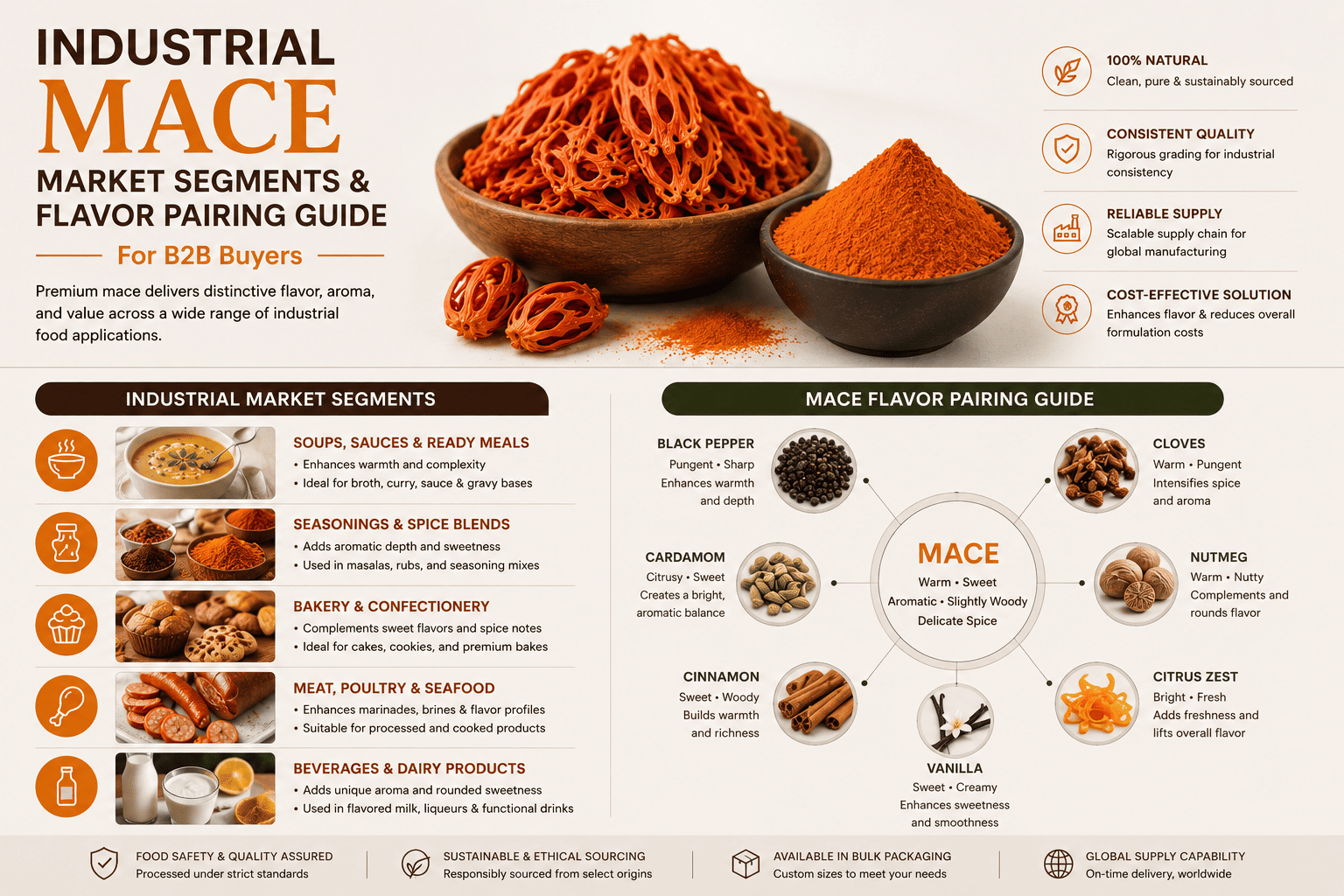
What is premium mace for food processing and how is it different from nutmeg? Here is a detailed explanation.
Specifically, premium mace is the dried aril of Myristica fragrans, while nutmeg is the seed kernel. In fact, mace contains 7-15% volatile oil (vs. nutmeg’s 5-8%), delivering 2-3x more flavor impact per kilogram. Furthermore, in industrial applications, mace offers superior heat stability up to 180°C, stronger antimicrobial properties, and a more refined, sweet-warm flavor profile that complements processed meats, bakery, and confectionery products without overpowering other ingredients.
Which food industries use the most premium mace? Here are the key usage statistics.
Notably, according to industry data, processed meat manufacturers account for approximately 45% of industrial mace consumption, followed by spice blend producers (25%), bakery applications (15%), and confectionery (10%). Moreover, the remaining 5% includes specialty applications in sauces, soups, and ready-to-eat meal manufacturing.
What is the recommended dosage of mace in processed meat formulations? Generally, the following guidelines apply.
Generally, recommended dosage ranges from 30-150g of ground mace per 100kg of meat product, depending on the application. In addition, emulsified sausages require 50-100g/100kg, liver-based products benefit from 80-150g/100kg, and seasoned meat systems use 30-60g/100kg for subtle aromatic enhancement. Typically, starting at the lower range and adjusting based on sensory evaluation ensures optimal results.
Can mace replace nutmeg in industrial spice blends? In brief, the answer depends on your application.
In brief, yes — mace can replace nutmeg at 40-60% of the nutmeg dosage due to its higher volatile oil concentration. However, the flavor profile differs slightly, with mace offering a more delicate, sweet-warm character compared to nutmeg’s stronger, more pungent notes. Accordingly, for cost-sensitive applications, a partial substitution (50% mace, 50% nutmeg) can optimize both flavor quality and raw material costs.
What certifications should I look for when sourcing premium mace? Specifically, the following credentials matter.
Specifically, for industrial procurement, ensure your supplier provides:
– Certificate of Analysis (COA) with batch-specific volatile oil content, moisture, and microbiological data. Accordingly, this ensures batch-level traceability.
– HACCP/ISO 22000 certification for food safety management. Therefore, food safety protocols are verifiable.
– Aflatoxin compliance meeting EU (<4 ppb total) and FDA (<10 ppb) limits. Consequently, global market access is assured.
– Organic certification if required for your product positioning. Notably, this certification supports premium market segmentation.
– Halal and/or Kosher certification for applicable markets. Thus, religious dietary compliance is maintained.
How should premium mace be stored in industrial quantities? Follow these storage guidelines.
Briefly, store whole mace blades below 25°C in vacuum-sealed or nitrogen-flushed packaging away from direct sunlight. Furthermore, ground mace should be used within 6 months of grinding for optimal flavor intensity. Additionally, for long-term storage, whole blades at 18-22°C maintain quality for 24-36 months, while ground mace at the same temperature retains peak flavor for 12-18 months.
Source Premium Mace for Food Processing for Your Production Line
Therefore, for procurement teams and product developers ready to evaluate premium mace for your specific applications, Bhavana Spice offers premium-grade mace from volcanic soil estates in the Banda Islands, with full quality documentation and batch traceability. Moreover, our direct-source model ensures competitive pricing, consistent volatile oil content, and compliance with international food safety standards.
Accordingly, to request detailed product specifications, discuss custom milling options for your application, or arrange for physical evaluation samples:
– Email: [email protected] (Technical specifications dispatched within 24 business hours). Accordingly, prompt communication is guaranteed.
– WhatsApp B2B Helpline: +62 822-3332-2034 (Direct procurement consultations and stock availability). Therefore, immediate assistance is available for urgent inquiries.
– Head Office & Export Coordination: Modinan RT 007/RW 021, Banyuraden, Gamping, Sleman, DIY – Indonesia. Notably, our team provides full export documentation support.
In short, our QA team is ready to provide moisture analysis certificates, gas chromatography profiles, and physical evaluation samples to your manufacturing facility worldwide.