
Bulk Nutmeg Sampling and Inspection: What Every B2B Buyer Should Verify Before Shipment
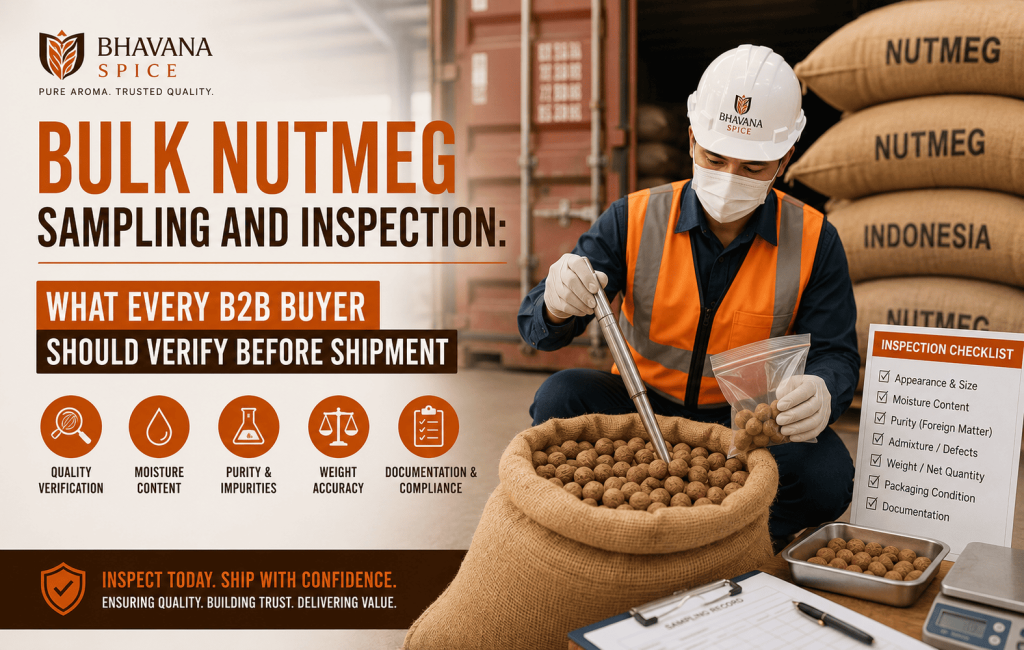
Bulk Nutmeg Sampling and Inspection: What Every B2B Buyer Should Verify Before Shipment
In the B2B nutmeg trade, bulk nutmeg inspection is the single most critical step between signing a contract and accepting a container at destination. Specifically, a single shipment containing moldy kernels, excess moisture, or undeclared foreign matter can result in demurrage fees exceeding USD 5,000 per day, rejected cargo at the port of entry, and strained relationships with downstream customers. Consequently, every procurement manager and QA professional must establish a clear inspection protocol before the container leaves the port of origin. Furthermore, for a baseline understanding of nutmeg quality grades, see our complete guide to wholesale nutmeg grades.
Accordingly, this guide provides a comprehensive walkthrough of every inspection point that B2B buyers should verify — from sampling methodology and laboratory testing to container condition checks and documentation review. By implementing these protocols, importers can significantly reduce the risk of receiving substandard product.
Why Pre-Shipment Inspection Matters in Bulk Nutmeg Procurement
To begin with, pre-shipment inspection protects B2B buyers against three categories of risk: quality non-conformance, quantity shortfalls, and logistical damage. In fact, industry data from SGS and other inspection agencies indicates that approximately 8–12% of bulk spice shipments require some form of claim or renegotiation due to inspection findings at destination. Specifically, the most common findings include moisture content exceeding contract limits, aflatoxin levels above regulatory thresholds, and visible mold or insect damage in a portion of the shipment.
Furthermore, the cost of rejecting a full container at destination is substantial. Notably, the buyer bears demurrage and detention charges, return freight or disposal costs, and the indirect cost of production line disruptions. A well-executed bulk nutmeg inspection at origin eliminates virtually all of these risks for a fraction of the shipment value.
Moreover, pre-shipment inspection serves as documented evidence in dispute resolution. In addition, reputable inspection agencies provide certified reports that customs authorities and insurance companies recognize, simplifying the claims process if issues arise.
Sampling Methods for Bulk Nutmeg Inspection
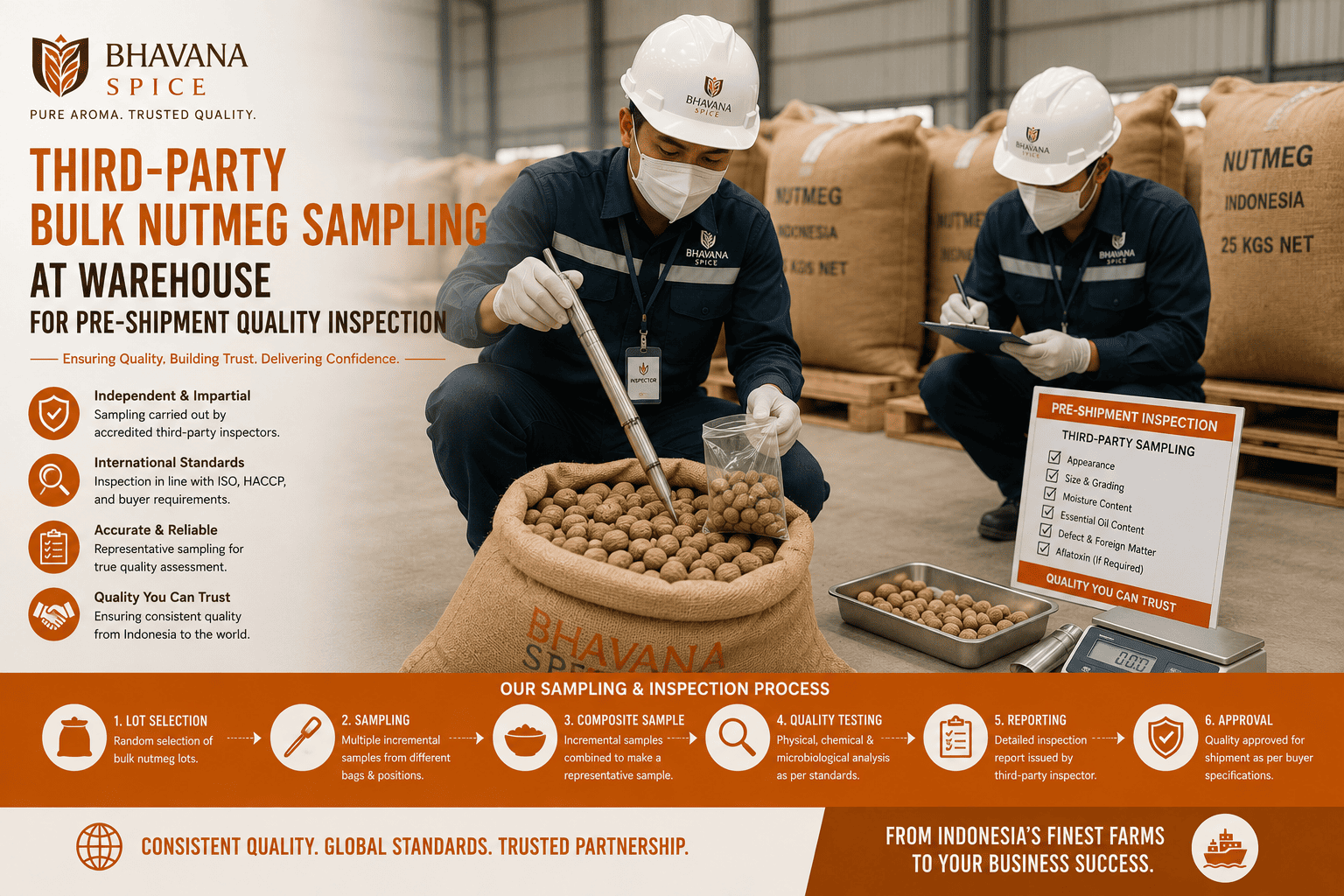
Accordingly, the foundation of any reliable bulk nutmeg inspection is proper sampling. In fact, without representative sampling, even the most sophisticated laboratory testing produces meaningless results. Specifically, the internationally recognized standard for spice sampling is the ASTM E300 standard, which specifies procedures for obtaining representative samples from bulk shipments.
Sample Size Requirements
First, the number of samples required depends on the lot size. Specifically, for a standard 20-foot container of nutmeg (approximately 10–12 metric tons packed in 25 kg or 50 lb bags):
| Lot Size (bags) | Minimum Sample Units | Aggregate Sample Weight |
|---|---|---|
| Up to 100 bags | 10 bags sampled | 2–3 kg |
| 101–500 bags | 15 bags sampled | 3–5 kg |
| 501–1,000 bags | 20 bags sampled | 4–6 kg |
| Over 1,000 bags | 25 bags sampled | 5–8 kg |
Consequently, procurement managers should specify in their contract that sampling follows ASTM E300 or equivalent ISO standards, and that the buyer or their appointed third-party inspector has the right to be present during sampling.
Sampling Equipment and Procedure
In particular, proper sampling requires the following equipment:
- Trier or probe sampler — a stainless steel hollow probe at least 50 cm in length that penetrates to the center of each bag
- Clean sample collection bags — food-grade polyethylene or kraft paper bags
- Composite sample divider — for creating representative laboratory samples from the aggregate
- Sealable containers — airtight containers for moisture-sensitive samples
The procedure begins by selecting bags at random from different pallets and layers within the container. Subsequently, each bag is probed diagonally from top to bottom to capture kernels from all depth zones. Next, the collected sub-samples are combined into a composite sample, mixed thoroughly, and then divided into three portions:
- Laboratory sample — sent to an accredited lab for testing
- Retention sample — retained by the inspector for reference
- Buyer sample — forwarded to the buyer or their local representative
Key Quality Parameters in Bulk Nutmeg Inspection
Thus, once representative samples are collected, the inspection process covers several critical quality parameters.
Moisture Content in Bulk Nutmeg Inspection
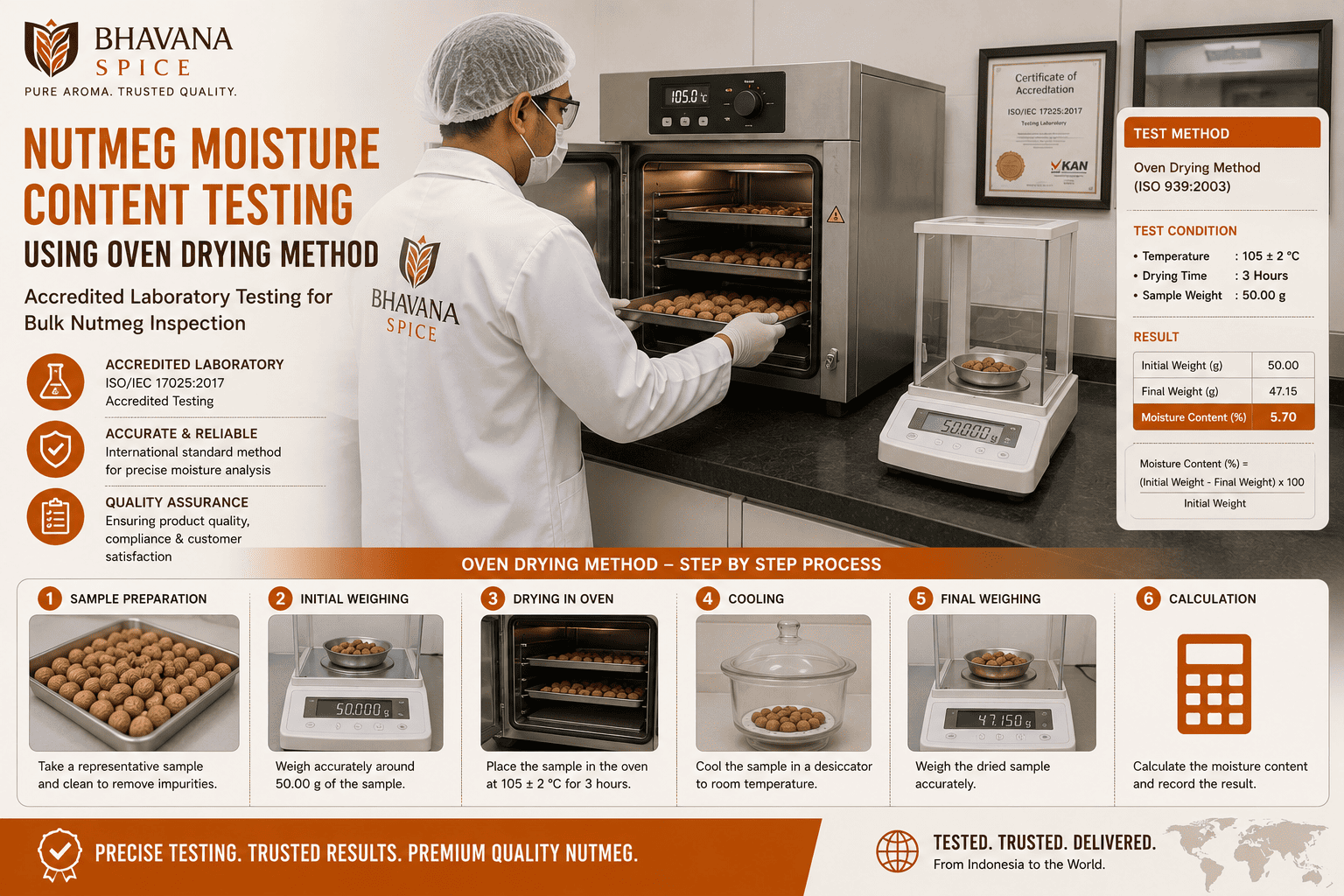
In general, moisture is the most important parameter in bulk nutmeg inspection. Specifically, nutmeg with moisture above 10% is susceptible to mold growth and aflatoxin development during sea freight. Furthermore, the standard testing method is AOAC 925.40 oven drying at 105°C, but many buyers also require Karl Fischer titration for verification.
| Moisture Level | Quality Assessment | Risk Profile |
|---|---|---|
| Below 8% | Premium quality — excellent shelf stability | Low risk |
| 8–10% | Export grade — meets most international standards | Moderate risk |
| 10–12% | Marginal — requires expedited shipping and use | High risk |
| Above 12% | Reject — high probability of mold during transit | Very high risk |
In addition, Bhavana Spice targets 8–9% moisture content for all exports, providing a safety margin below the maximum threshold. For a deeper understanding of how moisture relates to mold prevention, see our guide on aflatoxin prevention in bulk nutmeg shipments.
Volatile Oil Content
Similarly, volatile oil content directly correlates with flavor strength and commercial value. Specifically, premium export-grade nutmeg typically contains 8–15% volatile oil measured by steam distillation (USP method). However, acceptable minimums vary by buyer, but most specifications set the lower limit at 8%.
Aflatoxin Testing in Bulk Nutmeg Inspection
Notably, aflatoxin limits vary by destination country. Specifically, the European Union enforces the strictest standards at 5.0 ppb for B1 and 10.0 ppb for total aflatoxins. In contrast, the US FDA permits 20.0 ppb total. Consequently, the inspection protocol must include HPLC or ELISA testing at an accredited laboratory, with results documented in the Certificate of Analysis.
Visual and Physical Inspection
Notably, beyond laboratory testing, visual inspection remains an essential component of bulk nutmeg inspection. The inspector evaluates:
- Foreign matter — shell fragments, stones, twigs, and other non-nutmeg material
- Insect damage — holes, webbing, or live insects in the sample
- Mold — visible fungal growth on kernel surfaces
- Discoloration — abnormal darkening or bleaching that indicates improper drying or storage
- Uniformity — consistency of kernel size within the shipment
Defect Tolerance Standards
Consequently, the following table summarizes standard defect tolerance limits for export-grade whole nutmeg:
| Defect Category | Premium Grade | Standard Export Grade | Reject Threshold |
|---|---|---|---|
| Foreign matter | Less than 0.5% | Less than 1.0% | Above 2.0% |
| Moldy kernels | Less than 0.5% | Less than 1.0% | Above 2.0% |
| Insect-damaged kernels | Less than 0.5% | Less than 1.0% | Above 1.5% |
| Broken or shriveled kernels | Less than 3.0% | Less than 5.0% | Above 10.0% |
| Discolored kernels | Less than 1.0% | Less than 2.0% | Above 5.0% |
Container and Packaging Inspection in Bulk Nutmeg Inspection
In addition, the bulk nutmeg inspection must extend beyond the product itself to include the container and packaging condition.
Container Condition
Specifically, the inspector should verify the following before loading:
- Container cleanliness — no residual odors, dust, or previous cargo residue
- Container integrity — no holes, cracks, or damaged door seals
- Floor condition — dry, clean, and free of moisture
- Ventilation — vent openings configured according to the shipping route and climate
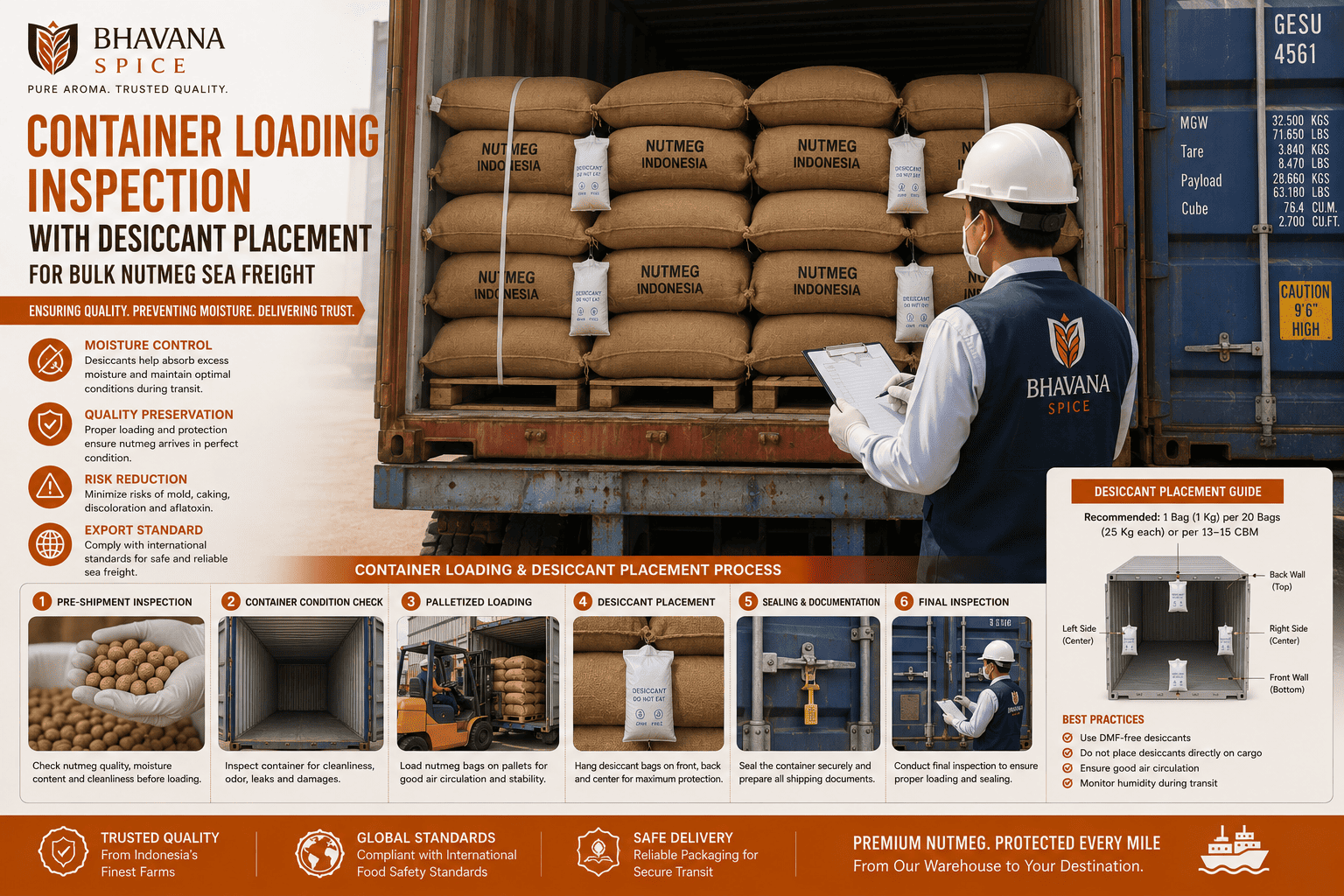
- Desiccant placement — pre-dried silica gel or clay desiccants installed per the packing specification
Additionally, upon arrival in the container, the inspector also evaluates that the nutmeg bags are stacked in a manner that allows air circulation and prevents compression damage. Furthermore, wooden pallets should be ISPM-15 compliant and free of mold or moisture stains.
Packaging Integrity
In particular, each bag should be inspected for:
- Seal integrity — all seams intact, no loose stitching or open edges
- Material condition — no tears, punctures, or abrasions
- Labeling accuracy — product name, grade, lot number, net weight, and exporter details match the packing list
- Pallet strapping — bands tight and undamaged, corner protectors in place
Documentation Review for Bulk Nutmeg Inspection
Specifically, the final step in any thorough bulk nutmeg inspection is documentation verification. The inspector should confirm that the following documents are complete and accurate:
| Document | Key Information to Verify |
|---|---|
| Certificate of Analysis (COA) | Moisture, volatile oil, aflatoxin results match contract specifications |
| Packing List | Bag count, lot numbers, net and gross weights |
| Commercial Invoice | Product description, unit price, total value, Incoterms |
| Phytosanitary Certificate | Pest-free status, country of origin, treatment records |
| Bill of Lading | Container number, seal number, port of loading, vessel name |
| Certificate of Origin | Issued by the local chamber of commerce |
In addition, if the shipment carries organic certification, Halal, or Kosher certifications, the corresponding certificates should be verified for validity and scope.
Engaging Third-Party Inspection Services
Furthermore, many B2B buyers choose to engage independent inspection agencies such as SGS, Bureau Veritas, or Intertek to perform bulk nutmeg inspection at origin. These agencies provide:
- Certified sampling following international standards
- Accredited laboratory testing with ISO 17025 certification
- Container loading supervision with photographic documentation
- Condition reports before and after loading
- Weight verification at the port of loading
Notably, the cost of third-party inspection typically ranges from 0.1% to 0.3% of the shipment value — a fraction of the potential loss from accepting non-conforming goods.
Summary: Pre-Shipment Inspection Checklist for B2B Buyers
In conclusion, every buyer should ensure the following checklist is completed before the container is sealed:
- Confirm sampling follows ASTM E300 or equivalent standard
- Verify laboratory testing covers moisture, volatile oil, and aflatoxin
- Review visual inspection results for defects and foreign matter
- Inspect container cleanliness, integrity, and desiccant installation
- Verify packaging integrity and labeling accuracy
- Cross-check all export documentation against contract terms
- Engage a qualified third-party inspector when contract value exceeds USD 50,000
Consequently, by implementing this protocol, importers can confidently receive bulk nutmeg shipments knowing that the product meets contract specifications, regulatory requirements, and end-user expectations. In addition, for further guidance on shipping logistics, see our comprehensive shipping and packing standards guide.
Need a Reliable Supplier with Verified Inspection Protocols?
Finally, Bhavana Spice welcomes independent third-party bulk nutmeg inspection at our warehouse and during container loading. Furthermore, we provide full access to our quality control documentation, laboratory results, and packing records for every shipment. Contact our export team to discuss your inspection requirements and request a sample inspection protocol for your next order.