
Halal & Kosher Certifications in Spice Manufacturing: Opening Global Markets
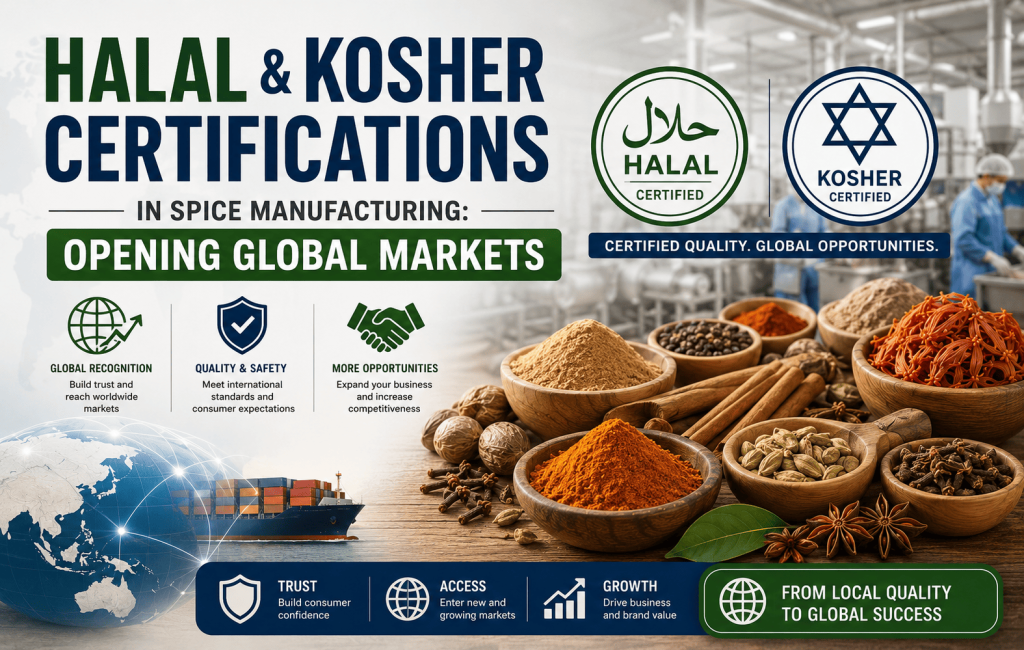
Halal Kosher Spice Certifications: Opening Global Markets
In global spice trade, halal kosher spice certifications are increasingly mandatory requirements rather than optional differentiators for B2B importers. Specifically, Middle Eastern and Southeast Asian markets require Halal certification for imported food ingredients, while Kosher certification opens doors to North American, European, and Israeli buyers. Consequently, Indonesian nutmeg exporters who hold both certifications gain a significant competitive advantage. Additionally, for broader regulatory context, see our FDA and EU compliance guide for nutmeg and mace importation. Notably, the demand for certified spices continues to grow across all major importing regions.
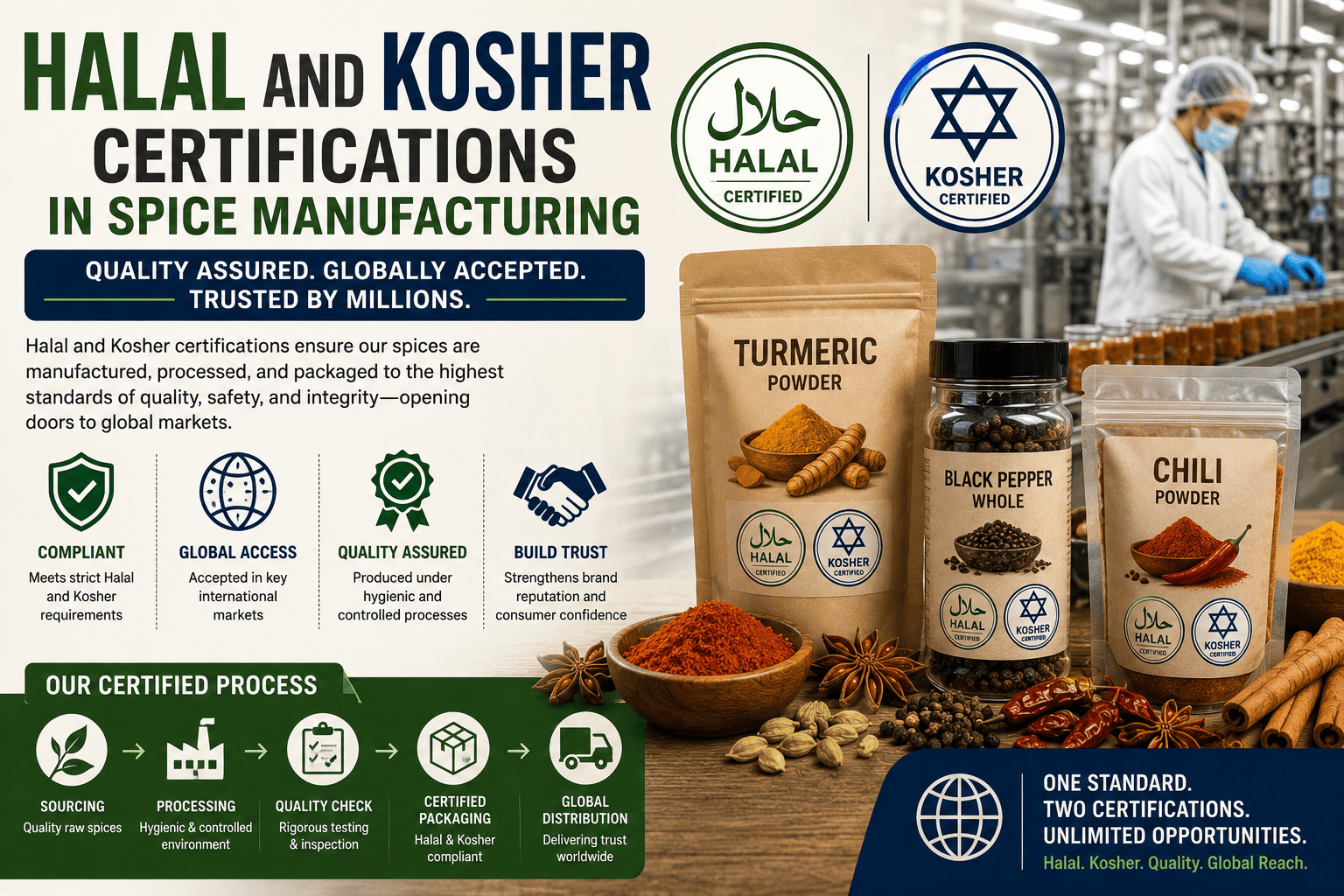
Why Halal Kosher Spice Certifications Matter for B2B Trade
Firstly, Halal and Kosher certifications serve as quality assurance mechanisms that go beyond religious compliance. In particular, the rigorous auditing processes involved in both certifications verify production hygiene, ingredient traceability, and facility sanitation. Therefore, certified suppliers offer inherently higher quality assurance:
| Certification | Global Muslim/Kosher Market Size | Key Importing Regions | Premium Potential |
|---|---|---|---|
| Halal | $2.3 trillion (global Islamic economy) | Notably, MENA, ASEAN, South Asia | 10–15% price premium |
| Kosher | $24 billion (US kosher food market) | Likewise, USA, Israel, Europe | 5–20% price premium |
| Both combined | Access to 60+ countries | Overall, global reach | 15–25% combined premium |
As shown above, dual-certified Indonesian nutmeg exporters can access substantially larger markets with meaningful pricing advantages.
Halal Certification in Spice Manufacturing: Indonesia Context
Furthermore, Halal certification in Indonesia is governed by BPJPH (Badan Penyelenggara Jaminan Produk Halal) in cooperation with MUI (Majelis Ulama Indonesia). Next, the certification process involves several stages:
Halal Certification Process
| Stage | Description | Timeline |
|---|---|---|
| Application | Manufacturer submits product details and ingredient list | 1–2 weeks |
| Halal Assurance System (HAS) | Documentation of production processes, ingredient sourcing, and cleaning procedures | Typically, 3–4 weeks |
| On-site audit | BPJPH/MUI auditor inspects facility, storage, and production lines | 1–2 days |
| Fatwa determination | MUI halal product agency reviews findings and issues fatwa | 2–4 weeks |
| Certificate issuance | BPJPH issues Halal certificate valid for 4 years | 1 week |
Typically, the complete process takes 2–4 months for Indonesian spice manufacturers. Moreover, after certification, the manufacturer must maintain segregation of Halal products from non-Halal materials throughout production, storage, and shipping.
Requirements for Spice Processing
- First, all equipment must be free from contamination by non-Halal substances (e.g., alcohol-based cleaning agents, pork-derived enzymes)
- Next, storage areas must segregate Halal-certified spices from non-certified products
- Additionally, cleaning procedures must follow Shariah-compliant protocols between production runs
- Finally, ingredient sourcing must be fully traceable and documented
Additionally, the official BPJPH Halal certification portal provides complete documentation requirements for Indonesian exporters.
Kosher Certification in Spice Manufacturing: Nutmeg and Mace Exporters
Similarly, Kosher certification for Indonesian nutmeg and mace follows a rigorous verification process managed by recognized certifying agencies. Specifically, the most widely accepted kosher certifiers include:
Major Kosher Certifying Agencies
| Agency | Symbol | Primary Market | Recognition |
|---|---|---|---|
| Orthodox Union (OU) | Ⓤ | USA, Global | Most widely recognized |
| OK Kosher Certification | Ⓚ | USA, Europe | Second largest globally |
| Star-K | Ⓢ | USA, Israel | High acceptance |
| KOF-K | ⓀⓀ | USA, Europe | Established reputation |
| KLBD | ⓀⓁ | Europe | Leading European certifier |
Consequently, OU certification (Ⓤ) is the most recognized symbol for B2B spice exports to North America, while KLBD serves European buyers effectively.
Kosher Certification Process for Spices
- Initially, the certifying agency reviews all ingredient specifications and supplier documentation
- Subsequently, a rabbinic field inspector visits the production facility for on-site audit
- During the audit, all production equipment, storage areas, and cleaning procedures are inspected
- Furthermore, the facility must demonstrate separation protocols for Kosher and non-Kosher production
- Finally, annual renewal inspections ensure ongoing compliance
Furthermore, the Orthodox Union Kosher certification page offers detailed guidance for spice manufacturers seeking OU certification.
Dual Halal Kosher Spice Certifications: Combined Benefits
Moreover, spice manufacturers pursuing both Halal and Kosher certification benefit from overlapping requirements. In particular, both certifications demand:
| Requirement | Halal | Kosher | Combined Benefit |
|---|---|---|---|
| Ingredient traceability | Required | Required | Consequently, single traceability system |
| Equipment cleaning validation | Required | Required | Resulting in shared cleaning protocols |
| Production segregation | Required | Required | Hence, joint segregation plan |
| Third-party audits | BPJPH/MUI | OU/OK/Star-K | Two independent verifications |
| Supply chain documentation | Required | Required | Thus, comprehensive documentation |
As a result, spice manufacturers who achieve dual certification create a robust compliance infrastructure that satisfies the most demanding B2B buyers globally.
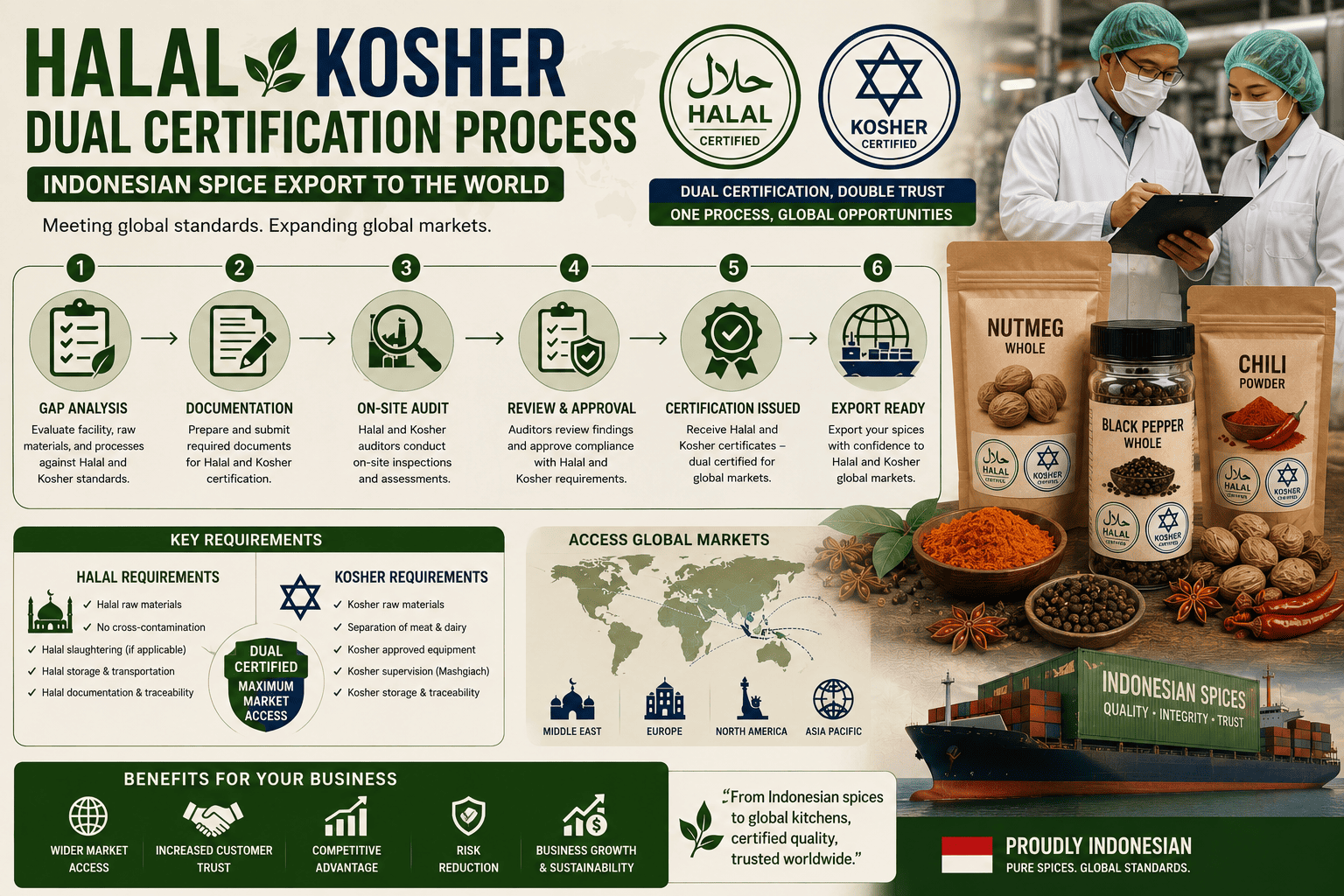
Market Access Benefits for Indonesian Nutmeg Exporters
Additionally, halal kosher spice certifications unlock specific market opportunities:
Halal Market Access
- In particular, Middle East (GCC): Saudi Arabia, UAE, Qatar require Halal certification for all food imports
- Additionally, Southeast Asia: Indonesia (mandatory since 2024), Malaysia (mandatory), Brunei
- Also, South Asia: Pakistan, Bangladesh (growing regulatory requirements)
- Furthermore, Africa: Nigeria, Egypt (expanding Halal food sectors)
Kosher Market Access
- Notably, United States: OU certification is standard requirement for mainstream retail and food service
- Similarly, Israel: All imported food ingredients require Kosher certification from recognized agencies
- Moreover, Europe: UK, France, Germany have significant kosher-certified product demand
- In addition, Latin America: Argentina, Brazil (growing kosher market segments)
In summary, exporters holding both certifications can access over 60 countries with combined Muslim and Kosher consumer populations exceeding 2.5 billion people.
Cost of Halal Kosher Spice Certifications and ROI
Furthermore, the investment in certification yields measurable returns:
| Certification | Estimated Annual Cost | Premium Potential | Payback Period |
|---|---|---|---|
| Halal (BPJPH/MUI) | $500–$1,500 | 10–15% | Typically, 1–3 months |
| Kosher (OU) | $3,000–$10,000 (annual fee + inspection) | 5–20% | Estimated 3–6 months |
| Combined | $3,500–$11,500 | 15–25% | Accordingly, 2–5 months |
Therefore, the return on investment for certification is substantial, particularly for exporters targeting premium markets.
How to Verify Halal Kosher Spice Certifications as a Buyer
Similarly, B2B buyers should verify supplier certifications through:
- First, request current certification certificates with expiration dates
- Next, verify certification numbers through the issuing body’s online portal
- Additionally, confirm that the certification covers the specific product being purchased
- Moreover, request audit reports showing compliance history
- Finally, check for any certification suspensions or violations
Consequently, working with established Indonesian exporters who maintain active Halal and Kosher certifications simplifies market entry for importers.
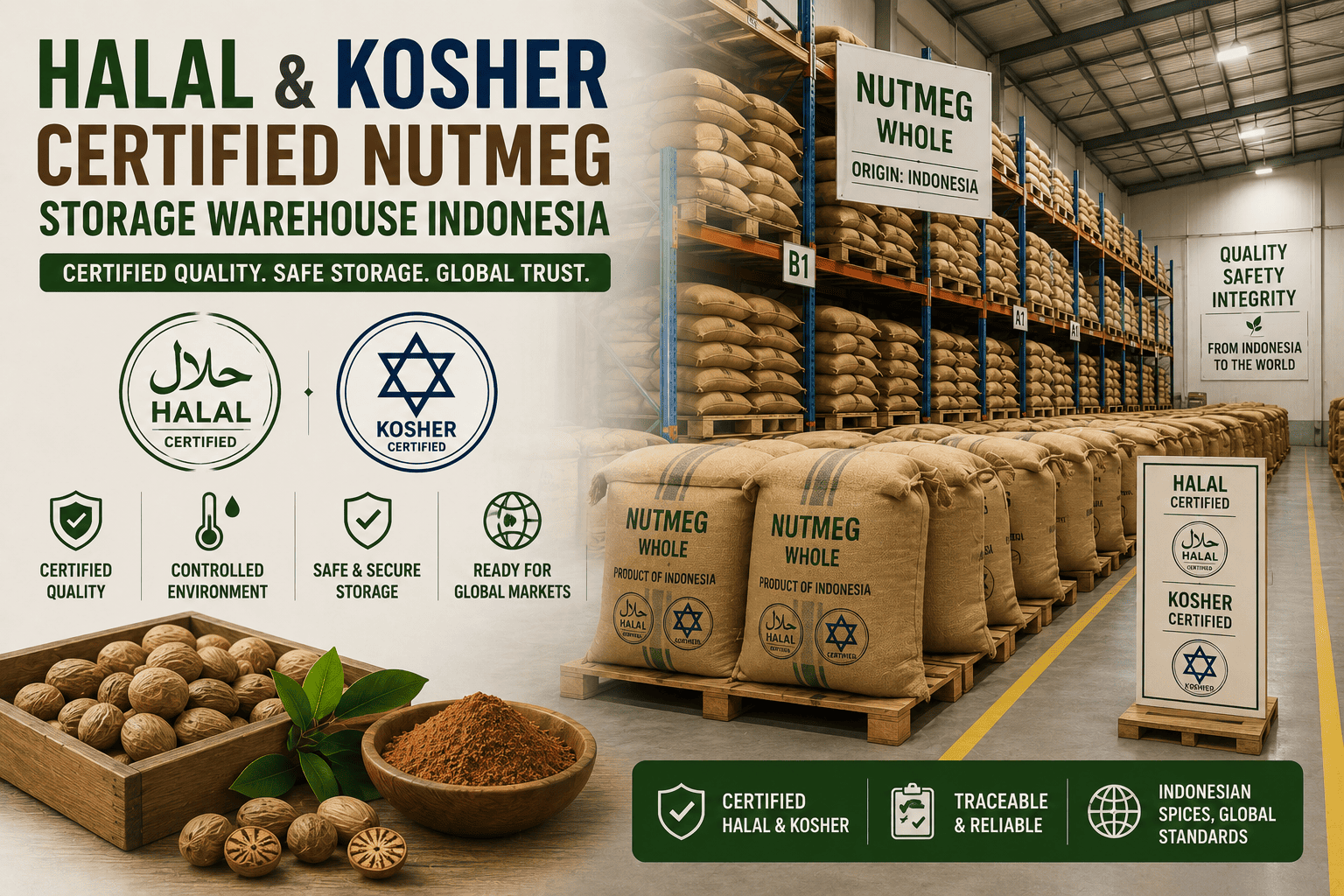
Halal Kosher Spice Certifications: Conclusion
In conclusion, halal kosher spice certifications represent essential market access tools for B2B Indonesian nutmeg exporters. Overall, the combined certification effort creates a compliance framework that satisfies the world’s most stringent buyers while commanding premium pricing. Furthermore, for Indonesian farming communities, certification enables participation in high-value export markets, bringing sustainable economic benefits.
For more information about our Halal and Kosher certified nutmeg and mace products, please contact us:
Email: [email protected]
WhatsApp B2B Helpline: +62 822-3332-2034
Head Office & Export Coordination: Modinan RT 007/RW 021, Banyuraden, Gamping, Sleman, DIY – Indonesia