
Traceability in B2B Spices: Tracking Nutmeg from Indonesian Farms to Export Containers
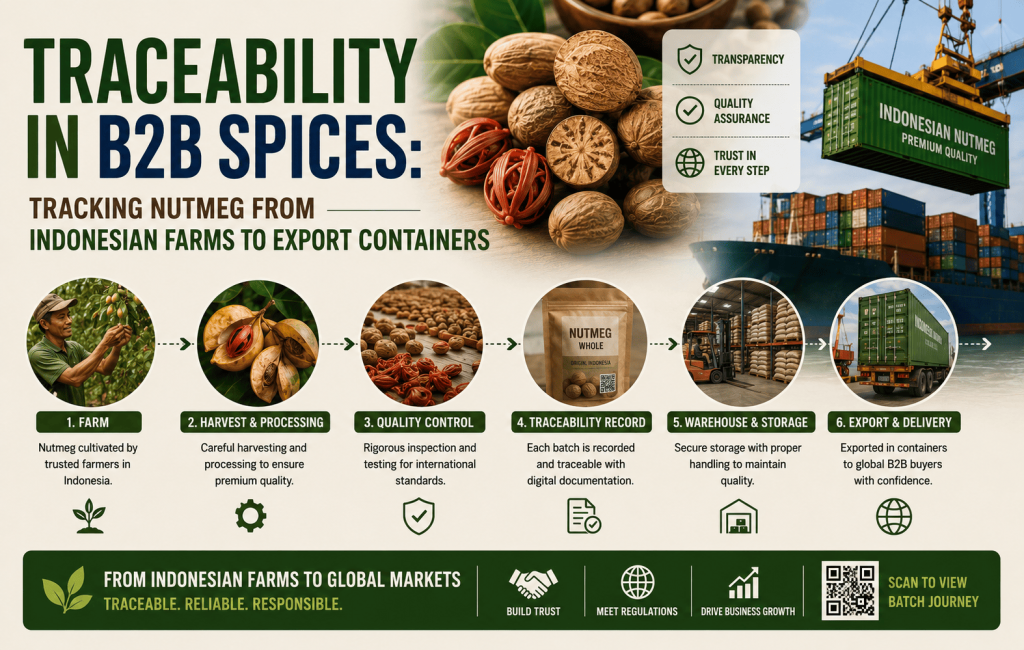
Traceability in B2B Spices: Tracking Nutmeg from Indonesian Farms to Export Containers
First and foremost, traceability in B2B spices is no longer optional — it is a regulatory requirement and a critical quality assurance tool. Specifically, new regulations such as the EU Deforestation Regulation (EUDR) mandate full supply chain traceability for commodities including nutmeg. Consequently, Indonesian exporters who implement robust traceability systems gain preferential access to regulated markets. Meanwhile, for context on related compliance, see our FDA and EU compliance guide for nutmeg and mace importation.
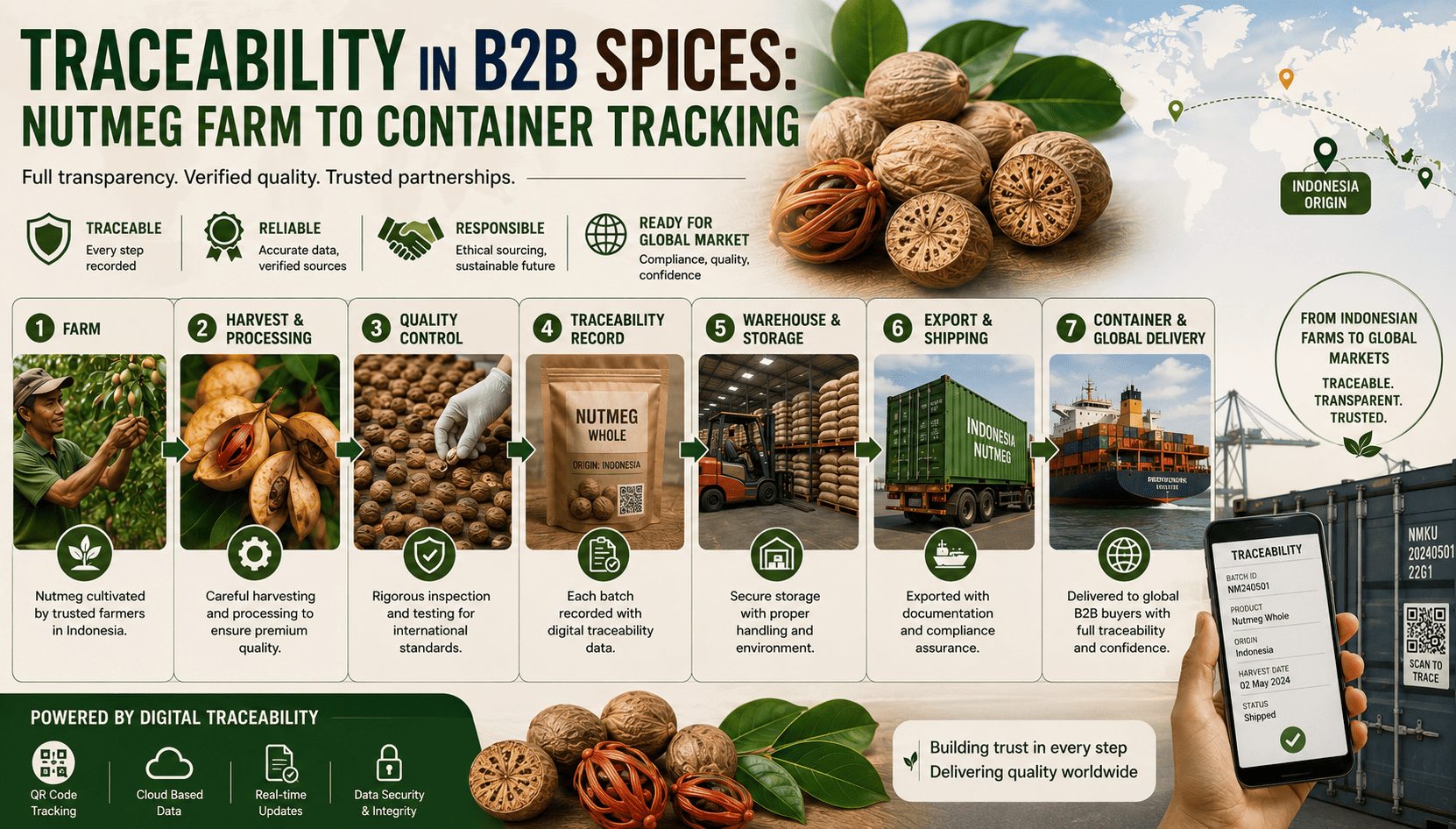
Why Traceability Matters in Spice Trade
Firstly, traceability provides transparency across every stage of the spice supply chain. In particular, it enables buyers to verify origin, processing conditions, and handling history. Therefore, traceability systems offer several key benefits:
| Benefit | Description | Impact on B2B Buyer |
|---|---|---|
| Regulatory compliance | Specifically, meets EUDR, FSMA, and FDA traceability requirements | Consequently, market access assurance |
| Quality verification | Consequently, tracks batch-level quality data from farm to shipment | Hence, confident purchasing decisions |
| Recall capability | As a result, identifies affected batches within hours | Rapid response to quality issues |
| Audit readiness | Subsequently, provides documented evidence for third-party audits | Simplified verification |
| Brand protection | Ultimately, demonstrates ethical and sustainable sourcing | Consumer trust |
As shown above, the business case for implementing traceability extends across regulatory, operational, and reputational dimensions.
Farm-Level Traceability in B2B Spices: From Tree to Cooperative
Furthermore, effective traceability in B2B spices begins at the farm level. Indonesian smallholder nutmeg farmers typically sell to village collectors or cooperatives, making farmer registration the first critical step:
Farmer Registration and Plot Identification
| Traceability Element | Description | Method |
|---|---|---|
| Farmer ID | Unique identifier for each farmer | Consequently, cooperative registration system |
| Plot geolocation | GPS coordinates of nutmeg growing area | Mobile data collection |
| Tree inventory | Number and age of productive trees | Annual field survey |
| Harvest records | Date and volume of each harvest | Paper or digital logbook |
| Input tracking | Fertilizer and pesticide usage records | Farmer self-reporting |
- First, cooperatives register each farmer with a unique ID linked to their plot location
- Next, geolocation data is collected to meet EUDR deforestation-free requirements
- Additionally, harvest volumes are recorded per farmer for lot-level traceability
- Finally, input usage is documented to verify organic or sustainable practices
Notably, the Fairtrade standard for spices includes specific traceability requirements for certified producer organizations.
Processing and Handling Traceability Systems
Similarly, once nutmeg enters the processing facility, traceability systems must track each batch through drying, grading, and packaging:
Batch Tracking Through Processing
| Processing Stage | Traceability Data Captured | Documentation |
|---|---|---|
| Receiving | Notably, Farmer ID, harvest date, weight, moisture content | Receiving report |
| Drying | Drying method, duration, final moisture level | Subsequently, drying log |
| Grading | Grade assigned (e.g., A/B, Sound/Shriveled), defect count | Accordingly, grading certificate |
| Packaging | Batch number, pack date, net weight, seal number | Packing list |
| Quality testing | Aflatoxin levels, moisture, oil content, microbiological results | Consequently, COA (Certificate of Analysis) |
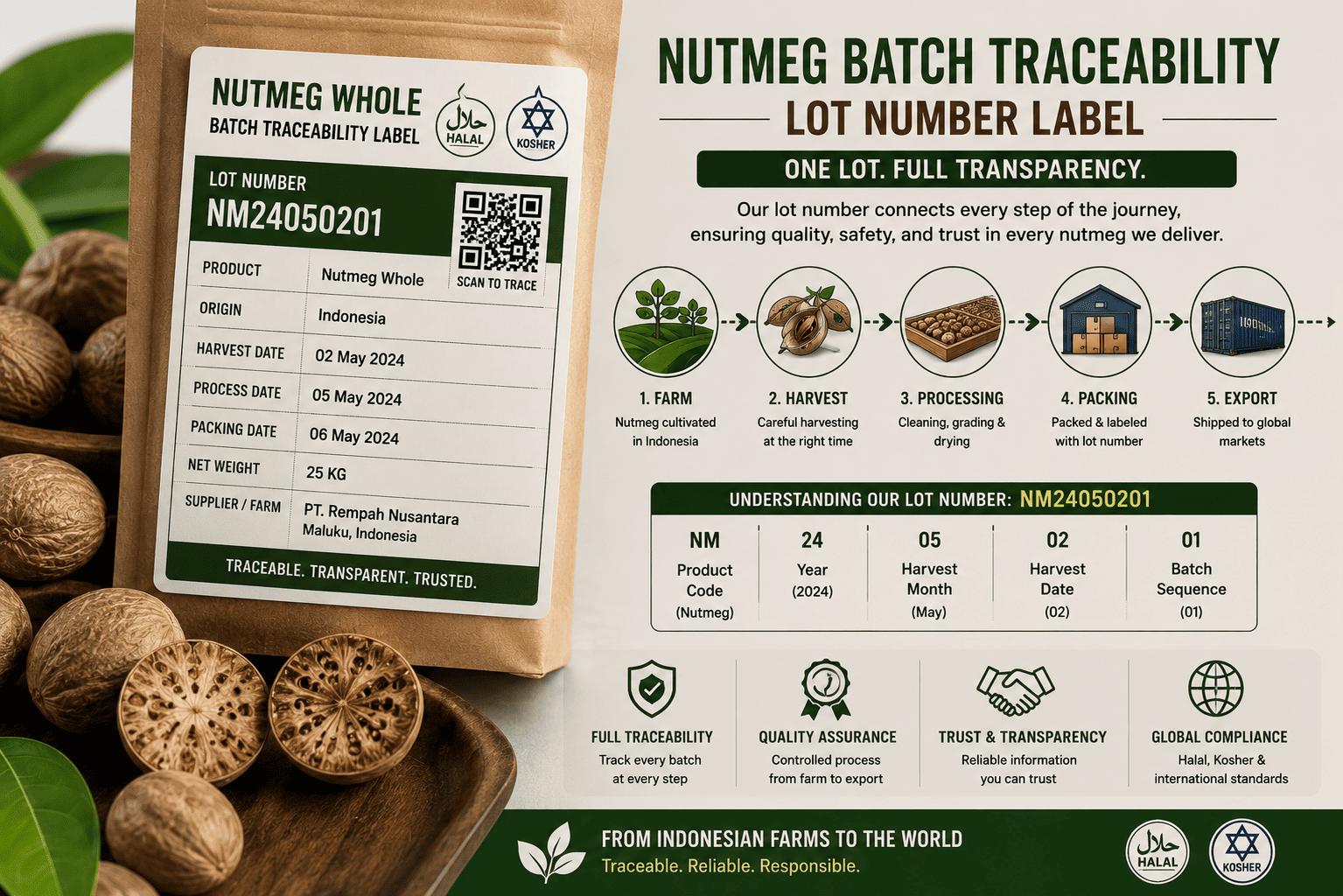
Typically, each batch is assigned a unique lot number that encodes the origin cooperative, harvest season, and processing date. Consequently, buyers can trace any shipment back to specific farming communities.
Lot Numbering System
Typically, a well-designed lot number might follow this structure:
ID-MLU-2026-03-B001

│    │     │    └── Batch sequence

│    │     └─────── Harvest month

│    └───────────── Origin region (MLU = Maluku)

└────────────────── Country code (ID = Indonesia)
Therefore, a lot number such as ID-MLU-2026-03-B001 immediately identifies a batch of nutmeg from Maluku, harvested in March 2026, as batch 001. As a result, this system enables rapid traceability in the event of quality issues or customer inquiries.
Export Documentation for Traceability in B2B Spices
Additionally, export documentation forms the backbone of traceability in B2B spices through the international supply chain. Specifically, these key documents include:
Essential Traceability Documents
| Document | Traceability Information | Regulatory Purpose |
|---|---|---|
| Packing list | Batch numbers, weights, package count | Shipping verification |
| Certificate of Origin (COO) | Country of origin, exporter details | Customs clearance, tariff preference |
| Phytosanitary certificate | Pest-free status, treatment records | Plant health compliance |
| Bill of Lading (B/L) | Container number, seal number, voyage details | Title of goods, shipping record |
| Certificate of Analysis (COA) | Quality parameters per batch | Buyer quality verification |
| Lab test report | Mycotoxin, pesticide residue, microbiology | Food safety compliance |
Furthermore, for EUDR compliance, additional documentation is required:
- First, geolocation data for all harvest plots (polygon coordinates)
- Next, deforestation-free declaration with satellite imagery evidence
- Also, due diligence statement submitted to EU member state authorities
- Finally, chain of custody documentation from farm to port of export
Furthermore, the Fairtrade standard for spices and EUDR requirements are converging on traceability expectations. Moreover, these standards include detailed traceability protocols for certified producers.
Technology Solutions for Traceability in B2B Spices
Moreover, technology is transforming traceability in B2B spices from paper-based systems to digital platforms:
Digital Traceability Options
| Technology | Application | B2B Benefit |
|---|---|---|
| Blockchain | Immutable record of each supply chain transaction | Verifiable proof of origin |
| QR codes on packaging | Scanner-readable lot information | Instant batch lookup |
| Cloud-based ERP | Centralized inventory and batch tracking | Real-time visibility |
| Mobile data collection | Farmer-level harvest recording | Complete chain of custody |
| Satellite monitoring | Land-use verification for EUDR | Deforestation-free proof |
As a result, digital traceability solutions reduce administrative burden while improving accuracy. However, implementation cost varies significantly:
- Basic (paper + spreadsheet): $500–$2,000 per year — consequently, suitable for small cooperatives
- Intermediate (cloud software): $5,000–$20,000 per year — accordingly, appropriate for medium exporters
- Advanced (blockchain + IoT): $50,000+ per year — typically, for large-scale operations
Therefore, Indonesian exporters should select a traceability system aligned with their volume and target market requirements.
B2B Buyer Verification for Traceability in B2B Spices
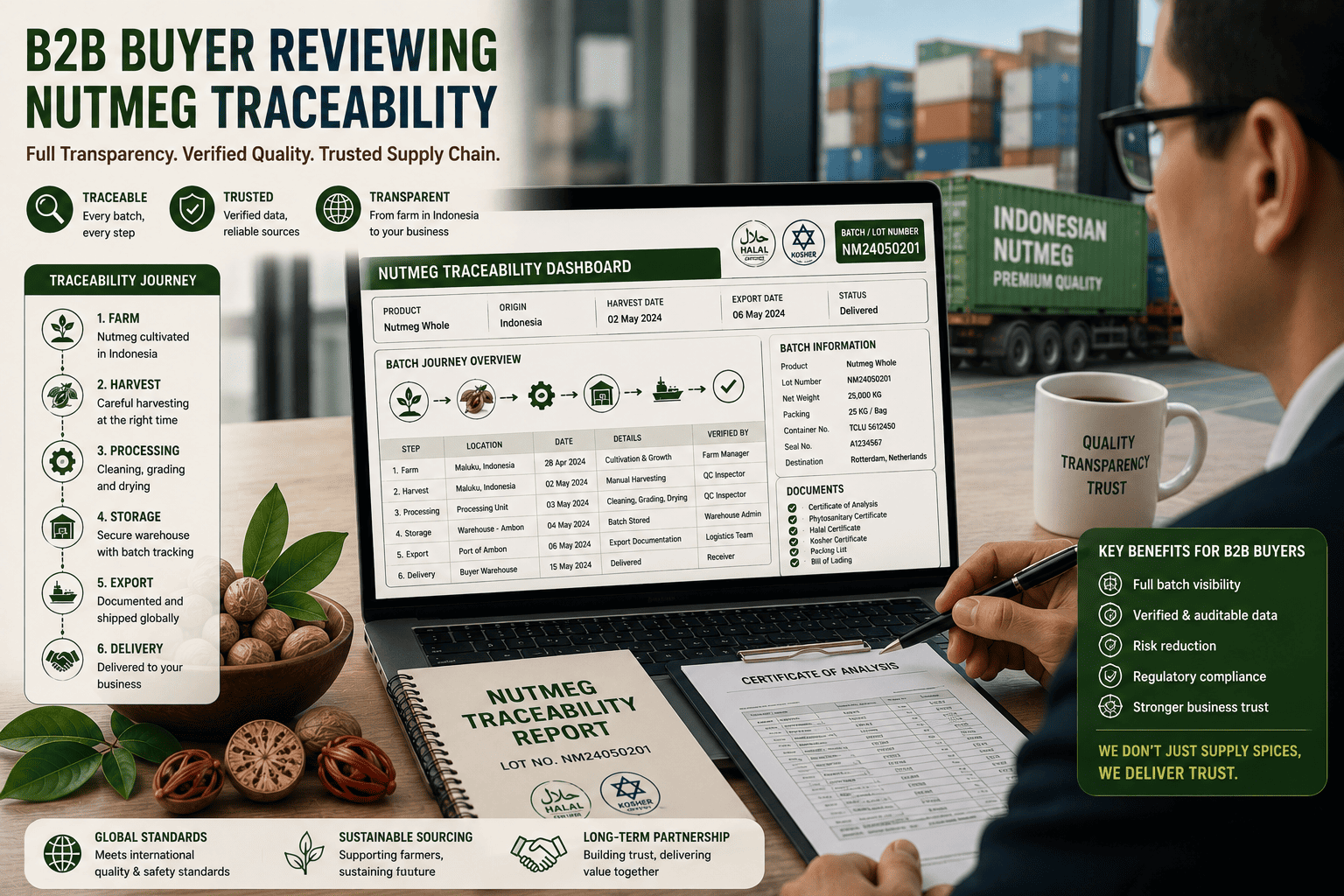
Similarly, B2B buyers should verify supplier traceability capabilities through:
- First, request sample lot numbers and trace back to origin farm
- Next, verify that geolocation data is available for all source plots
- Additionally, confirm that batch-level COAs accompany each shipment
- Moreover, review the supplier’s recall simulation records
- Finally, check EUDR due diligence documentation for regulated markets
Consequently, working with exporters who maintain digital traceability systems significantly reduces buyer risk.
Traceability in B2B Spices: Conclusion
In summary, traceability in B2B spices is a fundamental requirement for modern spice trade. Overall, comprehensive traceability systems enable regulatory compliance, quality assurance, and supply chain transparency. Consequently, for Indonesian nutmeg exporters, investment in robust traceability directly translates to market access and buyer confidence.
Finally, for more information about our traceable nutmeg and mace supply chain, please contact us:
Email: [email protected]
WhatsApp B2B Helpline: +62 822-3332-2034
Head Office & Export Coordination: Modinan RT 007/RW 021, Banyuraden, Gamping, Sleman, DIY – Indonesia