
FDA and EU Compliance Guide for Nutmeg and Mace Importation
FDA and EU Compliance Guide for Nutmeg and Mace Importation
For B2B importers, navigating FDA and EU compliance for nutmeg is a critical part of the procurement process. Specifically, both the US Food and Drug Administration (FDA) and the European Union have established strict regulations for spice imports, covering contaminant limits, documentation, and facility registration. Furthermore, failure to comply can result in shipment detention, rejection, or even placement on import alerts. As a baseline, understanding how mace grades affect compliance is covered in our mace grades and quality standards guide.
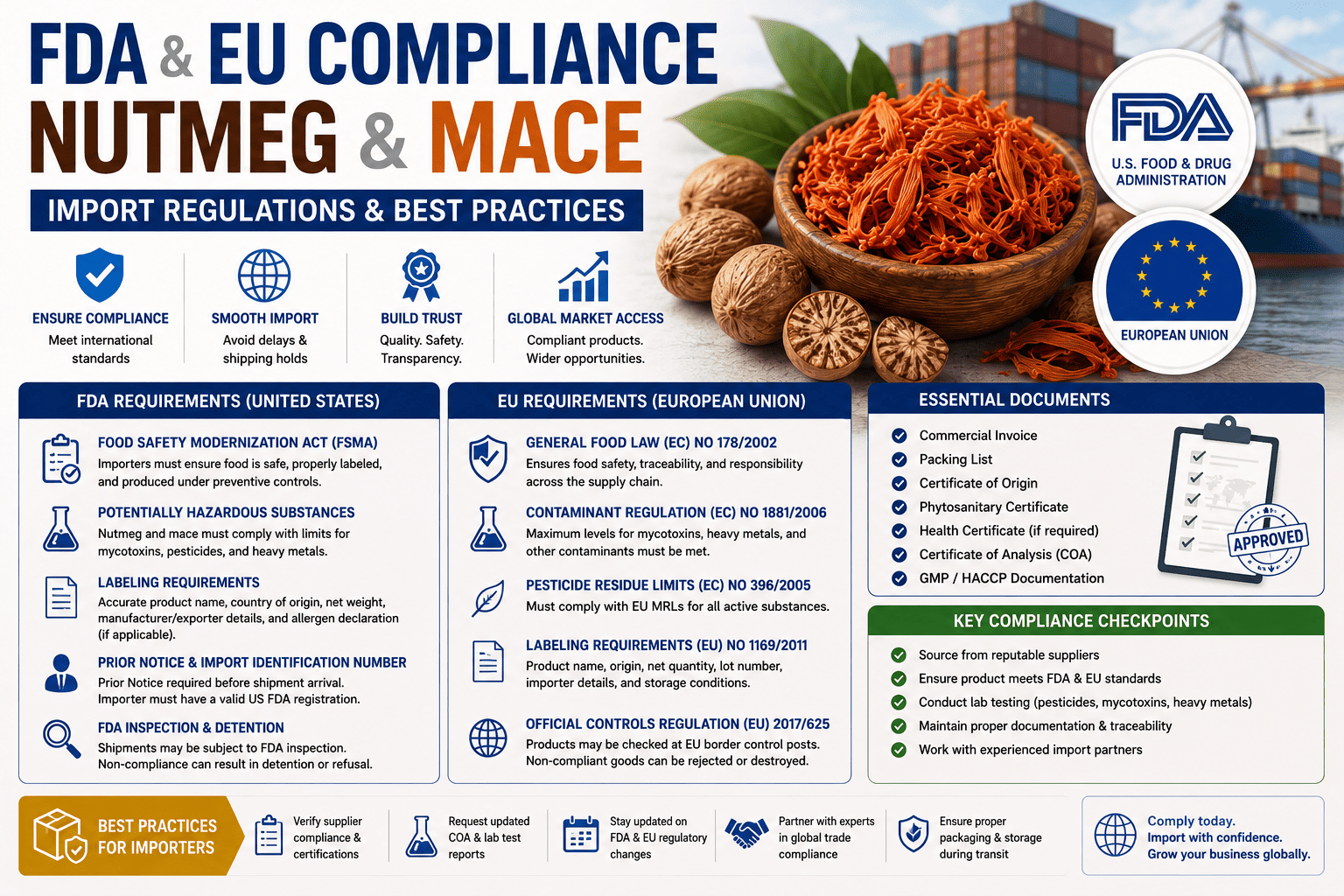
FDA Compliance for Nutmeg and Mace Imports
Firstly, the FDA regulates nutmeg and mace imports under the Federal Food, Drug, and Cosmetic Act. Consequently, importers must ensure compliance with the following key areas:
FDA Compliance: Facility Registration and Prior Notice
Before shipment, foreign suppliers must register their facility with the FDA under the Bioterrorism Act. Additionally, importers must submit Prior Notice to the FDA before any food product arrives in the United States:
| Requirement | Details | Timeline |
|—|—|—|—|
| Foreign facility registration | Annual renewal via FDA FURLS system | Before first shipment |
| Prior Notice submission | Electronic submission via FDA PN system | 2 hours to 5 days before arrival |
| Importer identification | FSVP (Food Supplier Verification Program) | Ongoing compliance |
| US Agent designation | Must have a US-based agent for communication | Notably, prior to registration |
FDA Compliance: Contaminant Limits for Nutmeg
Specifically, the FDA enforces specific action levels for contaminants in spices, including nutmeg and mace:
| Contaminant | FDA Action Level | Testing Method |
|—|—|—|—|
| Aflatoxins (total) | 20 ppb (parts per billion) | Typically, HPLC or ELISA |
| Insect filth | Average of 5% or more by weight | Visual + microscopic |
| Mammalian excreta | Average of 3 mg/lb or more | Microscopic analysis |
| Mold | Average of 5% or more by weight | Visual + microscopic |
| Salmonella | Zero tolerance in all food products | Notably, PCR or culture method |
| E. coli | Negative per 25g sample | Culture method |
Additionally, the FDA 21 CFR Part 110 for current good manufacturing practices provides the regulatory framework for spice processing facilities.
FSVP (Food Supplier Verification Program)
Furthermore, under the FSMA (Food Safety Modernization Act), importers must verify their foreign suppliers meet FDA standards. Specifically, this includes:
- First, developing a supplier verification plan
- Next, conducting annual supplier audits or sampling
- Then, maintaining records for at least 2 years
- Finally, corrective action procedures for non-compliant shipments
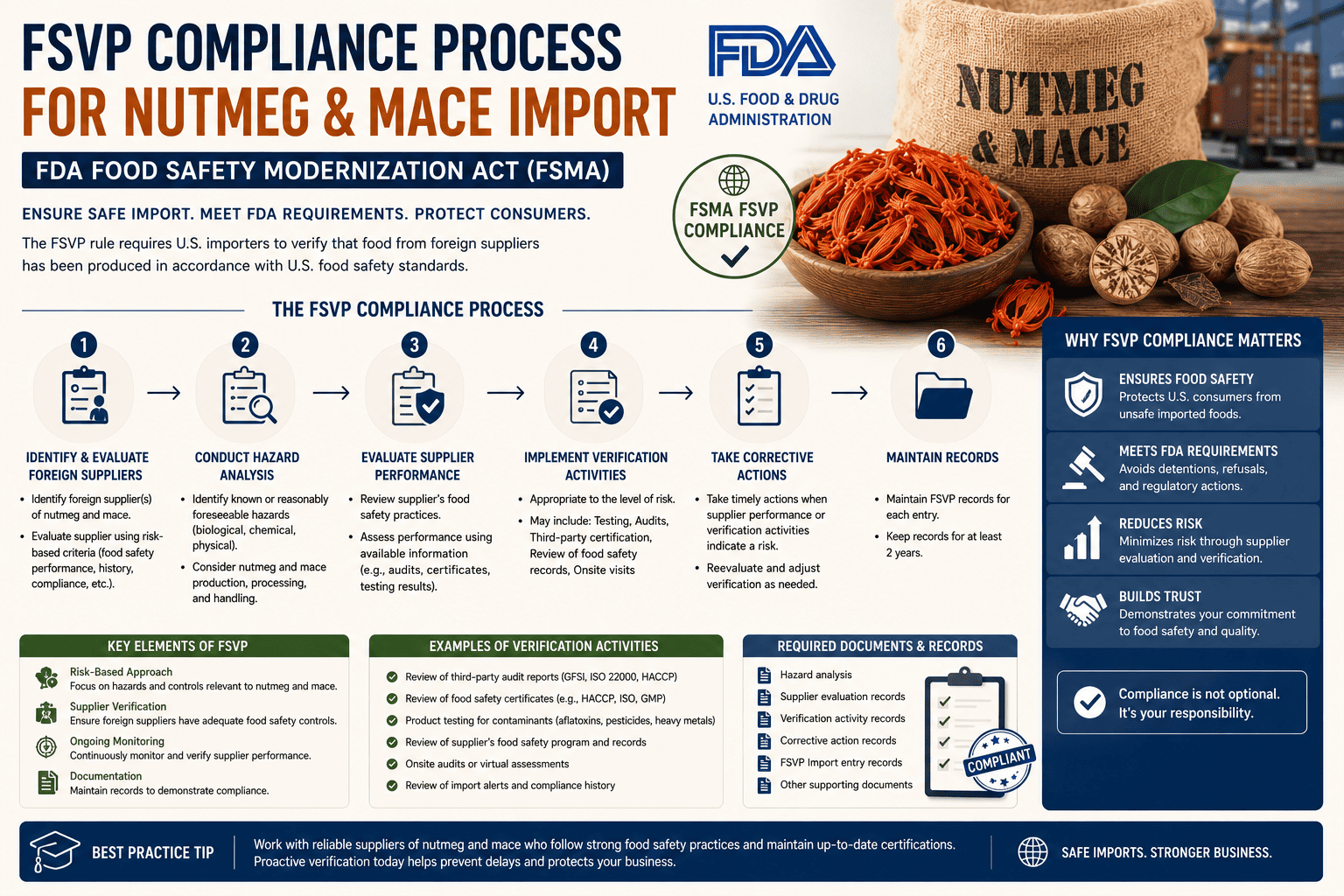
EU Compliance for Nutmeg and Mace Imports
Similarly, the European Union has its own regulatory framework for spice imports. The key regulations affecting FDA and EU compliance for nutmeg include:
EU Compliance: Contaminant Regulations for Nutmeg
In general, the EU sets stricter limits than the FDA for certain contaminants:
| Contaminant | EU Maximum Level | Regulation Reference |
|---|---|---|
| Aflatoxin B1 | 5.0 µg/kg (ppb) | EC 1881/2006 |
| Aflatoxins (total) | 10.0 µg/kg (ppb) | EC 1881/2006 |
| Ochratoxin A | 15 µg/kg | EC 1881/2006 |
| Lead | 2.0 mg/kg | EC 2021/1317 |
| Cadmium | 0.5 mg/kg | EC 2021/1323 |
| Pesticide residues | Varies per substance | EC 396/2005 |
In particular, EU aflatoxin limits are twice as strict as FDA limits (10 ppb vs 20 ppb total). Consequently, this affects sourcing decisions for importers supplying both markets.
EU Compliance: Import Documentation for Nutmeg
Specifically, for shipments entering the EU, the following documentation is mandatory:
| Document | Purpose | Issued By |
|—|—|—|—|
| Certificate of Origin (COO) | Proves country of origin | Chamber of Commerce (Indonesia) |
| Phytosanitary Certificate | Certifies plant health | Notably, Indonesian Quarantine Agency |
| Health Certificate | Certifies food safety | Also, BPOM (Indonesian FDA equivalent) |
| Bill of Lading (BOL) | Shipping documentation | Shipping carrier |
| Certificate of Analysis (COA) | Lab analysis results | Accredited laboratory |
| Importer’s Declaration | Importer responsibility | EU-based importer |
EUDR Compliance
Additionally, the EU Deforestation Regulation (EUDR) affects nutmeg and mace imports starting in 2025–2026:
- Notably, requires full traceability to farm level
- Also, geo-coordinates of production plots
- Then, due diligence statement by the importer
- Finally, proof of deforestation-free supply chain
Consequently, Indonesian exporters must implement traceability systems to comply with EUDR requirements for continued market access.
FDA vs EU Compliance Comparison for Nutmeg Importers
Overall, understanding the differences helps B2B buyers plan compliance strategies:
| Parameter | FDA (US) | EU |
|—|—|—|—|
| Aflatoxin total limit | 20 ppb | Hence, 10 ppb |
| Salmonella | Zero tolerance | Also, zero tolerance |
| Facility registration | FDA FURLS | RASFF system |
| Prior notice | Required (PN system) | Required (TRACES NT) |
| Traceability | FSVP plan required | Notably, EUDR mandatory |
| Testing frequency | Risk-based | Consequently, routine for high-risk |
| COA requirement | Recommended | Mandatory |
| Organic certification | USDA NOP | EU Organic Regulation |
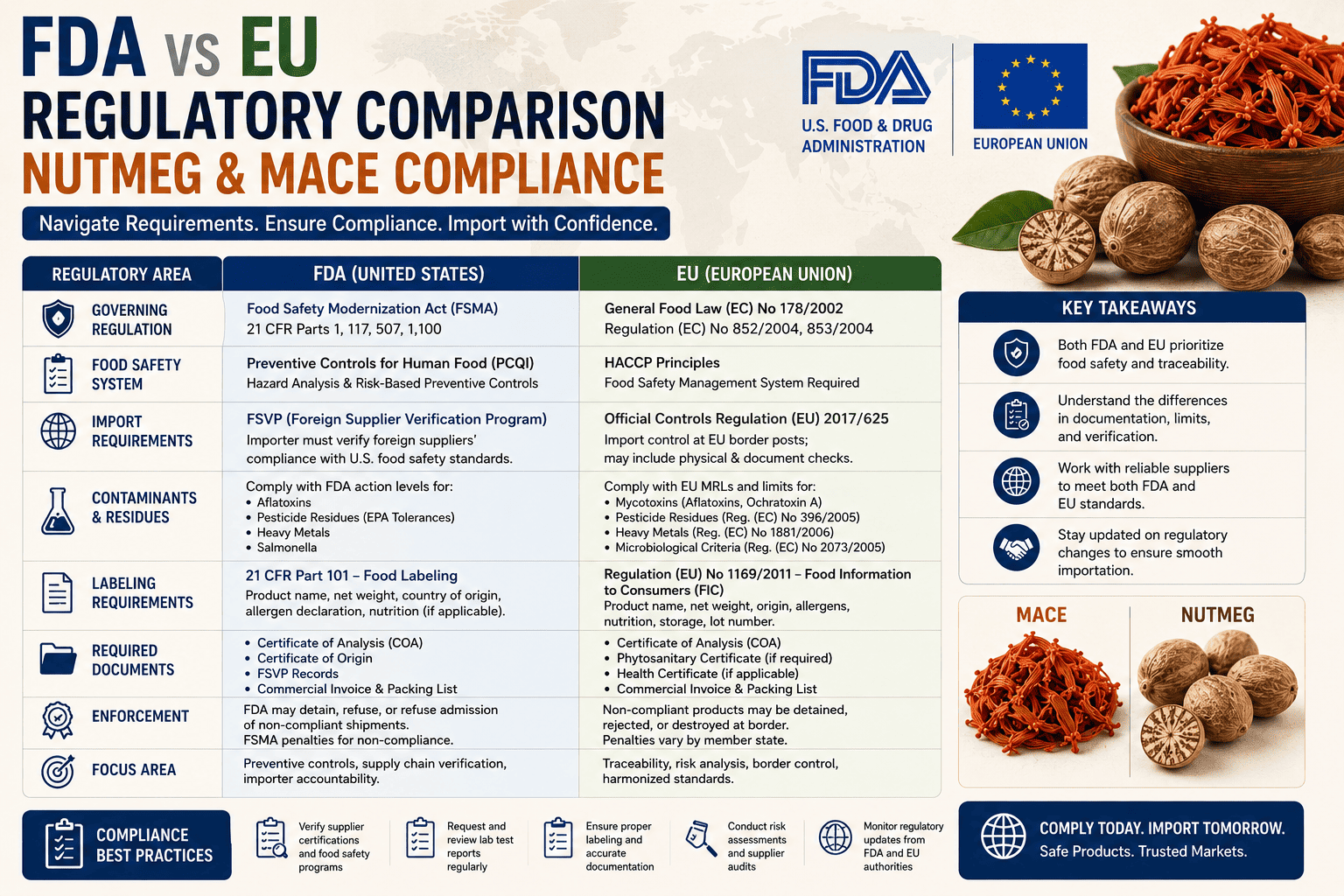
FDA and EU Compliance Checklist for Nutmeg
Therefore, B2B buyers should follow this checklist when contracting nutmeg or mace from Indonesian suppliers:
Pre-Shipment
- First, verify supplier’s FDA facility registration (FURLS number)
- Next, confirm EUDR compliance documentation readiness
- Then, request COA with aflatoxin, pesticide, and heavy metal analysis
- Also, review phytosanitary certificate validity
- Finally, agree on prior notice submission responsibilities
At Shipment
- Immediately, obtain Bill of Lading and COO
- Next, verify laboratory testing covers both FDA and EU limits (if dual-market)
- Then, confirm phytosanitary inspection is completed
- Also, submit prior notice to FDA or TRACES NT filing to EU
Post-Arrival
- First, retain all documentation for minimum 2 years (3 years for EU)
- Next, log compliance data for future FSVP audits
- Then, verify no import alerts on supplier’s name
- Also, conduct random quality checks on arrival
- Finally, provide feedback to supplier for continuous improvement
Additionally, the FDA food safety guidelines for imported spices offer additional reference for importers establishing compliance programs.
Summary
In conclusion, FDA and EU compliance for nutmeg requires careful attention to differing contaminant limits, documentation requirements, and traceability standards. Furthermore, by working with experienced Indonesian exporters who understand both regulatory frameworks, B2B importers can minimize compliance risks and ensure smooth customs clearance.
Finally, for more information about compliant nutmeg and mace sourcing:
Email: [email protected]
WhatsApp B2B Helpline: +62 822-3332-2034
Head Office & Export Coordination: Modinan RT 007/RW 021, Banyuraden, Gamping, Sleman, DIY – Indonesia