
The Economics of Bulk Mace Sourcing: Yield, Grading, and Price Trends
The Economics of Bulk Mace Sourcing: Yield, Grading, and Price Trends
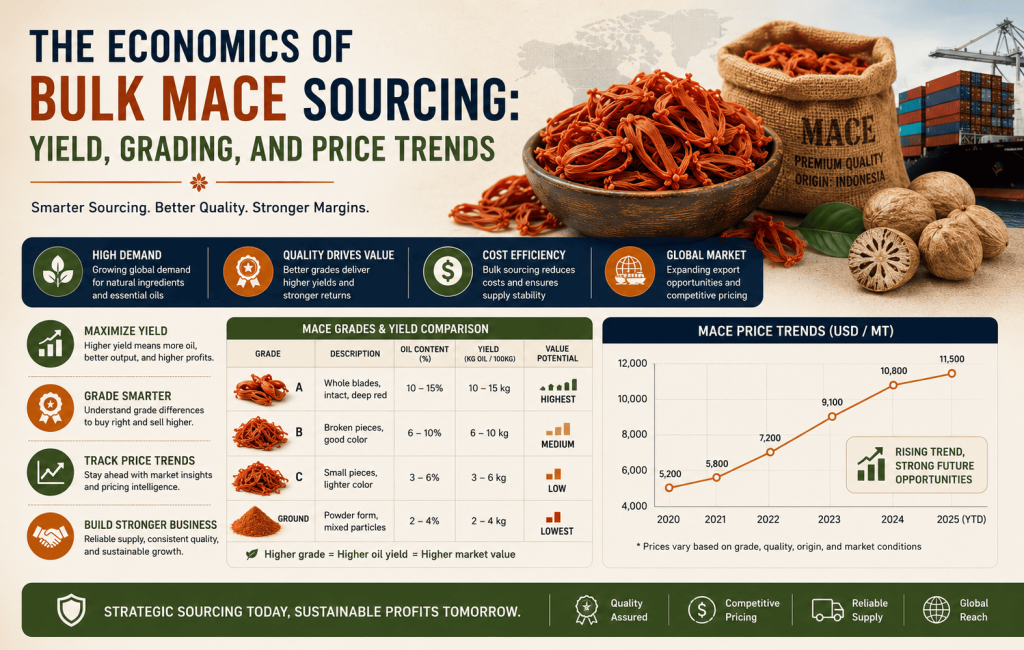
For B2B procurement managers and importers, understanding the economics of bulk mace sourcing is essential for budgeting, supplier negotiations, and supply chain planning. Consequently, mace pricing differs significantly from nutmeg due to lower yields, more labor-intensive processing, and higher volatile oil content. Furthermore, knowing the cost drivers helps buyers make informed decisions when contracting with Indonesian suppliers. For a baseline understanding of mace grades, see our complete guide to mace grades and quality standards, and for the chemical value behind pricing, refer to our mace chemical profiles guide.
Bulk Mace Sourcing Yield Economics: Tree to Market
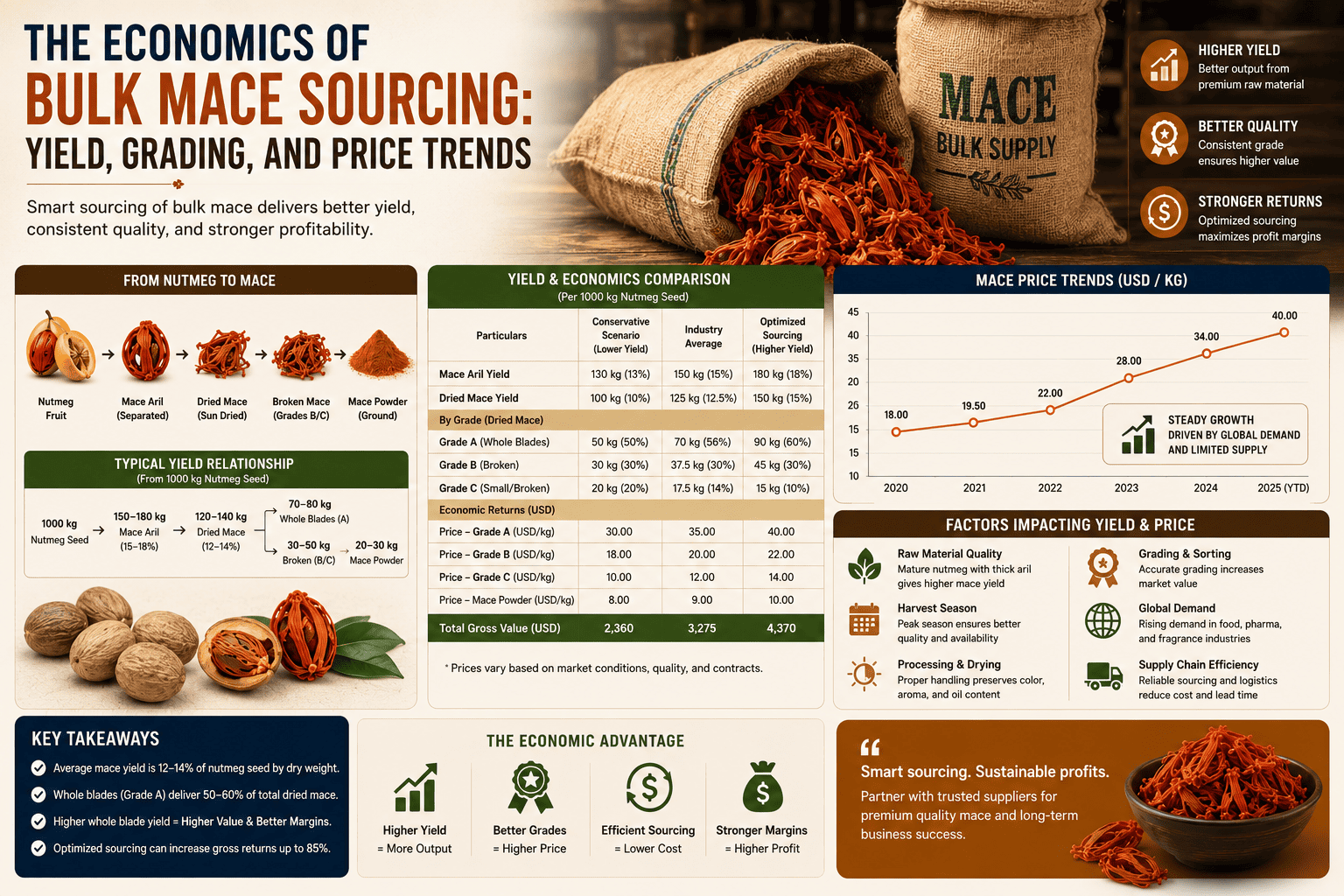
Firstly, the most fundamental factor in bulk mace sourcing economics is yield. Specifically, mace is the aril (lacy covering) of the nutmeg seed, and each nutmeg fruit produces only a small amount of dried mace.
| Parameter | Typical Range |
|---|---|
| Fresh nutmeg fruits per tree per year | 1,000–2,000 |
| Fresh mace weight per fruit | 1.5–3 grams |
| Fresh mace to dried mace ratio | 4:1 to 5:1 |
| Dried mace yield per tree per year | 0.3–1.2 kg |
| Dried mace yield per hectare (mature orchard) | 50–200 kg |
| Nutmeg yield per hectare (mature orchard) | 800–1,500 kg |
| Mace as percentage of total spice yield | 4–8% |
As a result, mace is approximately 10–20 times scarcer than nutmeg on a weight basis. Consequently, this scarcity is the primary driver of the significant price premium that mace commands in international markets.
Bulk Mace Sourcing: Grade-Based Pricing Structure
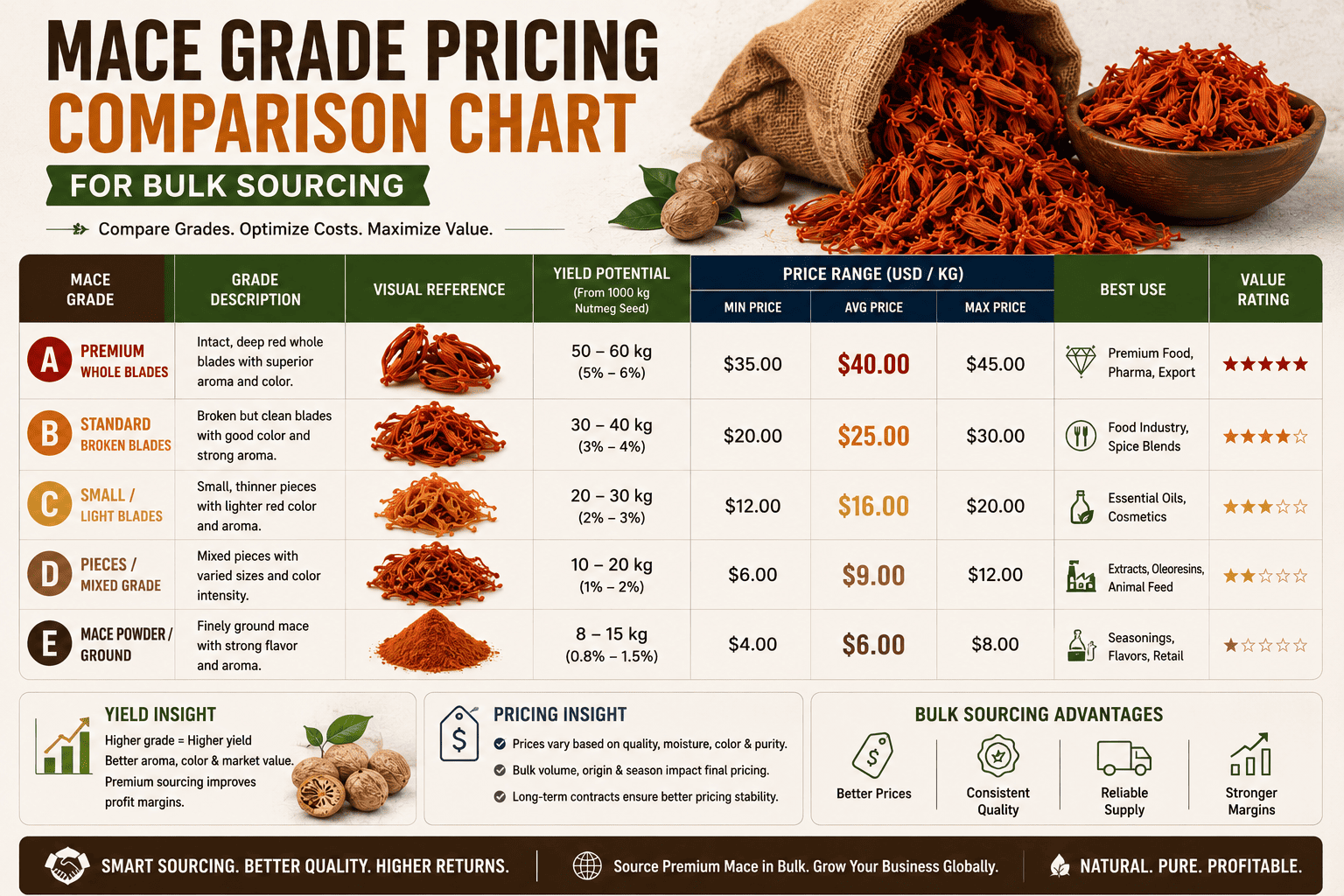
Similarly, the bulk mace sourcing price depends heavily on grade. Indonesian exporters typically classify mace into four commercial grades:
| Grade | Description | Typical Price Premium vs Nutmeg | Common Use Cases |
|---|---|---|---|
| Grade A | Whole, unbroken blades, uniform color, 10–15% oil | 2.5–3.5× | Premium spice blends, retail, essential oil |
| Grade B | Broken blades, good color, 8–12% oil | 2.0–2.5× | Industrial seasoning, food processing |
| Grade C | Ground/powdered mace, 5–10% oil | 1.5–2.0× | Bakery, confectionery, meat processing |
| Grade D | Fines and sifting remnants, 2–5% oil | 1.0–1.5× | Oleoresin extraction, distillation |
Overall, Grade A mace commands the highest premium because it retains full visual integrity and maximum volatile oil content. Moreover, buyers in the essential oil and premium food sectors consistently pay a premium for whole-blade mace, making it the most profitable segment for exporters.
Key Cost Factors in Bulk Mace Sourcing
Furthermore, several cost factors influence bulk mace sourcing prices beyond the grade classification:
Harvest Seasonality
Specifically, the nutmeg harvest in Indonesia follows two main seasons:
| Harvest Season | Months | Mace Production Volume | Typical Price Impact |
|—|—|—|—|—|
| Main harvest | June–October | Highest | Consequently, lowest prices (peak supply) |
| Secondary harvest | January–March | Moderate | Moderate prices |
| Off-season | April–May, November–December | Lowest | Hence, highest prices (supply gap) |
Thus, B2B buyers who contract during the main harvest season can secure better pricing. However, off-season procurement typically carries a 15–30% price premium.
Drying and Processing Costs
Additionally, the drying method significantly impacts both quality and cost:
| Drying Method | Processing Cost | Oil Retention | Final Price Impact |
|—|—|—|—|—|
| Sun drying | Lowest | 70–80% | Baseline pricing |
| Mechanical drying | Moderate (+15–25%) | 85–90% | Hence, +10–20% premium |
| Freeze drying | Highest (+50–100%) | 90–95% | Thus, +30–50% premium |
Specifically, for bulk buyers, mechanical drying offers the best value proposition. Meanwhile, freeze-dried mace is typically reserved for pharmaceutical-grade applications where maximum volatile oil retention is critical.
Labor Intensity
Furthermore, mace processing is significantly more labor-intensive than nutmeg because each aril must be carefully removed by hand, flattened, and dried individually. Specifically, labor costs account for approximately 30–40% of the total production cost of dried mace, compared to 10–15% for nutmeg. Consequently, rising minimum wages in Indonesian production regions directly affect bulk mace sourcing prices.
Bulk Mace Sourcing Price Trends and Market Outlook
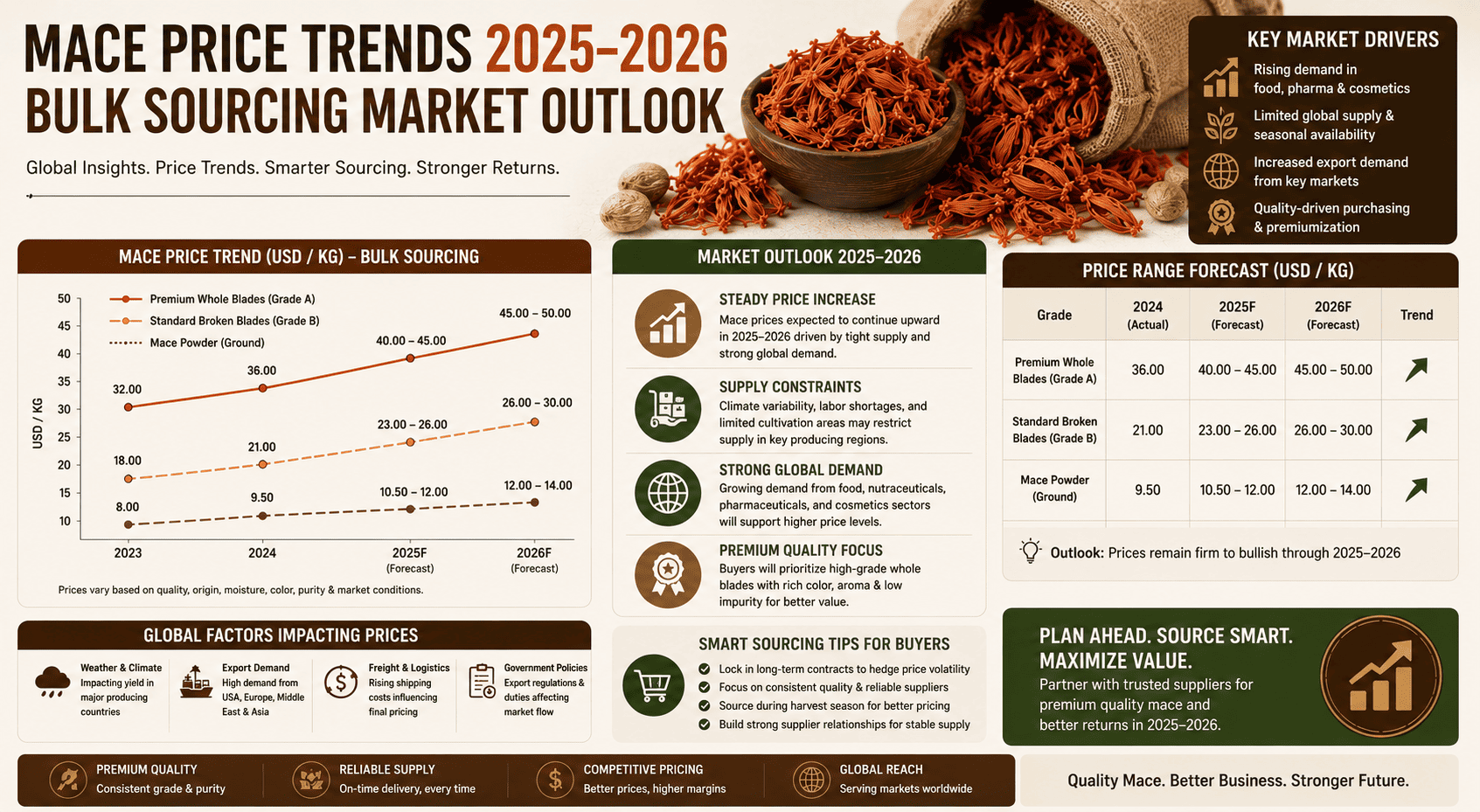
Additionally, the Tridge market intelligence platform for mace provides useful reference data for tracking international mace prices. Moreover, key trends affecting the 2025–2026 market include:
Supply-Side Factors
| Factor | Impact on Mace Prices | Trend Direction |
|—|—|—|—|
| Aging nutmeg trees in Indonesia | Reduced yield per hectare | Notably, upward pressure |
| Climate variability (El Niño) | Lower fruit set and mace quality | Also, upward pressure |
| Labor shortage in rural areas | Higher processing costs | Upward pressure |
| Expansion of new plantations | Increased supply (5–7 year lag) | Downward pressure (long-term) |
Demand-Side Factors
| Factor | Impact on Mace Prices | Trend Direction |
|—|—|—|—|
| Growing essential oil market | Higher demand for Grade A | Notably, upward pressure |
| Clean label movement in food | Higher demand for natural spices | Also, upward pressure |
| Pharmaceutical applications | Stable demand for premium grades | Neutral |
| Economic slowdown in EU/US | Potential demand reduction | Consequently, downward pressure |
As a result, the medium-term outlook for bulk mace sourcing suggests continued price strength, driven by supply constraints and steady demand growth from the natural food and essential oil sectors.
Bulk Mace Sourcing Purchasing Strategies
Therefore, B2B buyers can optimize their bulk mace sourcing costs through several strategies:
Contract Timing
- Main harvest contracts (June–October): Lock in annual volume at lowest seasonal prices
- Next, forward contracts: Secure pricing 6–12 months ahead for budgeting certainty
- Finally, spot purchases: Only for urgent or small-volume requirements (pay premium)
Grade Mix Optimization
- First, blend Grade A + Grade C: Use whole blades for visual appeal in retail and ground mace for manufacturing, optimizing overall cost
- Then, dedicated distillation grade: For oleoresin extraction, specify Grade D to minimize raw material cost
- In addition, long-term supplier relationships: Consistent volume commitments often yield 5–10% price advantages
Quality Verification
Firstly, for the ASTA (American Spice Trade Association) cleanliness specifications, mace must meet minimum quality standards. Accordingly, ensure suppliers provide:
- First, third-party laboratory analysis of volatile oil content
- Next, GC-MS chromatogram with each shipment
- Then, moisture content certificate (<10%)
- Finally, visual grade verification (photographic evidence)
Summary for B2B Bulk Mace Sourcing Buyers
Overall, effective bulk mace sourcing requires understanding the interplay between yield scarcity, grade-based pricing, seasonal availability, and processing costs. Consequently, by aligning procurement strategy with these economic factors, B2B importers can secure consistent quality at competitive prices.
Finally, for more information about bulk mace pricing and availability:
Email: [email protected]
WhatsApp B2B Helpline: +62 822-3332-2034
Head Office & Export Coordination: Modinan RT 007/RW 021, Banyuraden, Gamping, Sleman, DIY – Indonesia