
Sun-Dried vs Mechanically Dried Mace: Preserving Rich Volatile Oils
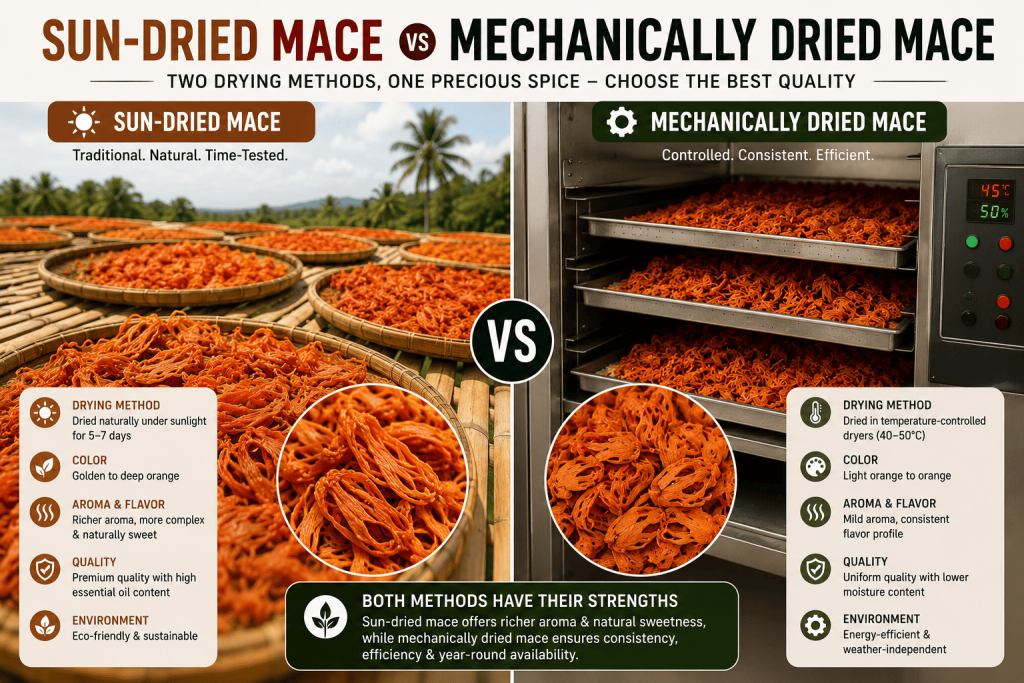
Sun-Dried vs Mechanically Dried Mace: Preserving Rich Volatile Oils for B2B Buyers
What is the best drying method for preserving sun-dried mace quality? In essence, the drying method chosen for mace processing directly determines volatile oil retention, color development, shelf life, and compliance with international quality standards. For B2B procurement teams and QA managers sourcing premium Indonesian mace, understanding the differences between sun-drying and mechanical drying is essential for making informed purchasing decisions aligned with production requirements and regulatory specifications. As a result, this comprehensive guide examines both drying methodologies in depth, providing technical data and practical sourcing recommendations.
In essence, mace, the delicate aril of Myristica fragrans, contains 7-15% volatile oil content—significantly higher than nutmeg’s 5-8%. Furthermore, this volatile oil is the primary determinant of mace’s commercial value, flavor profile, and functional performance in industrial applications. Indeed, the drying process represents the most critical control point in mace processing, as improper or uncontrolled drying can degrade volatile oil content by 20-40%, rendering premium-grade mace unsuitable for pharmaceutical, cosmetic, and high-end food applications. For more on mace quality standards, refer to our guide on wholesale nutmeg grades.
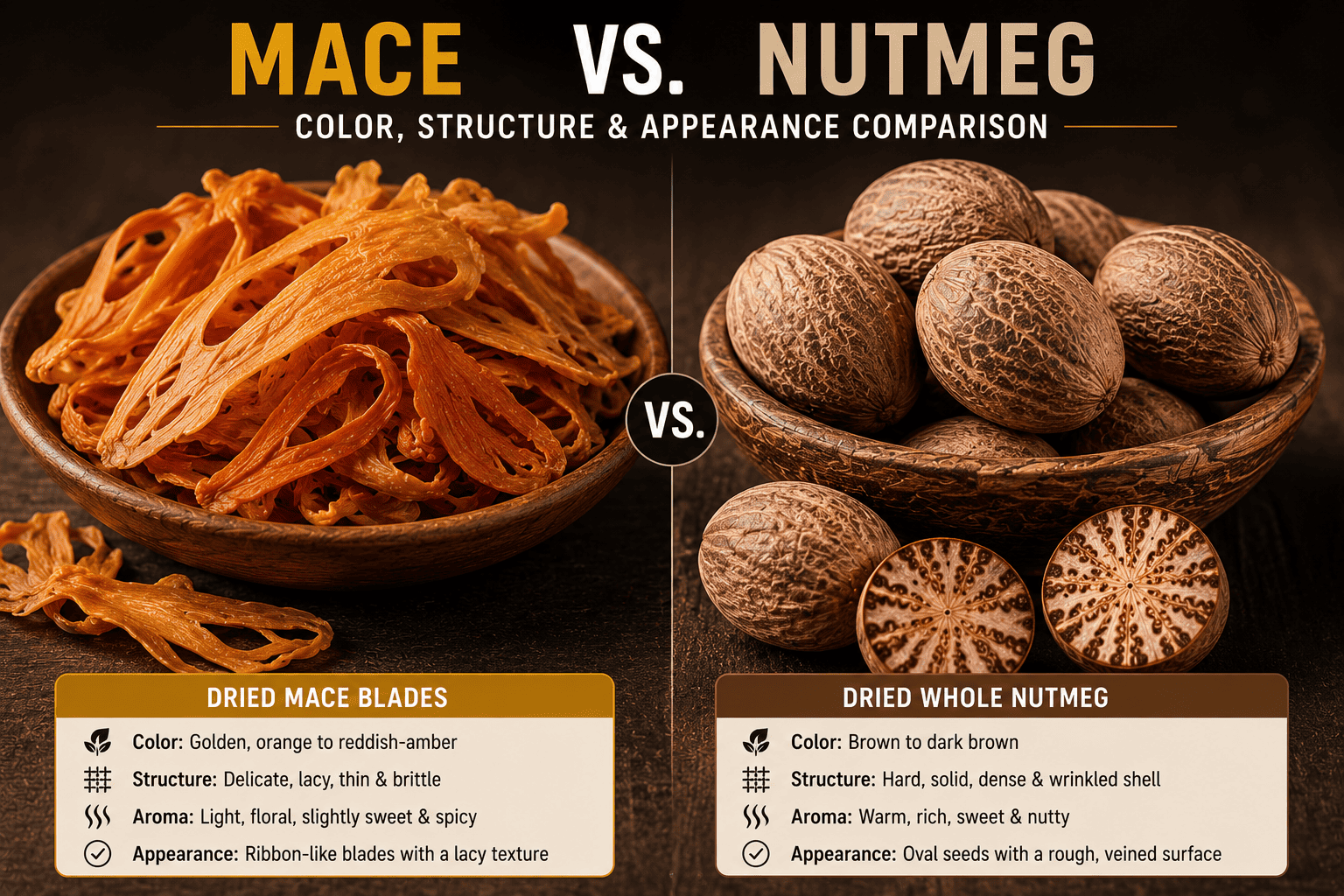
What Makes Mace Drying Different from Other Spice Drying?
In contrast to robust spices such as black pepper or cinnamon, mace requires specialized drying protocols due to its unique structural and chemical characteristics. Consequently, standard drying approaches used for other commodities are rarely suitable.
Mace-specific drying challenges:
– Delicate physical structure: Firstly, mace blades are thin, brittle, and prone to shattering during processing
– High oil content vulnerability: Secondly, volatile oils begin evaporating at temperatures exceeding 65°C
– Enzymatic browning risk: Thirdly, improper drying triggers undesirable color changes from golden-amber to dark brown
– Moisture gradient sensitivity: Additionally, uneven drying creates localized moisture pockets promoting microbial growth
– Yield preservation: Finally, improper drying can reduce marketable yield by 15-25% due to breakage and quality downgrading
Therefore, selecting the appropriate drying method is not merely a processing preference—it is a strategic decision directly impacting product quality, compliance, and procurement value.
How Does Traditional Sun-Drying Preserve Mace Volatile Oils?
Historically, sun-drying is the traditional Indonesian method for processing mace, practiced for centuries in the Banda Islands and other spice-growing regions. Despite technological advances, sun-drying remains the preferred method for certain premium applications.
Sun-Drying Process: Step by Step
In practice, the traditional sun-drying process follows precise steps refined over generations:
- Harvesting: First, fresh mace is separated from nutmeg seeds immediately after fruit splitting
- Spreading: Next, mace blades are spread in single layers on bamboo trays or clean raised beds
- Exposure: Then, trays are placed under direct sunlight during peak hours (8:00 AM to 4:00 PM)
- Rotation: Subsequently, blades are turned every 2-3 hours to ensure uniform drying
- Night covering: After that, trays are covered or moved indoors overnight to prevent moisture reabsorption
- Duration: Overall, complete drying requires 10-14 days depending on weather conditions
- Sorting: Finally, dried blades are sorted by color, integrity, and moisture content
Duration: 10-14 days of sun exposure (weather-dependent)
Volatile oil retention: 85-92% of original volatile oil preserved
Final moisture content: 8-14% (variable)
Quality Indicators of Sun-Dried Mace
Additionally, sun-dried mace exhibits distinctive quality characteristics valued by certain market segments:
| Quality Parameter | Sun-Dried Mace | Buyer Implication |
|---|---|---|
| Color | Golden-amber to light orange | Preferred by artisanal and specialty buyers |
| Texture | Flexible yet brittle | Easier to grind but higher breakage in transport |
| Aroma | Complex, layered, fully developed | Preferred for premium culinary applications |
| Oil retention | 85-92% | Suitable for most food and some pharmaceutical uses |
| Moisture consistency | Variable (8-14%) | Risk of non-compliance with EU/FDA moisture limits |
Advantages of Sun-Drying for B2B Buyers
- Minimal energy costs: Moreover, no mechanical energy input required, reducing processing costs by $2-5/kg compared to mechanical drying
- Artisanal market positioning: Additionally, sun-dried mace commands 15-25% premium in specialty food and organic markets
- Organic certification compatibility: Furthermore, sun-drying aligns with organic processing requirements under most certification bodies
- Complex flavor development: Finally, slow drying allows enzymatic flavor development producing nuanced aromatic profiles
Disadvantages of Sun-Drying for B2B Buyers
- Weather dependency: However, monsoon season (October-April) causes significant drying delays and quality variability
- Inconsistent moisture: Furthermore, final moisture varies from 8-14% vs. target <10%, increasing mold risk during sea freight
- Higher microbial load: Consequently, open-air exposure increases total plate count and potential pathogen contamination
- Larger footprint: Meanwhile, requires extensive drying yard space (approximately 10m² per 100kg fresh mace)
- Labor intensive: Lastly, requires constant monitoring, turning, and weather-responsive handling
What Is Mechanical Drying and How Does It Preserve Mace Quality?
In contrast, mechanical drying (also called hot-air drying or forced-air drying) uses temperature-controlled equipment to remove moisture from mace blades under precisely regulated conditions. In particular, this method addresses the limitations of sun-drying while introducing its own considerations for B2B buyers.
Mechanical Drying Process: Step by Step
Generally, the mechanical drying process follows controlled parameters to optimize volatile oil retention:
- Pre-cleaning: First, fresh mace is inspected and cleaned of foreign matter
- Loading: Next, blades are loaded into drying trays at 5-8 kg/m² density
- Temperature setting: Then, air temperature is maintained at 50-65°C (optimal range)
- Airflow regulation: Subsequently, cross-flow air circulation at 0.5-2.0 m/s ensures uniform drying
- Moisture monitoring: Meanwhile, in-line moisture sensors track progress to target <8%
- Cool-down: After drying, mace is cooled gradually to ambient temperature before packaging
- Immediate sealing: Finally, vacuum-sealed packaging locks in preserved volatile oils
Duration: 24-48 hours
Volatile oil retention: 78-88% of original volatile oil preserved
Final moisture content: <8% (consistent, controllable)
Quality Indicators of Mechanically Dried Mace
Similarly, mechanically dried mace offers distinct quality characteristics suited to industrial applications:
| Quality Parameter | Mechanically Dried Mace | Buyer Implication |
|---|---|---|
| Color | Consistent amber | Uniform appearance for bulk industrial buyers |
| Texture | Predictable brittleness | Consistent grinding behavior in production |
| Aroma | Clean, stable profile | Suitable for standardized product formulations |
| Oil retention | 78-88% | Meets EU minimum volatile oil requirements |
| Moisture consistency | <8% (uniform) | Full compliance with FDA, EU, and ISO standards |
Advantages of Mechanical Drying for B2B Buyers
- Rapid processing: Moreover, 24-48 hours vs. 10-14 days enables faster order fulfillment and higher throughput
- Consistent quality: Additionally, every batch achieves predictable moisture, color, and oil retention specifications
- Regulatory compliance: Accordingly, consistently meets FDA (<12% moisture), EU (<12%), and ISO 22000 standards
- Reduced contamination risk: Furthermore, closed-system processing minimizes microbial and foreign matter exposure
- HACCP compatibility: Meanwhile, documentable temperature and time records satisfy food safety audit requirements
- Year-round production: Finally, independence from weather conditions enables reliable supply scheduling
Disadvantages of Mechanical Drying for B2B Buyers
- Higher energy costs: However, processing costs $2-5/kg above sun-drying due to electricity and equipment maintenance
- Slight oil loss: Moreover, 2-7% additional volatile oil loss compared to optimal sun-drying
- Capital investment: Meanwhile, mechanical dryers require $15,000-50,000 initial investment (reflected in pricing)
- Flavor profile difference: Lastly, some specialty buyers perceive mechanical drying produces less complex flavor
How Do Sun-Dried and Mechanically Dried Mace Compare Head-to-Head?
For quick reference, the following comparison table provides a side-by-side analysis enabling procurement teams to match drying method to application requirements.
| Parameter | Sun-Dried Mace | Mechanically Dried Mace |
|---|---|---|
| Drying duration | 10-14 days | 24-48 hours |
| Volatile oil retention | 85-92% | 78-88% |
| Final moisture content | 8-14% (variable) | <8% (consistent) |
| Color consistency | Variable (golden to amber) | Uniform (amber) |
| Microbial load | Higher (open-air exposure) | Lower (closed system) |
| Energy cost per kg | $0.50-1.00 | $3.00-6.00 |
| Equipment investment | Minimal (bamboo trays) | $15,000-50,000 |
| Weather dependency | High (monsoon delays possible) | None (year-round) |
| Certification fit | Organic, fair-trade | HACCP, ISO 22000 |
| Premium pricing potential | 15-25% above mechanical | Standard market pricing |
| Shelf life | 12-18 months | 18-24 months |
| Best suited for | Artisanal food, specialty retail | Pharma, cosmetic, industrial food |
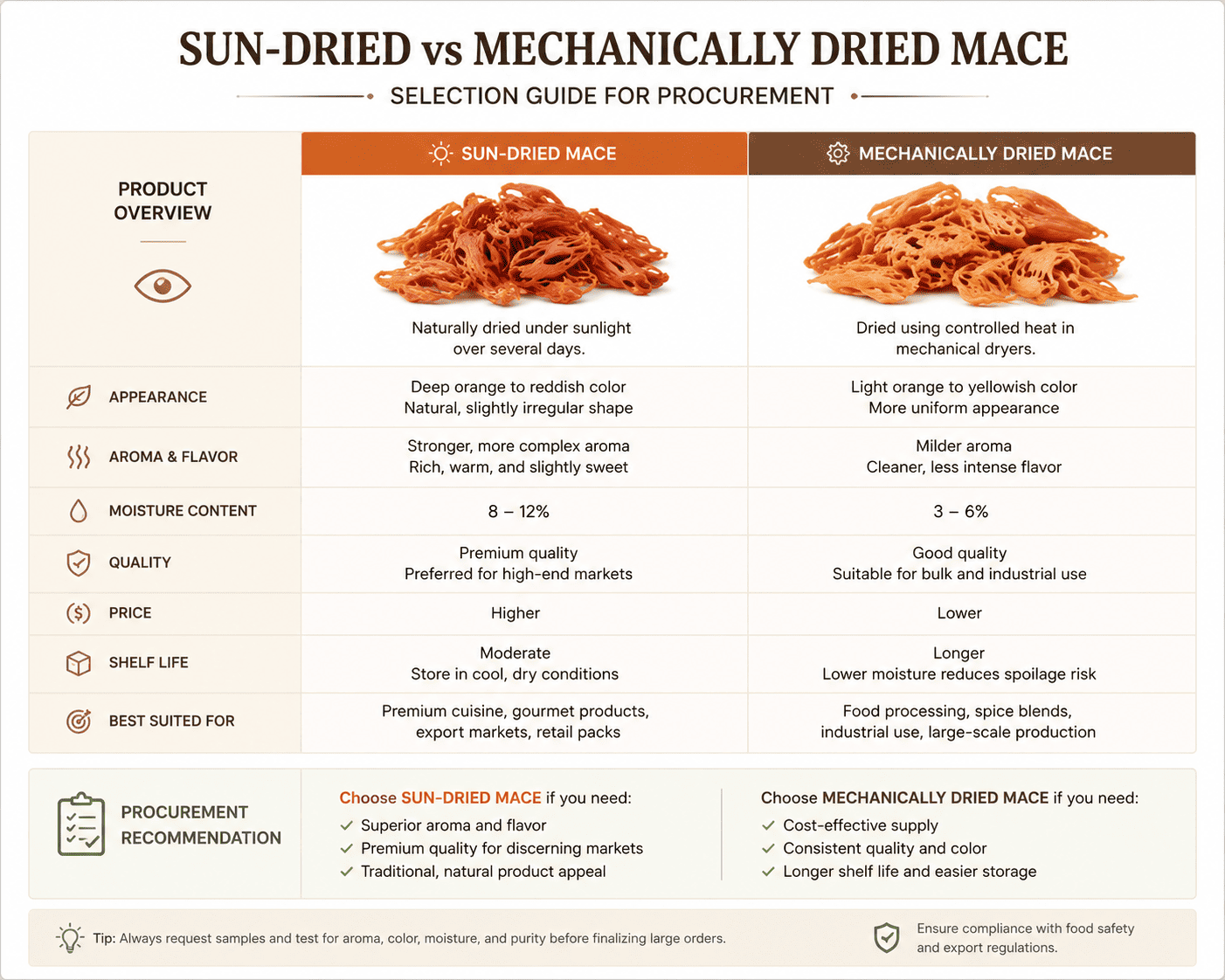
Which Drying Method Should You Choose for Your Application?
Ultimately, the selection between sun-dried and mechanically dried mace depends on your specific production requirements, regulatory environment, and target market positioning. Notably, there is no universally superior method—each offers distinct advantages for different applications.
Choose Sun-Dried Mace When:
- Organic certification: Firstly, if your production requires organic or fair-trade certification requiring traditional processing
- Artisanal positioning: Secondly, if your target market values artisanal quality and differentiated flavor profiles
- Variable moisture tolerance: Thirdly, if your supply chain can accommodate variable moisture content with additional testing
- Premium markets: Additionally, if you serve premium culinary or specialty food markets commanding 15-25% price premiums
- Advance planning: Finally, if your order volume allows for advance planning accommodating weather-related delays
Choose Mechanically Dried Mace When:
- Consistent specifications: Firstly, if your production requires consistent batch-to-batch specifications for standardized formulations
- Regulatory compliance: Secondly, if your regulatory compliance demands documented temperature control (pharmaceutical, EU-market)
- Sea freight logistics: Thirdly, if your logistics involve long-distance sea freight requiring stable <8% moisture
- Oil content predictability: Moreover, if your quality assurance protocol requires predictable oil content for extraction processes
- Year-round scheduling: Finally, if your supply chain demands reliable year-round scheduling independent of weather
Application-Specific Recommendations
For instance, the following recommendations match drying methods to common B2B applications:
| Application | Recommended Method | Rationale |
|---|---|---|
| Pharmaceutical formulations | Mechanically dried | Consistent oil content, documented HACCP compliance |
| Premium bakery products | Sun-dried | Complex flavor profile, organic positioning |
| Cosmetic essential oil extraction | Mechanically dried | Predictable yield, low microbial load |
| Specialty spice blends | Sun-dried | Differentiated quality, premium marketing |
| Industrial sauce manufacturing | Mechanically dried | Uniform specs, reliable supply, cost efficiency |
| Organic-certified products | Sun-dried | Compliance with organic processing standards |
How Can B2B Buyers Verify Mace Quality After Drying?
Accordingly, QA managers and procurement professionals should implement verification protocols to confirm drying quality upon receipt. Consequently, establishing systematic testing ensures consistent supply quality.
Visual Inspection Checklist:
– Color: Firstly, color should be golden-amber to light orange (sun-dried) or consistent amber (mechanical)
– Damage: Secondly, no dark brown or black patches indicating overheating or enzymatic damage
– Integrity: Thirdly, blades should be intact with minimal shattering (<5% fines by weight)
– Contamination: Additionally, no visible mold, insect fragments, or foreign matter
– Uniformity: Finally, consistent blade size within shipment (indicates uniform drying)
Laboratory Testing Protocol:
First, verify moisture content (Karl Fischer titration per ISO 939):
– Sun-dried target: <12% (verify supplier consistency)
– Mechanical target: <8% (full compliance)
Then, test volatile oil content (GC-MS per ISO 11050):
– Minimum acceptable: 7.0% for EU compliance
– Premium grade: 10-15% (indicates optimal drying)
Next, assess color measurement (CIE Lab colorimetry):
– Establish baseline Lab* values for your approved supplier
– Reject shipments exceeding ±2 Delta-E variation
Additionally, conduct microbial testing:
– Total plate count: <10⁴ CFU/g
– Yeast/mold: <10³ CFU/g
– Pathogens: Negative for Salmonella, E. coli
Finally, check shell fragment content:
– Acceptable maximum: 2% by weight
– Excessive shell indicates poor mace-nutmeg separation
Cost estimate: Comprehensive quality testing approximately $150-250 per shipment. Nevertheless, this investment is justified by preventing production disruptions and ensuring regulatory compliance.
Furthermore, establishing a consistent testing protocol with your supplier reduces long-term risk and builds trust through documented quality history.
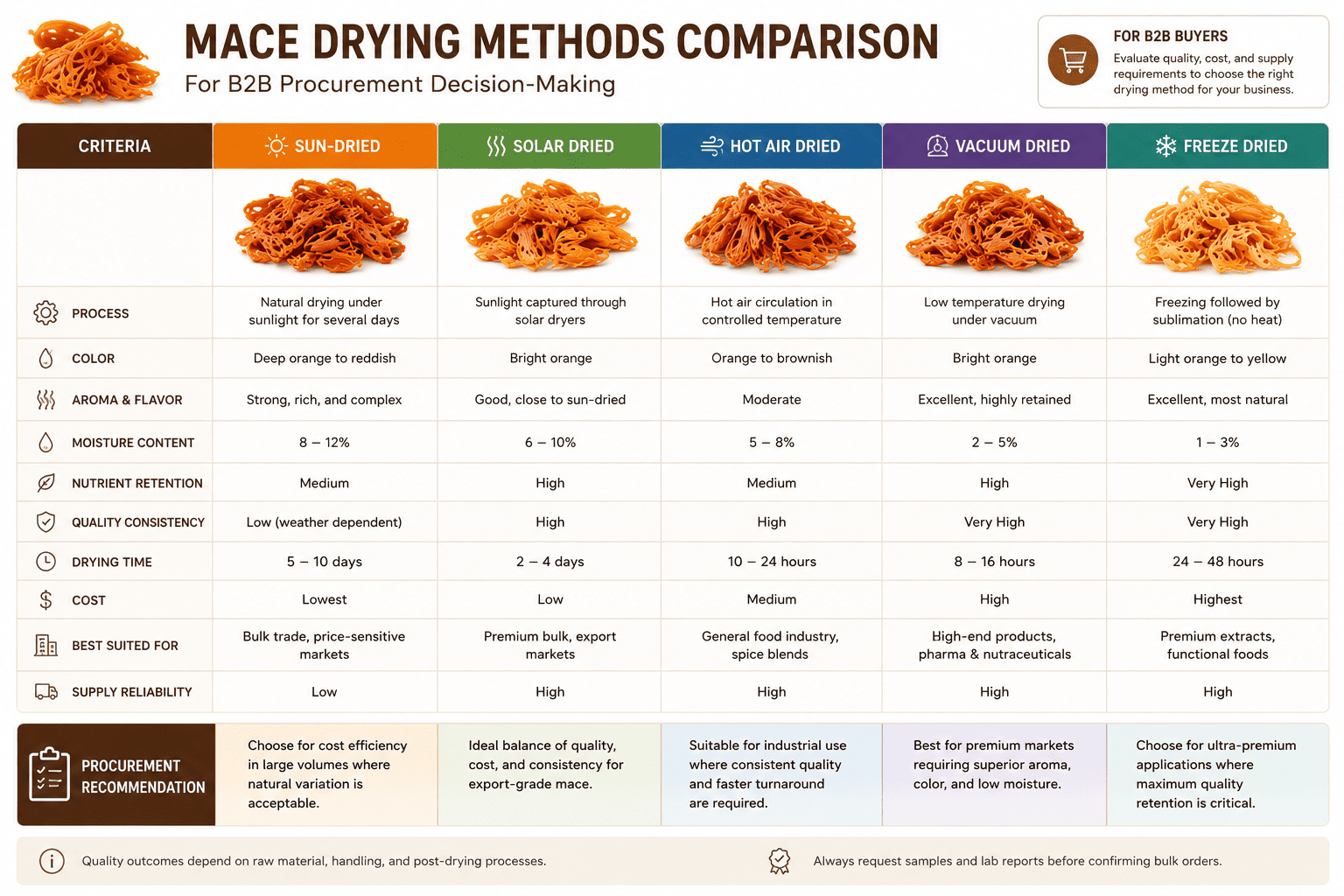
Frequently Asked Questions About Mace Drying Methods
What is the difference between sun-dried and mechanically dried mace?
Specifically, sun-dried mace is processed under direct sunlight over 10-14 days, preserving 85-92% of volatile oils but resulting in variable moisture content (8-14%). In contrast, mechanically dried mace is processed in temperature-controlled equipment over 24-48 hours, achieving consistent <8% moisture but slightly lower oil retention (78-88%).
Which drying method retains more volatile oil in mace?
Clearly, sun-drying retains more volatile oil (85-92%) compared to mechanical drying (78-88%). However, the 2-7% additional oil loss in mechanical drying is offset by consistent moisture content, lower microbial load, and full regulatory compliance—factors often more critical for industrial B2B applications.
Is sun-dried mace better than mechanically dried mace for food manufacturing?
In brief, the answer depends on your specific application. Specifically, sun-dried mace is preferable for premium culinary products and organic-certified formulations. On the other hand, mechanically dried mace is superior for industrial food manufacturing requiring consistent batch specifications, HACCP compliance, and reliable year-round supply.
What moisture content should mace have for bulk export?
Typically, mechanically dried mace achieves <8% moisture content, ensuring compliance with FDA (<12%), EU (<12%), and bulk shipping standards for sea freight. Sun-dried mace varies between 8-14%, requiring additional verification before container loading.
How does drying method affect mace pricing?
In addition, sun-dried mace typically commands a 15-25% premium in specialty and organic markets due to its traditional processing and complex flavor profile. Mechanically dried mace follows standard market pricing, with the added cost of mechanical processing ($2-5/kg) offset by reduced labor requirements and higher throughput.
Conclusion: Matching Drying Method to Procurement Strategy
In summary, the choice between sun-dried and mechanically dried mace represents a strategic procurement decision rather than a simple quality preference. Specifically, each method delivers distinct advantages aligned with specific production requirements, regulatory environments, and market positioning.
Key takeaways for procurement teams:
- For pharmaceutical and cosmetic applications: Firstly, mechanically dried mace provides consistent specifications, documented HACCP compliance, and <8% moisture content essential for long-term stability
- For premium food and specialty retail: Secondly, sun-dried mace offers differentiated quality, complex flavor profiles, and organic certification compatibility commanding 15-25% price premiums
- For cost-sensitive bulk applications: Thirdly, mechanically dried mace delivers consistent quality with predictable pricing and reliable year-round supply
- For dual-certification requirements: Finally, sun-dried mace aligns with organic standards while mechanical drying supports HACCP documentation—choose based on your primary certification target
As a result, working with an experienced Indonesian mace exporter who offers both drying methods enables procurement teams to select the optimal processing approach for each specific application. Furthermore, this flexibility—combined with direct sourcing advantages—creates significant value for B2B buyers seeking to optimize quality, compliance, and cost across their supply chain.
Source Premium Mace for Your Production Line
For procurement teams ready to evaluate sun-dried or mechanically dried mace for your specific applications, Bhavana Spice offers both processing options with full quality documentation and batch traceability. Moreover, our direct-source model from volcanic soil estates in the Banda Islands ensures competitive pricing, consistent quality, and compliance with international standards.
For your convenience, to request detailed product specifications, discuss drying method options for your application, or arrange for physical evaluation samples:
- Email: [email protected] (Technical specifications dispatched within 24 business hours)
- WhatsApp B2B Helpline: +62 822-3332-2034 (Direct procurement consultations and stock availability)
- Head Office & Export Coordination:
Modinan RT 007/RW 021, Banyuraden, Gamping, Sleman, DIY – Indonesia
Finally, our QA team is ready to provide moisture analysis certificates, gas chromatography profiles, and physical evaluation samples to your manufacturing facility worldwide.