
How to Vet an Indonesian Spice Exporter: Checklist for Procurement Teams
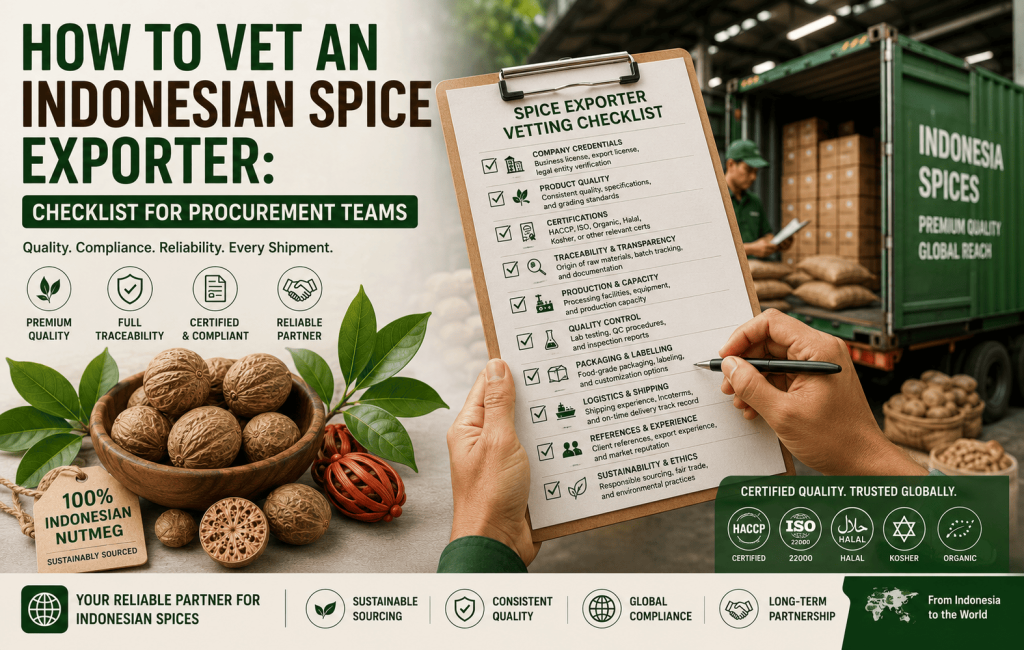
How to Vet an Indonesian Spice Exporter: Checklist for Procurement Teams
For B2B procurement teams, knowing how to vet an Indonesian spice exporter thoroughly is essential before committing to long-term supply contracts. Specifically, thorough due diligence reduces the risk of quality issues, regulatory non-compliance, and supply disruptions. Consequently, this checklist provides a structured approach to evaluating potential Indonesian spice exporters. For broader regulatory context, see our FDA and EU compliance guide for nutmeg and mace importation.
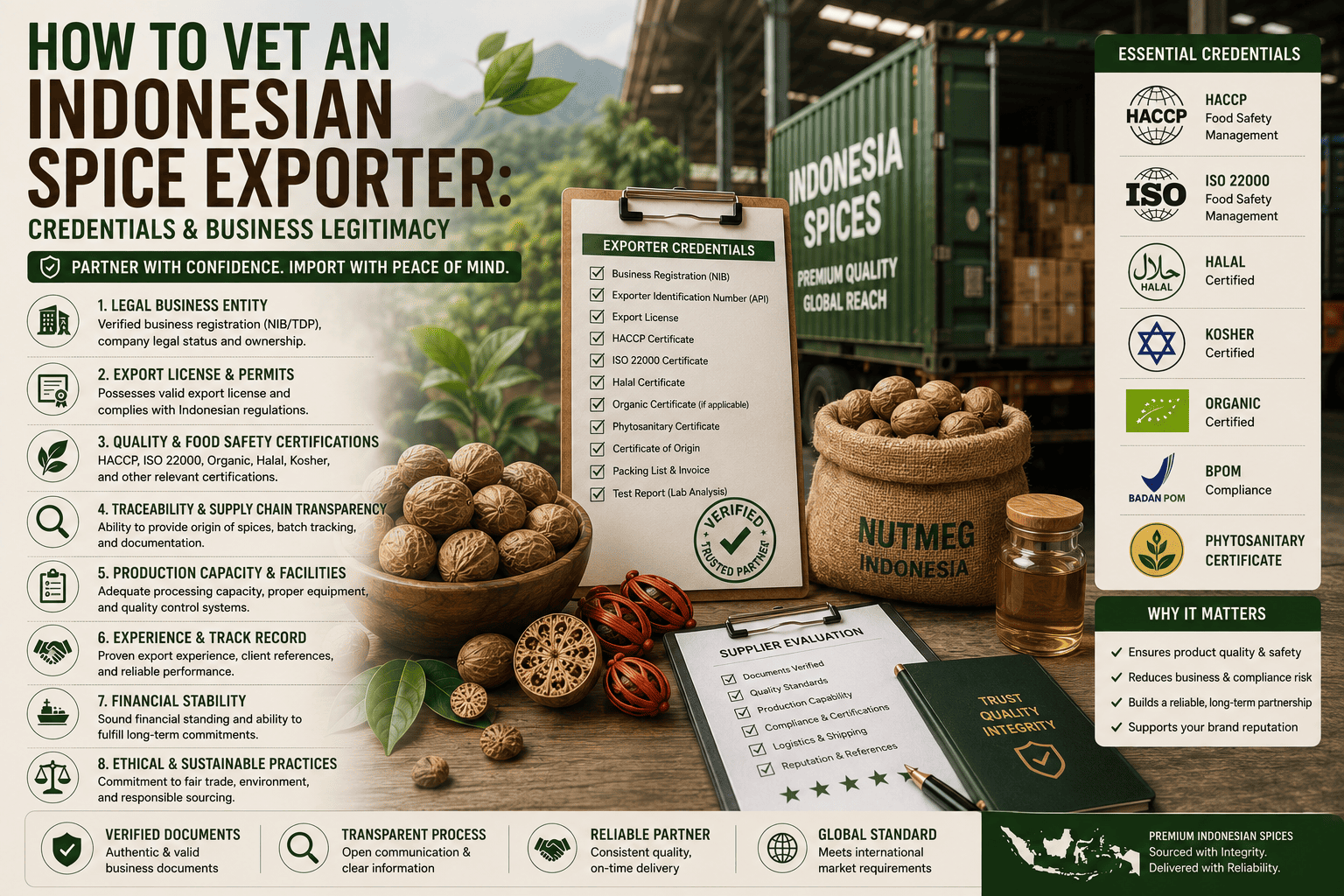
How to Vet an Indonesian Spice Exporter: Credentials and Business Legitimacy
Firstly, verify the exporter’s legal status and business credentials. Consequently, this step ensures you are dealing with a legitimate entity:
| Document | What to Verify | Why It Matters |
|---|---|---|
| Company registration (Akta Pendirian) | Legal name, notary number, also article of association | Confirms legal existence, therefore non-negotiable |
| Business license (SIUP/NIB) | Validity date and business scope including spice export | Operating authority, as well as legal compliance |
| Exporter registration (API-U/Angka Pengenal Ekspor) | Valid API-U number including product categories | Legal export capacity, thus a primary requirement |
| Tax ID (NPWP) | Company tax registration status | Tax compliance, particularly for contract validity |
| Customs ID (NIK/NPPBKC) | Customs registration for export clearance | Smooth customs processing, for example faster shipments |
Therefore, request copies of these documents and verify expiration dates before proceeding further.
Vetting Quality Management Systems for Spice Exporters
Furthermore, assess the exporter’s quality management infrastructure. In particular, certified systems demonstrate commitment to consistent quality:
Required Certifications
| Certification | Relevance | Verification Method |
|---|---|---|
| ISO 22000 or FSSC 22000 | Food safety management system, therefore critical | Request current certificate |
| HACCP certification | Hazard analysis and critical control points | Audit report review, including corrective actions |
| GMP (Good Manufacturing Practice) | Facility and process standards | On-site inspection report, also third-party audits |
| Organic certification (if claimed) | USDA Organic, EU Organic, or equivalent | Certificate validity check, for example online verification |
| Halal certification | BPJPH/MUI certificate, specifically for Muslim markets | Online verification with BPJPH |
Notably, certifications should be current and cover the specific products you intend to purchase. The ISO 22000 resource center offers guidance on food safety certification requirements.
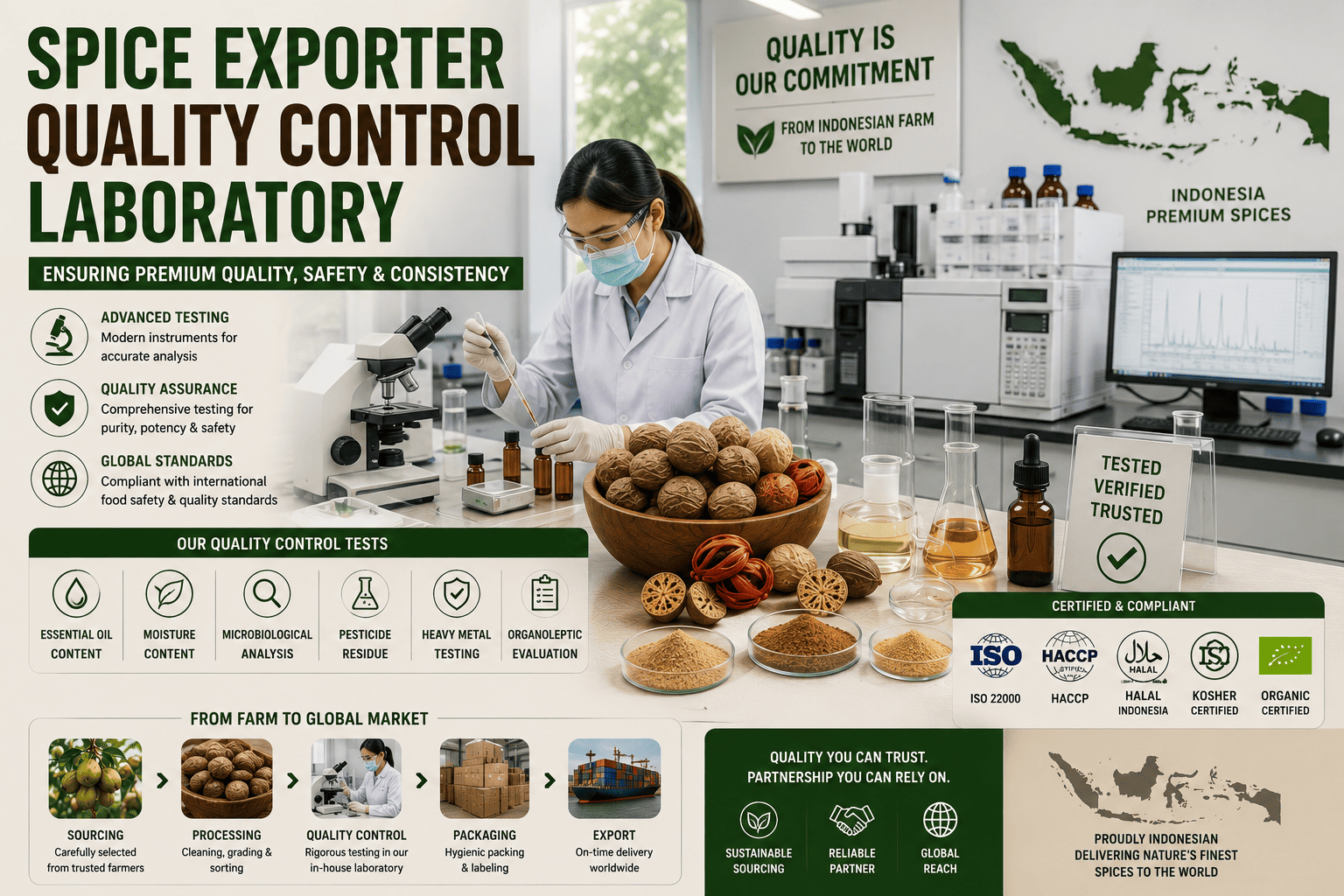
Due Diligence for Product Quality and Consistency
Additionally, evaluate the exporter’s product quality track record. Specifically, request the following:
- First, Certificate of Analysis (COA) for the last 3–5 shipments to different buyers
- Next, third-party lab test results covering aflatoxins, pesticide residues, and microbiology
- Also, moisture content records including variability across shipments
- In addition, grade consistency data such as percentage of Grade A versus Grade B in each shipment
- Finally, customer feedback or quality scorecards from existing buyers
Similarly, ask for reference samples from current production and arrange independent lab testing to verify the exporter’s claimed specifications.
Exporter Due Diligence for Traceability and Supply Chain Transparency
Moreover, traceability is increasingly mandatory for regulatory compliance. Therefore, verify that the exporter can:
- First, provide batch-level traceability from farm to container, including lot numbers
- Next, supply geolocation data for source farms such as GPS coordinates for EUDR compliance
- Additionally, maintain lot numbers that link farmer records to specific shipments, thereby enabling recall
- Furthermore, share chain of custody documentation for each batch, for example invoices and transfer records
- Lastly, demonstrate recall capability through documented simulation records including test results
Consequently, exporters with digital traceability systems offer significantly lower supply chain risk.
Supplier Audit Checklist: Export Documentation Capability
Similarly, proper export documentation is critical for smooth customs clearance in both Indonesia and the destination country. Verify the exporter’s capability to produce:
| Document | Purpose | Common Issues to Check |
|---|---|---|
| Packing list | Shipping verification, including weight confirmation | Inconsistent weights or counts, therefore flag discrepancies |
| Certificate of Origin (COO) | Tariff preference as well as origin proof | Incorrect HS code, for example wrong tariff classification |
| Phytosanitary certificate | Plant health compliance, particularly for EU | Expired treatment records, such as outdated fumigation |
| Bill of Lading (B/L) | Title of goods, also transport contract | Incorrect consignee details; consequently clearance delays |
| Certificate of Analysis (COA) | Quality verification, including spec confirmation | Missing batch reference, specifically no lot link |
| Fumigation certificate | Pest control, especially for wooden pallets | Outdated certificate, for example beyond validity period |
Therefore, request sample documents from recent shipments and verify them with relevant authorities before contracting.
Spice Supplier Evaluation: Financial Stability and Contract Terms
Furthermore, assess the exporter’s financial health and contract reliability:
- First, request bank references or trade credit reports, including trade references
- Next, verify confirmed letters of credit (L/C) history with previous buyers, as well as dispute records
- In addition, review payment terms offered such as T/T, L/C, DP and check flexibility
- Also, check the exporter’s track record for on-time delivery, for example shipping records over 12 months
- Finally, confirm minimum order quantities (MOQ) and lead times, specifically for your product grades
Typically, established exporters will have verifiable trade finance relationships and clear contract terms.
Indonesian Spice Exporter Verification: Logistics and Shipping Capability
Additionally, logistics capability affects delivery reliability. Specifically, evaluate:
- First, warehouse capacity and storage conditions including temperature, humidity, and pest control records
- Next, proximity to major ports such as Tanjung Priok, Tanjung Perak, or Belawan for efficient loading
- Additionally, container loading capability as well as fumigation facilities for export compliance
- Furthermore, experience with FOB, CIF, and CNF incoterms, particularly for bulk spice shipments
- Finally, freight forwarding partnerships and shipping frequency, for example weekly consolidation schedules
Consequently, exporters near major ports with modern warehousing offer more reliable shipping.
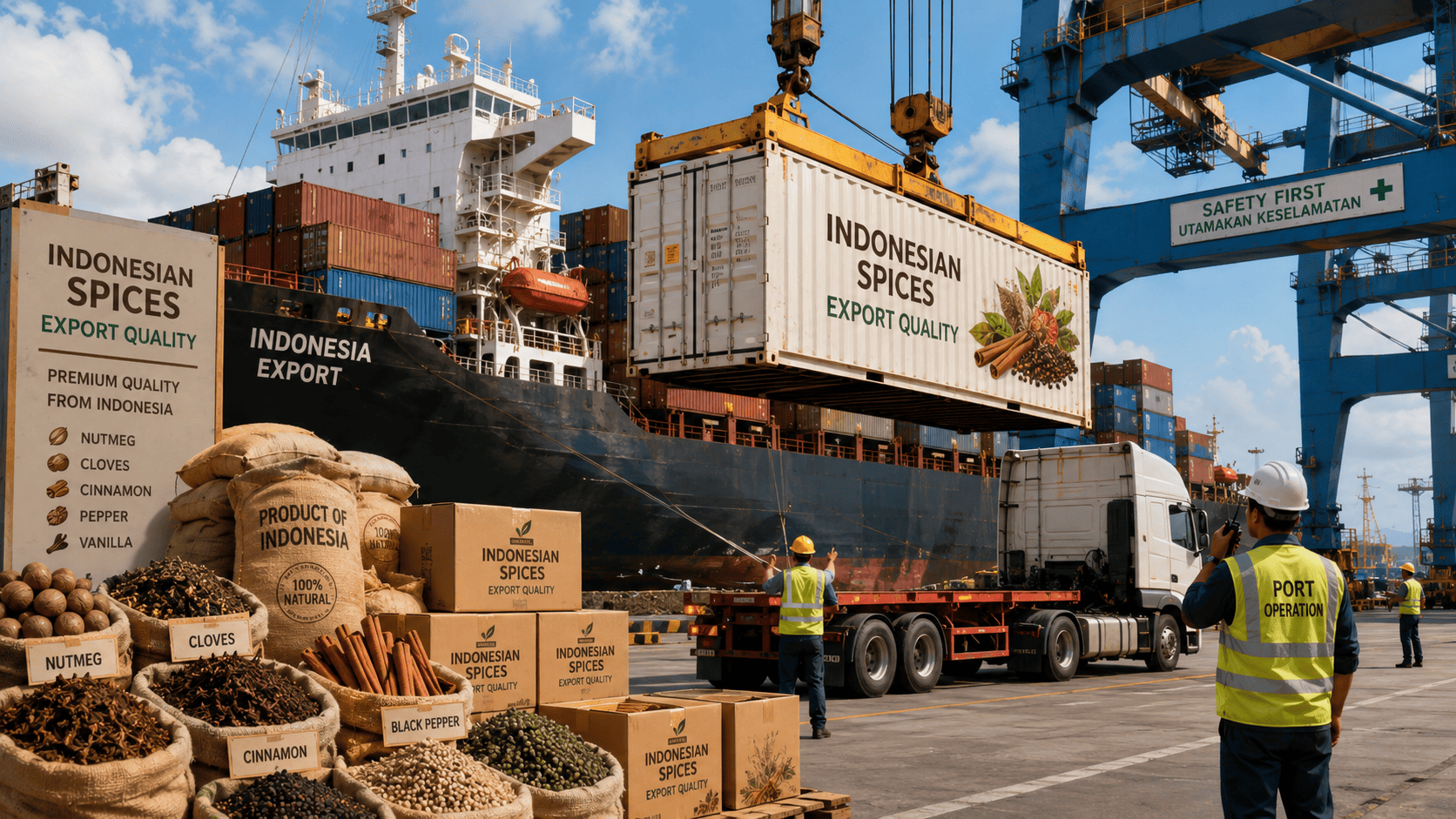
How to Vet an Indonesian Spice Exporter: Final Checklist Summary
In summary, knowing how to vet an Indonesian spice exporter systematically reduces procurement risk. Overall, the due diligence process should cover:
| Category | Key Verification Points | Priority |
|---|---|---|
| Legal credentials | Company registration, also export license and tax ID | High, therefore start here |
| Quality systems | ISO 22000, HACCP as well as GMP certifications | High, particularly for food safety |
| Product quality | COAs, lab tests, furthermore grade consistency | High, specifically for contract compliance |
| Traceability | Batch tracking, geolocation, as well as EUDR readiness | High, consequently non-negotiable |
| Documentation | COO, phytosanitary, B/L and packing list | Medium, but still important |
| Financial stability | Bank references, L/C history, also payment terms | Medium, yet critical for long-term contracts |
| Logistics | Warehouse, port access, including incoterms experience | Medium, however affects delivery reliability |
Consequently, procurement teams who follow this checklist can confidently select reliable Indonesian spice exporters. For more information about our verified export capabilities and quality systems:
Email: [email protected]
WhatsApp B2B Helpline: +62 822-3332-2034
Head Office & Export Coordination: Modinan RT 007/RW 021, Banyuraden, Gamping, Sleman, DIY – Indonesia