
Chemical Profiles of Mace Spice: Key Active Compounds and Volatile Oil Yields
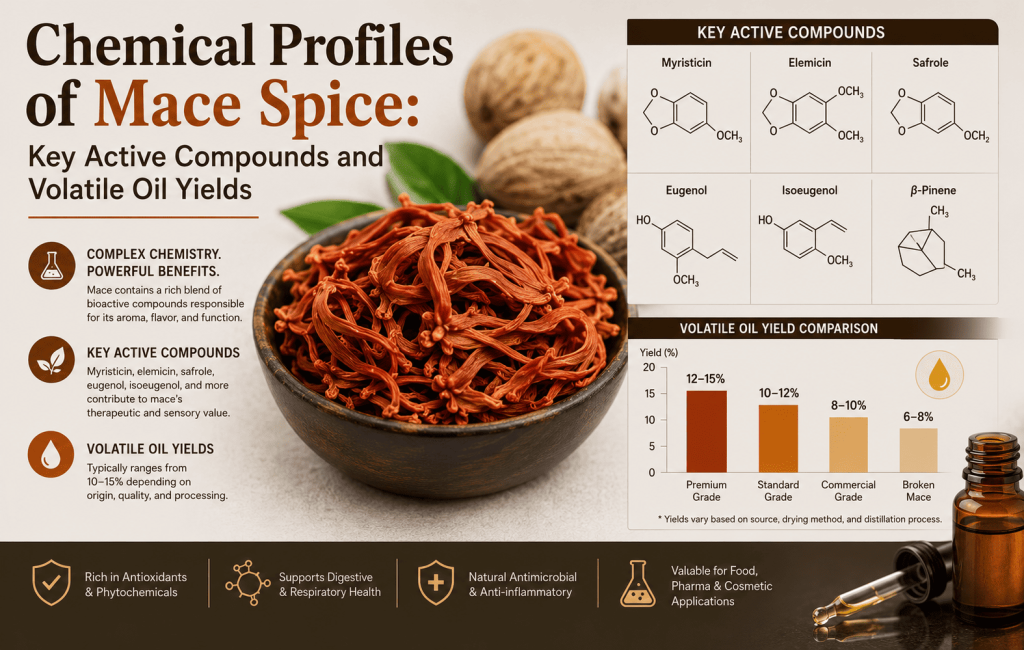
Chemical Profiles of Mace Spice: Key Active Compounds and Volatile Oil Yields
Specifically, for B2B buyers in the food, pharmaceutical, and cosmetic industries, understanding the mace chemical profile is essential for selecting the right grade for specific applications. In particular, mace contains a distinct set of volatile compounds that differ from nutmeg in both composition and concentration. Consequently, knowing these chemical parameters helps procurement teams specify exact requirements to suppliers. Furthermore, for a baseline understanding of mace grades, see our complete guide to mace grades and quality standards.
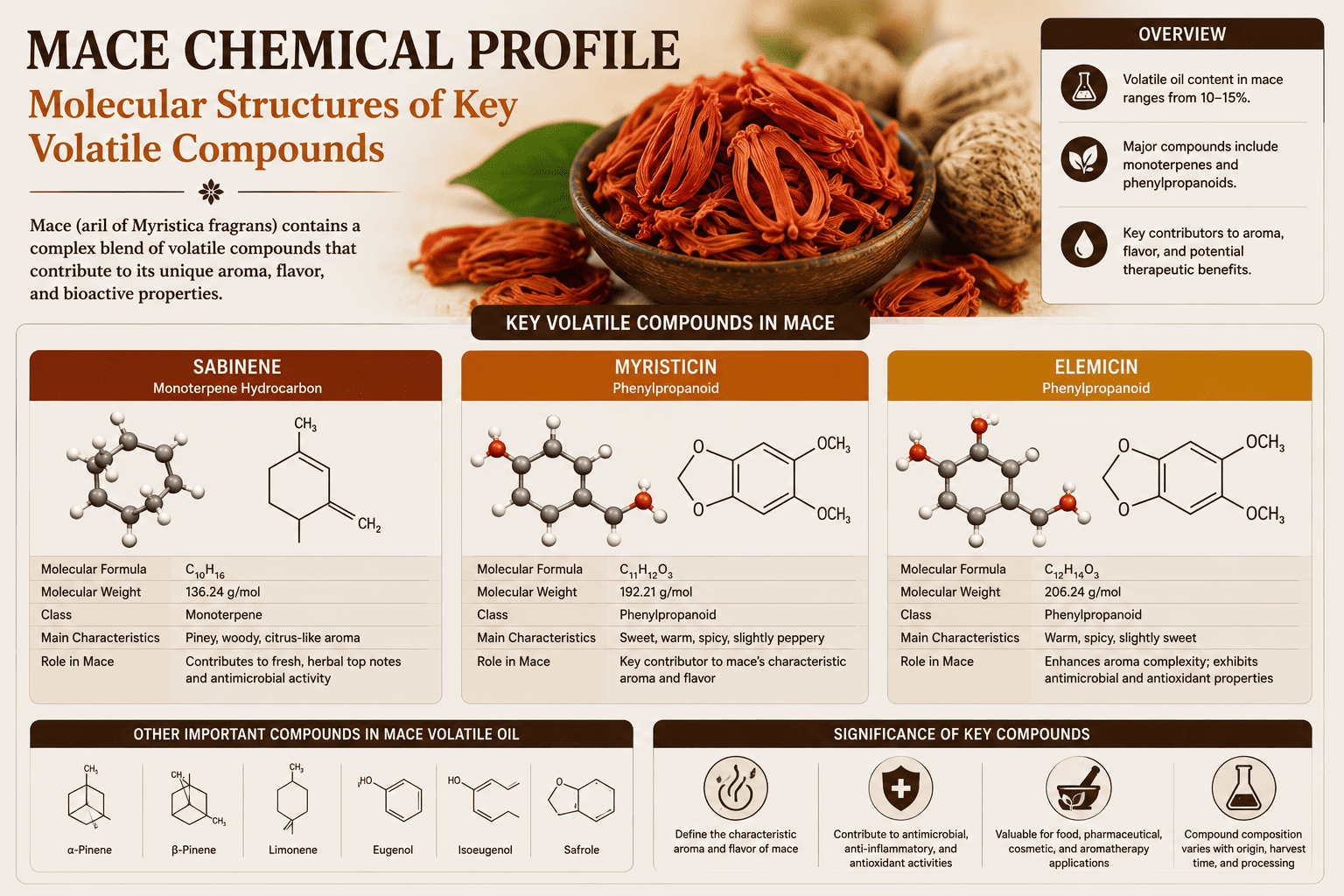
Key Compounds in Mace Chemical Profile
Firstly, the mace chemical profile is dominated by monoterpene hydrocarbons, phenylpropanoids, and oxygenated compounds. Specifically, the primary volatile compounds include:
| Compound | Chemical Class | Typical Percentage | Aroma Characteristic |
|—|—|—|—|—|
| Sabinene | Monoterpene | 16–28% | Notably, woody, spicy, peppery |
| Myristicin | Phenylpropanoid | 8–14% | Warm, nutmeg-like, aromatic |
| Elemicin | Phenylpropanoid | 2–6% | Sweet, clove-like |
| Terpinen-4-ol | Oxygenated monoterpene | 4–8% | Earthy, musty |
| α-Pinene | Monoterpene | 4–7% | Pine, fresh |
| β-Pinene | Monoterpene | 3–6% | Woody, resinous |
| Safrole | Phenylpropanoid | 1–3% | Sweet, sassafras-like |
| γ-Terpinene | Monoterpene | 2–5% | Herbal, citrus |
| Limonene | Monoterpene | 1–3% | Citrus, fresh |
| Linalool | Oxygenated monoterpene | 0.5–2% | Floral, lavender-like |
Overall, sabinene is the most abundant compound in high-quality mace, typically comprising 20–25% of the total volatile oil. Furthermore, myristicin, the compound responsible for mace’s characteristic warm aroma, is the second most abundant.
Mace Chemical Profile: Volatile Oil Yield by Grade
Furthermore, volatile oil yield is a key differentiator across mace grades and directly correlates with purchasing price:
| Mace Grade | Typical Oil Yield | Sabinene Content | Myristicin Content | Relative Value |
|---|---|---|---|---|
| Grade A whole blades | 10–15% | 20–25% | 10–14% | Notably, premium |
| Grade B broken blades | 8–12% | 18–22% | 8–12% | Standard |
| Grade C ground mace | 5–10% | 16–20% | 6–10% | Economy |
| Grade D fines | 2–5% | 10–16% | 4–6% | Consequently, distillation grade |
As a result, Grade A mace commands the highest price because its volatile oil yield is 2–3 times higher than Grade D. The sabinene and myristicin content also decreases significantly in lower grades, affecting both aroma intensity and functional properties.
Mace Chemical Profile vs Nutmeg: A Comparative Analysis
Similarly, understanding the differences between mace and nutmeg chemistry is important for B2B buyers who source both spices:
| Parameter | Mace | Nutmeg |
|---|---|---|
| Total volatile oil | 8–15% | 5–10% |
| Sabinene | 16–28% | 10–20% |
| Myristicin | 8–14% | 5–10% |
| Elemicin | 2–6% | 1–3% |
| α-Pinene | 4–7% | 6–12% |
| β-Pinene | 3–6% | 4–8% |
| Safrole | 1–3% | 0.5–2% |
| Fatty oil content | 20–30% | 30–40% |
For example, mace typically has 30–50% higher volatile oil content than nutmeg, making it more aromatic and flavorful per gram. Additionally, mace contains higher levels of myristicin and elemicin, which contribute to its more complex flavor profile.
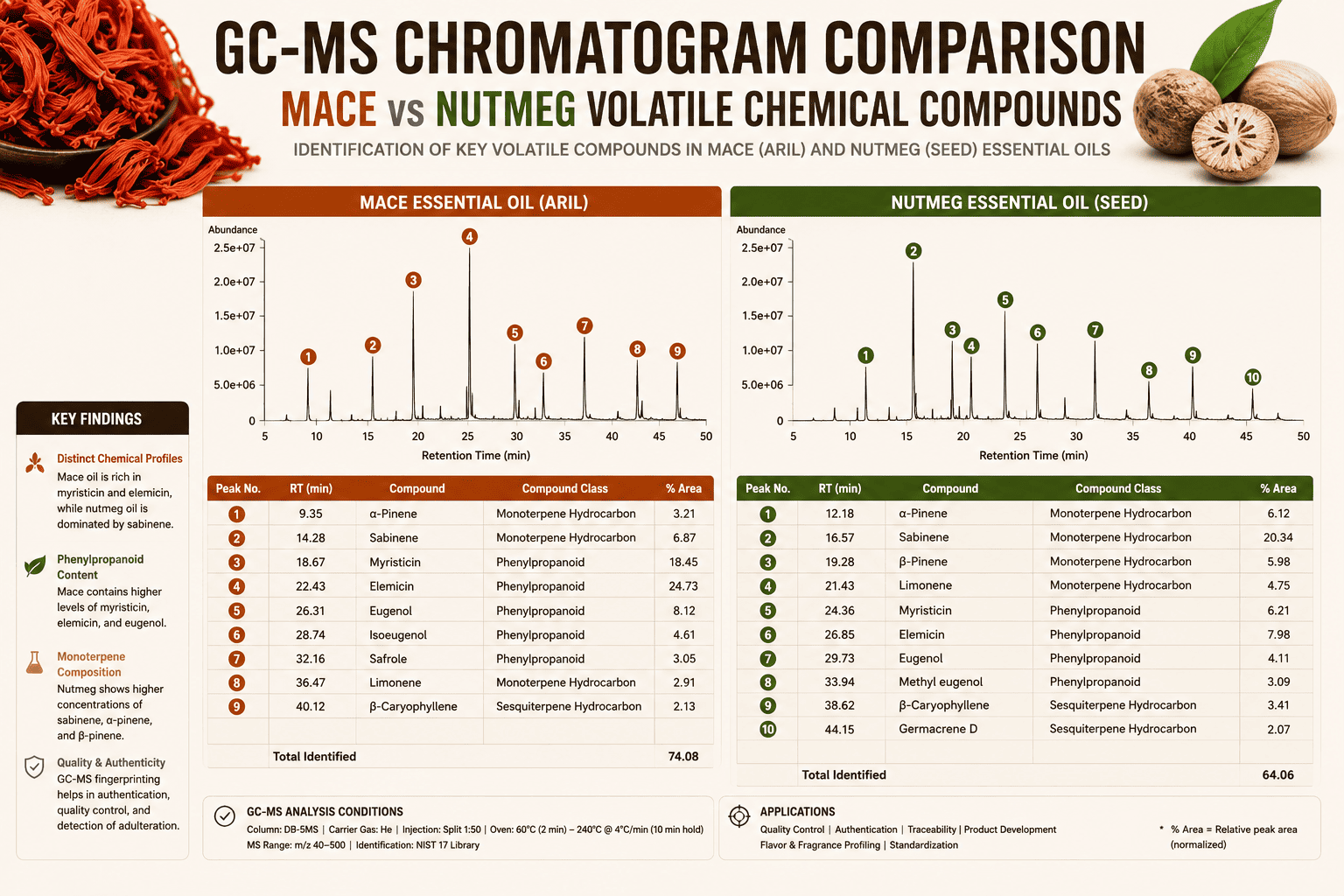
Factors Affecting Mace Chemical Profile
Moreover, the mace chemical profile varies depending on several factors that B2B buyers should be aware of:
Geographic Origin
| Origin | Sabinene Range | Myristicin Range | Characteristic |
|---|---|---|---|
| Indonesia (Banda Islands) | 20–25% | 10–14% | Notably, high sabinene, balanced profile |
| Indonesia (Aceh) | 18–22% | 8–12% | Meanwhile, moderate sabinene, lower myristicin |
| India (Kerala) | 16–20% | 8–10% | Overall, lower volatile oil |
| Grenada | 18–22% | 9–12% | Similarly, comparable to Indonesian origin |
Overall, mace from the Banda Islands, the original source of nutmeg and mace, consistently shows the highest sabinene and total volatile oil content.
Harvest Time and Processing
Additionally, harvest timing significantly impacts the mace chemical profile:
- First, early harvest (4–5 months after flowering): Lower oil yield, higher myristicin relative to sabinene
- Next, optimal harvest (6–7 months): Peak oil yield, balanced sabinene/myristicin ratio
- Finally, late harvest (8–9 months): Declining oil yield, increased fatty oil content
Consequently, for B2B buyers, specifying optimal harvest timing in procurement contracts ensures consistent chemical profiles across shipments.
Drying Method
Furthermore, the drying method affects volatile oil retention:
| Drying Method | Oil Retention | Typical Use |
|---|---|---|
| Sun drying | 70–80% | Traditional, lowest cost |
| Mechanical drying (40°C) | 85–90% | Hence, commercial, consistent quality |
| Freeze drying | 90–95% | Thus, premium, high-value applications |
| Shade drying | 75–85% | Also, traditional, moderate quality |
To summarize, mechanical drying at controlled temperatures below 40°C offers the best balance between cost and oil retention. Meanwhile, sun drying, while economical, can result in significant volatile oil loss.
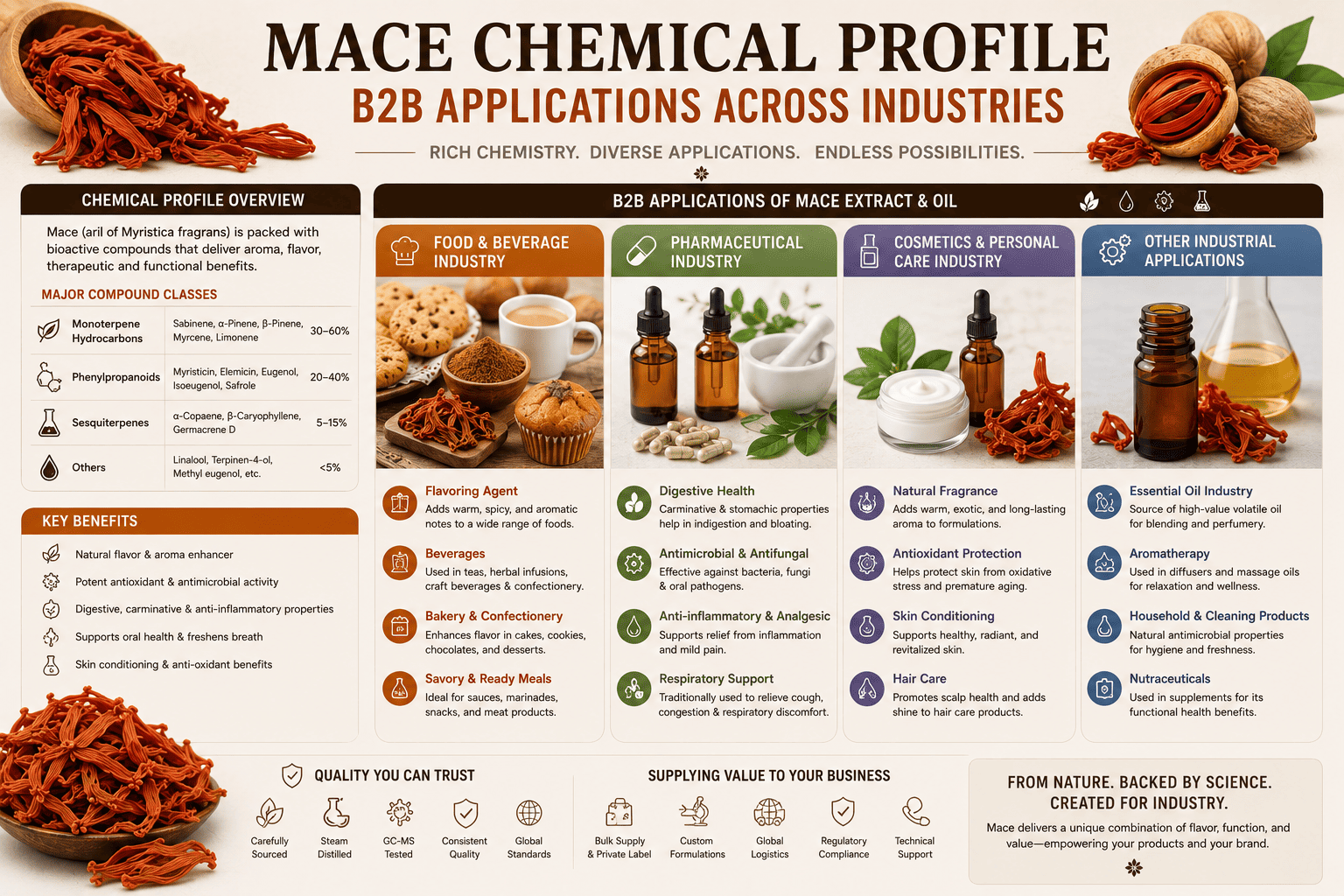
B2B Applications of Mace Chemical Profile
Thus, specific mace chemical profile characteristics determine suitability for different industries:
Food Industry
- For premium applications, whole mace (Grade A): High sabinene and myristicin for premium spice blends, gourmet products
- Meanwhile, ground mace (Grade B–C): Moderate volatile oil for industrial seasoning, bakery, confectionery
- Additionally, mace oleoresin: Extracted volatile oil for processed meat, sauces, ready meals
Pharmaceutical Applications
- First, standardized mace extract: Minimum 10% myristicin for digestive health formulations
- Next, purified sabinene: Antimicrobial applications, natural preservative development
- Finally, mace volatile oil: Capsule formulations for traditional medicine
Cosmetic and Fragrance
- Specifically, mace essential oil: Perfume fixative, warm spicy notes in men’s fragrances
- Also, mace absolute: Premium fragrance compounding, aromatherapy blends
- Similarly, sabinene-rich fraction: Natural fragrance ingredient in luxury cosmetics
Additionally, the FAO guidelines on food chemicals and contaminants provide further reference for mace extract specifications in food applications.
Testing Mace Chemical Profile Quality
In conclusion, verifying the mace chemical profile requires laboratory analysis. Specifically, the standard method is gas chromatography-mass spectrometry (GC-MS), which identifies and quantifies individual volatile compounds.
Recommended Testing Protocol
- GC-MS analysis: Full volatile compound profile with quantification of key marker compounds
- Then, steam distillation: Total volatile oil percentage (USP method)
- Next, moisture content: Karl Fischer titration or oven drying
- After that, heavy metals: ICP-MS for compliance with regulatory limits
- Finally, pesticide residues: Multi-residue screening per EU or FDA requirements
Key Specifications for Purchase Contracts
Therefore, for B2B buyers, the following specifications ensure consistent mace chemical profile:
- First, minimum total volatile oil: As per grade (e.g., 10% for Grade A)
- Second, sabinene content: Minimum 18% of total oil
- Third, myristicin content: Minimum 8% of total oil
- Next, maximum safrole: Below regulatory limits (EU: 1 mg/kg in food)
- Then, moisture content: Maximum 10%
- Finally, GC-MS chromatogram: Provided with each shipment for verification
Finally, for more information about mace sourcing specifications:
Email: [email protected]
WhatsApp B2B Helpline: +62 822-3332-2034
Head Office & Export Coordination: Modinan RT 007/RW 021, Banyuraden, Gamping, Sleman, DIY – Indonesia