
A Guide to Nutmeg Storage: Preventing Quality Degradation in Warehouses
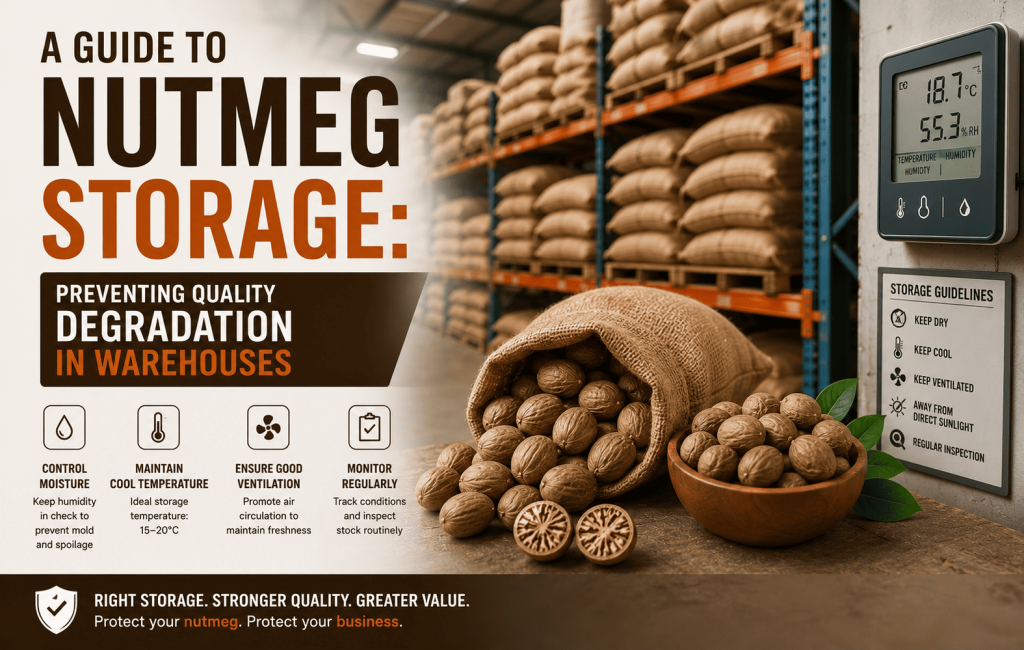
A Guide to Nutmeg Storage: Preventing Quality Degradation in Warehouses
For B2B importers and procurement managers, proper nutmeg storage is one of the most critical factors in preserving product quality from shipment to end-use. Specifically, even the highest-grade nutmeg kernels can degrade rapidly under poor warehouse conditions, resulting in volatile oil loss, mold growth, and aflatoxin contamination. Consequently, understanding the science behind nutmeg storage is essential for protecting your inventory investment. Furthermore, for a baseline understanding of nutmeg quality before storage, see our guide to bulk nutmeg sampling and inspection.
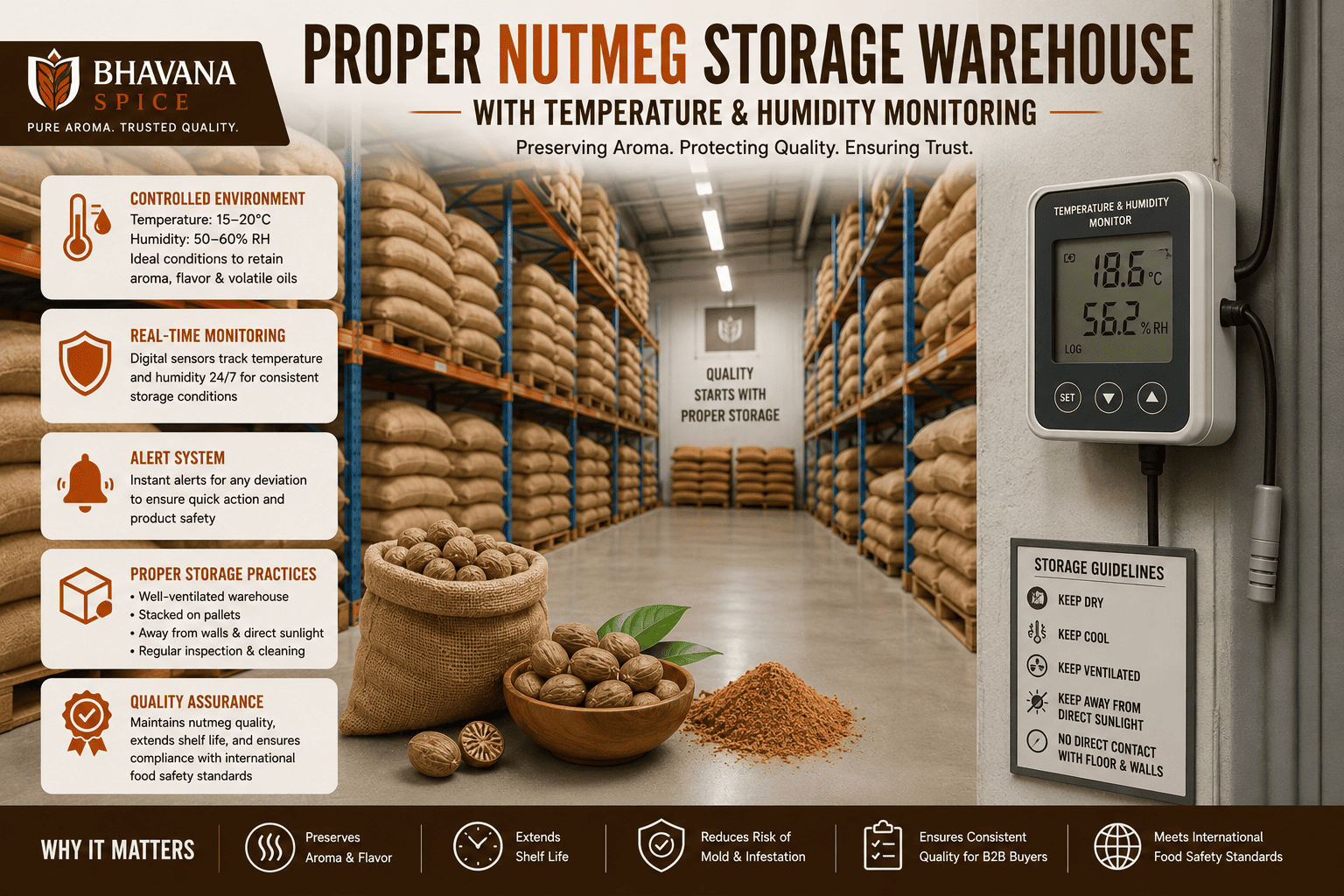
Ideal Nutmeg Storage Conditions
Firstly, maintaining the correct storage environment is the foundation of successful nutmeg storage. However, whole nutmeg kernels and ground nutmeg powder have different sensitivities, but the general principles apply to both forms.
Nutmeg Storage Temperature Requirements
Specifically, temperature control is the single most important factor in nutmeg storage. In general, the recommended temperature range is:
| Storage Form | Optimal Temperature | Maximum Acceptable | Effect of Exceeding |
|---|---|---|---|
| Whole nutmeg kernels | 15–22°C | 25°C | Accelerated volatile oil evaporation above 25°C |
| Ground nutmeg powder | 10–20°C | 22°C | Rapid oxidation and flavor loss above 22°C |
| Nutmeg essential oil | 5–15°C | 20°C | Chemical composition changes above 20°C |
For instance, for every 10°C increase above the optimal range, the rate of volatile oil loss approximately doubles. In fact, this temperature effect, known as the Q10 rule in food science, means that nutmeg stored at 35°C degrades roughly four times faster than nutmeg stored at 25°C.
Humidity Control for Nutmeg Storage
Furthermore, relative humidity (RH) directly affects mold growth and aflatoxin risk in nutmeg storage. In fact, nutmeg kernels have a natural moisture content of 6–8%, and maintaining this range is critical.
| Parameter | Whole Nutmeg | Ground Nutmeg |
|---|---|---|
| Optimal RH range | 55–65% | 50–60% |
| Maximum RH | 70% | 65% |
| Critical moisture content | Above 10% triggers mold risk | Above 8% triggers caking and mold |
| Condensation risk | Below 50% causes kernel cracking | Below 45% causes static and dust |
In practice, warehouses in tropical climates require dehumidification systems during wet seasons. Meanwhile, in temperate climates, monitoring during winter months when cold storage meets warm outdoor air is equally important to prevent condensation inside packaging.
Packaging Solutions for Nutmeg Storage
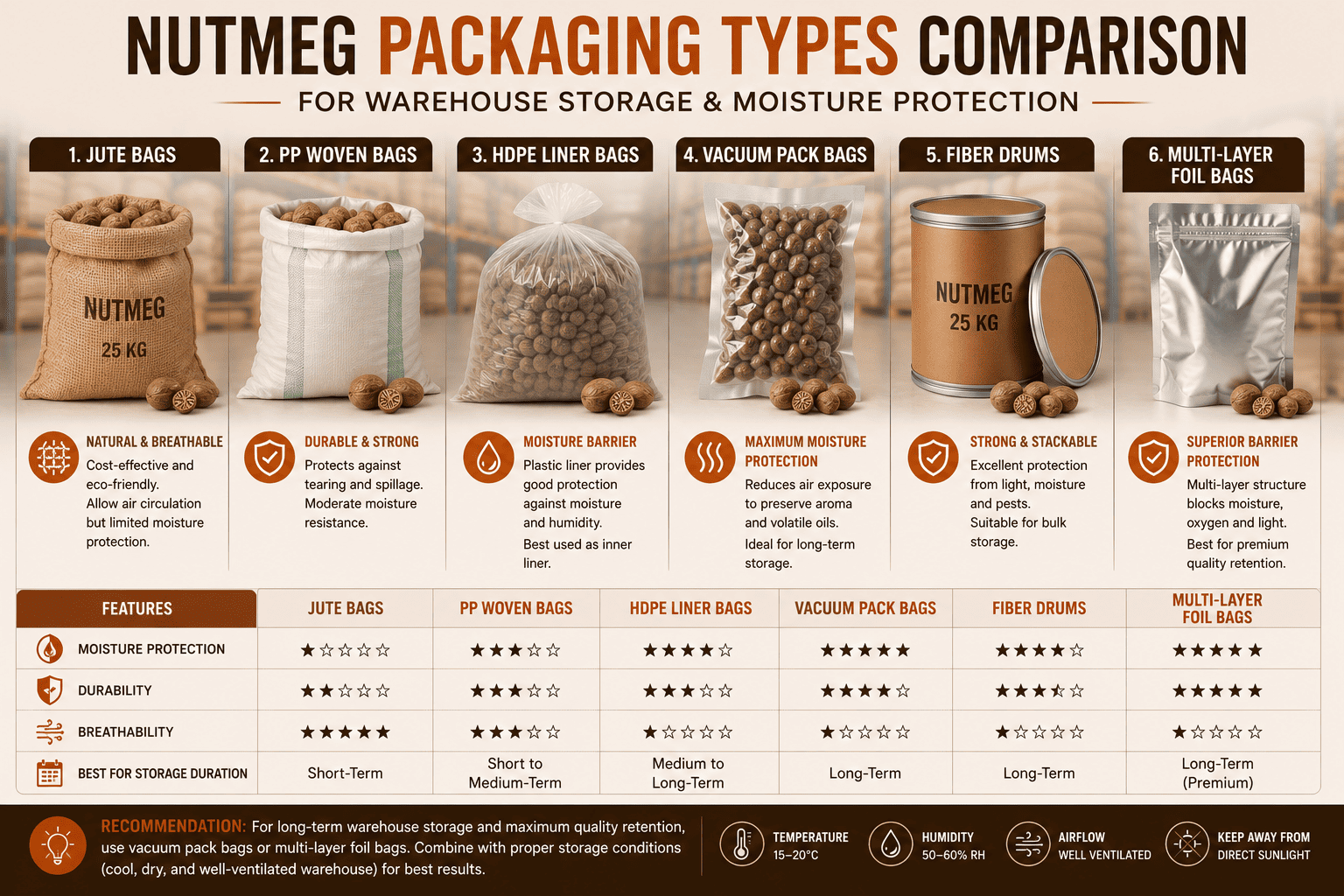
Moreover, packaging plays a crucial role in nutmeg storage by creating a microclimate around the product. Specifically, the choice of packaging depends on storage duration and form.
Packaging Types for Nutmeg Storage
| Packaging Type | Whole Nutmeg Suitability | Ground Nutmeg Suitability | Typical Shelf Life | Cost per 25 kg |
|---|---|---|---|---|
| Polypropylene (woven) | Good | Not recommended | 6–12 months | Low |
| Polyethylene (PE) lined | Excellent | Moderate | 12–18 months | Low–Medium |
| Multi-layer kraft/Al/PE | Excellent | Excellent | 18–24 months | Medium |
| Vacuum-sealed nitrogen-flushed | Excellent | Excellent | 24–36 months | High |
| Hermetic grain bags | Excellent | Not recommended | 24–36 months | Medium |
Generally, for whole nutmeg, standard polypropylene or jute bags with PE liners are sufficient for most storage durations up to 12 months. In comparison, for ground nutmeg or longer storage periods, multi-layer barrier packaging with nitrogen flushing is strongly recommended.
Nutmeg Storage Packaging Best Practices
Notably, proper packaging alone is not sufficient. In general, the following practices extend storage life:
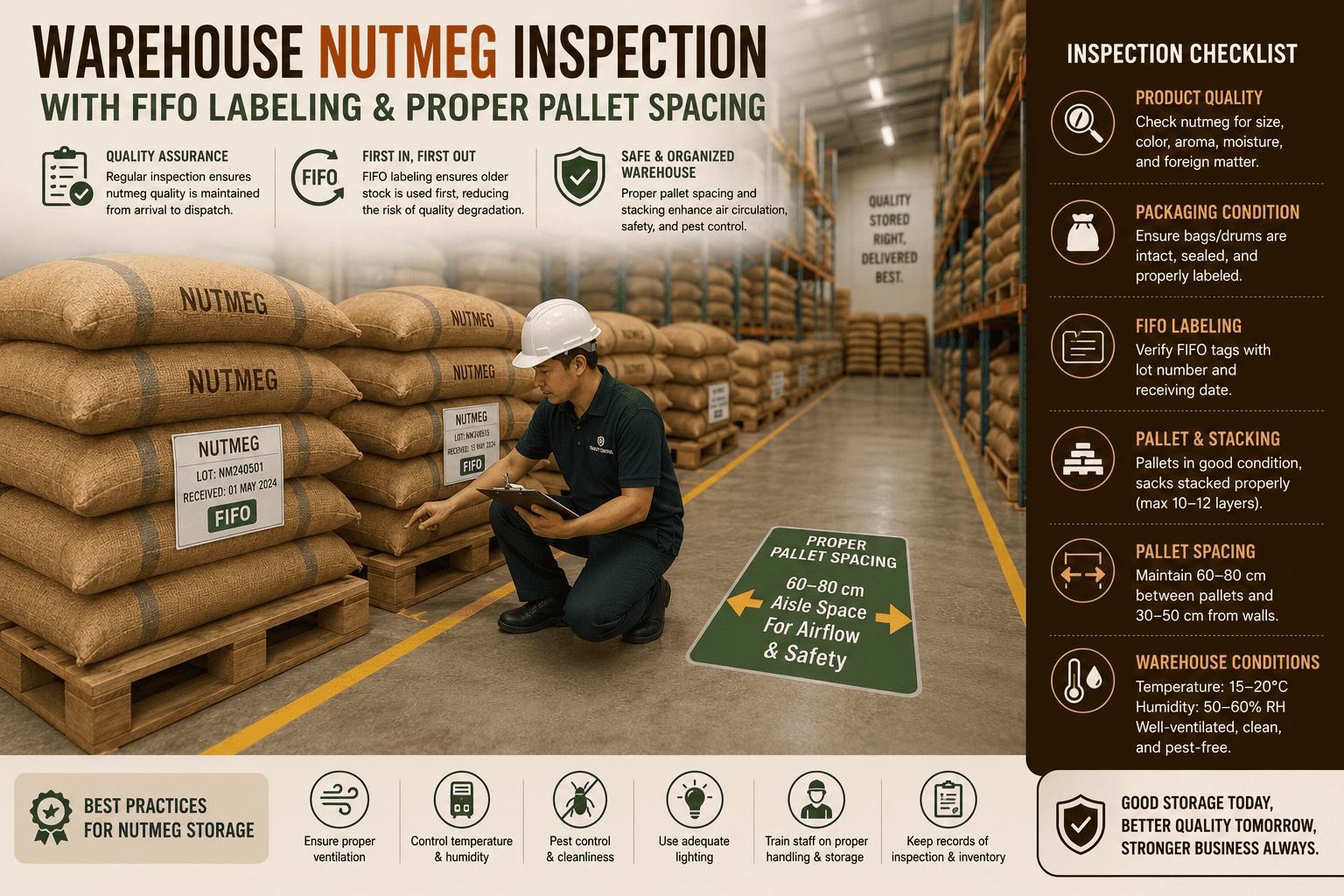
- Stacking: First, pallets should be elevated at least 15 cm off the floor and kept 30 cm away from walls to allow air circulation
- FIFO rotation: Next, first-in-first-out inventory management prevents older stock from exceeding shelf life
- Seal inspection: Then, regularly check bag seals for micro-perforations that allow moisture ingress
- Batch traceability: Finally, each pallet should carry a label with harvest date, processing date, and storage entry date
Aflatoxin Prevention in Nutmeg Storage
In addition, aflatoxin contamination is one of the most serious risks in nutmeg storage. Specifically, aflatoxins are toxic metabolites produced by Aspergillus flavus and Aspergillus parasiticus molds that thrive in warm, humid conditions.
Aflatoxin Risk Factors
| Risk Factor | Threshold | Prevention Method |
|---|---|---|
| Moisture content | Above 10% | Pre-storage drying to 6–8% moisture content |
| Relative humidity | Above 70% | Dehumidifiers and HVAC control |
| Temperature | Above 28°C | Air conditioning or cool storage |
| Storage duration | Beyond 18 months | FIFO rotation and inventory turnover |
| Pest damage | Any visible infestation | Fumigation and pest monitoring |
Specifically, aflatoxin levels in nutmeg are regulated by the European Union at a maximum of 5 ppb (parts per billion) for total aflatoxins and 2 ppb for aflatoxin B1. As a result, exceeding these limits results in automatic rejection of shipments at EU borders. Moreover, the FAO provides comprehensive guidelines on aflatoxin management in spices, which serve as the industry standard for prevention.
Monitoring Schedule
Furthermore, regular monitoring during nutmeg storage is essential:
- Weekly: Notably, visual inspection for mold, pest activity, and condensation
- Monthly: Then, temperature and humidity log review
- Quarterly: Moreover, moisture content testing on representative samples
- Bi-annual: Finally, aflatoxin screening via HPLC or ELISA test kits
Pest Management in Nutmeg Storage Warehouses
Additionally, pest infestation can compromise nutmeg storage quality quickly. Specifically, common pests affecting stored nutmeg include:
- Cigarette beetle (Lasioderma serricorne): Notably, attacks both whole and ground nutmeg
- Drugstore beetle (Stegobium paniceum): In particular, prefers ground nutmeg
- Indian meal moth (Plodia interpunctella): Moreover, causes surface infestation in bags
- Saw-toothed grain beetle (Oryzaephilus surinamensis): Meanwhile, acts as a secondary pest after initial damage
Integrated Pest Management (IPM) Approach
| Method | Application | Frequency |
|---|---|---|
| Pheromone traps | Monitor pest population levels | Continuous |
| Sanitation | Clean spills and debris immediately | Daily |
| Temperature treatment | Heat treatment to 50°C for 24 hours | Upon detection |
| Modified atmosphere | CO2 or nitrogen atmosphere in sealed storage | Continuous for high-value stock |
| Fumigation | Phosphine or sulfuryl fluoride | Only when threshold exceeded |
As a result, for B2B buyers, requesting pest management documentation from suppliers is recommended practice. In addition, a reputable exporter should provide fumigation certificates and pest monitoring logs upon request.
Nutmeg Storage Duration and Quality Degradation Timeline
Thus, understanding how quality degrades over time in nutmeg storage helps buyers plan inventory turnover. Specifically, the timeline below shows what to expect:
| Storage Duration | Whole Nutmeg Quality | Ground Nutmeg Quality | Recommended Action |
|---|---|---|---|
| 0–6 months | Excellent — no measurable loss | Excellent — minimal loss | Normal use |
| 6–12 months | Excellent — less than 5% volatile oil loss | Good — 10–15% volatile oil loss | Prioritize for use |
| 12–18 months | Good — 5–10% volatile oil loss | Fair — 15–25% volatile oil loss | Reduce price or use in blends |
| 18–24 months | Fair — 10–15% volatile oil loss | Poor — 25–35% volatile oil loss | Consider reprocessing |
| Beyond 24 months | Poor — above 15% loss | Unsuitable — above 35% loss | Discard or essential oil extraction |
In most cases, whole nutmeg should be used within 18 months of harvest, and ground nutmeg within 12 months of grinding, assuming optimal storage conditions.
Warehouse Facility Requirements for Nutmeg Storage
Similarly, the physical warehouse facility itself must meet certain standards for effective nutmeg storage. In particular, the following facility features are essential:
- Insulation: For example, proper wall and roof insulation to minimize temperature fluctuations
- HVAC: Moreover, heating, ventilation, and air conditioning capable of maintaining 20–22°C year-round
- Lighting: Specifically, UV-free lighting to prevent photodegradation of volatile oils
- Flooring: In addition, sealed concrete floors to prevent moisture wicking
- Drainage: Furthermore, proper floor drainage for cleaning and condensation management
- Ventilation: Also, air exchange system to prevent stagnant air and odor absorption
Warehouse Audit Checklist
Additionally, before storing nutmeg in a new facility, B2B buyers should verify:
- [ ] First, temperature logging system in place (continuous data logger preferred)
- [ ] Next, humidity monitoring with alerts for threshold exceedance
- [ ] Also, pest monitoring program active with pheromone traps
- [ ] Then, FIFO inventory system implemented
- [ ] Moreover, cleaning schedule documented and enforced
- [ ] Additionally, staff trained in spice handling best practices
- [ ] Finally, emergency plan for HVAC failure or flooding
Summary: Best Practices for B2B Nutmeg Storage Buyers
In conclusion, successful nutmeg storage depends on three factors: environmental control, proper packaging, and regular monitoring. In particular, key takeaways for B2B buyers include:
- Maintain temperature below 25°C: firstly, keep humidity between 55–65% for whole nutmeg
- Use moisture-barrier packaging: also, use it for ground nutmeg and long-term storage
- Implement regular aflatoxin monitoring: moreover, conduct quarterly testing
- Adopt FIFO rotation: in addition, use it to minimize aging inventory
- Verify supplier storage practices: finally, verify through documentation and facility audits
Furthermore, for further guidance on nutmeg sourcing and shipping, see our comprehensive shipping and packing standards guide.
Partner with an Experienced Nutmeg Exporter
Finally, Bhavana Spice follows strict warehouse protocols to ensure every shipment meets quality specifications. In fact, our storage facilities maintain continuous temperature and humidity monitoring with backup systems for uninterrupted control. Contact our export team to discuss your storage requirements and request a facility audit report.
Email: [email protected]
WhatsApp B2B Helpline: +62 822-3332-2034
Head Office & Export Coordination: Modinan RT 007/RW 021, Banyuraden, Gamping, Sleman, DIY – Indonesia