
B2B Nutmeg Powder vs. Whole Nutmeg: Which Fits Your Production Line Best?
B2B Nutmeg Powder vs. Whole Nutmeg: Which Fits Your Production Line Best?
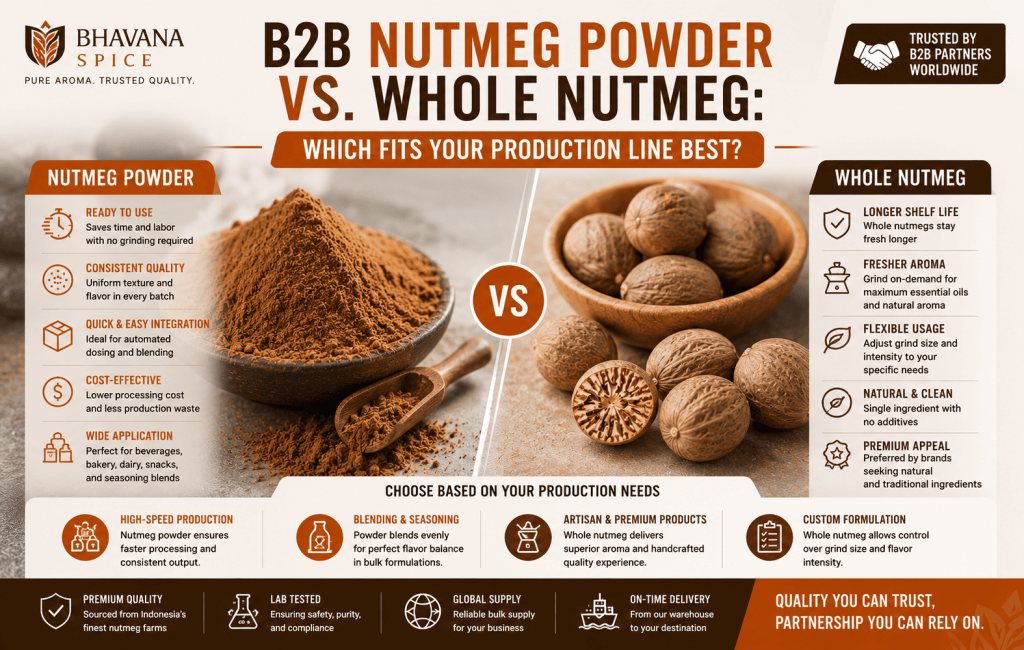
Generally, for procurement managers and food production teams, the decision between nutmeg powder vs whole nutmeg is a strategic choice that affects product quality, operational costs, and supply chain complexity. Specifically, each form offers distinct advantages depending on the application, production volume, and quality requirements. Consequently, understanding these differences is essential for optimizing procurement decisions and ensuring consistent product output. Furthermore, for a baseline understanding of nutmeg quality grades, see our complete guide to wholesale nutmeg grades.
Key Differences Between Nutmeg Powder and Whole Nutmeg
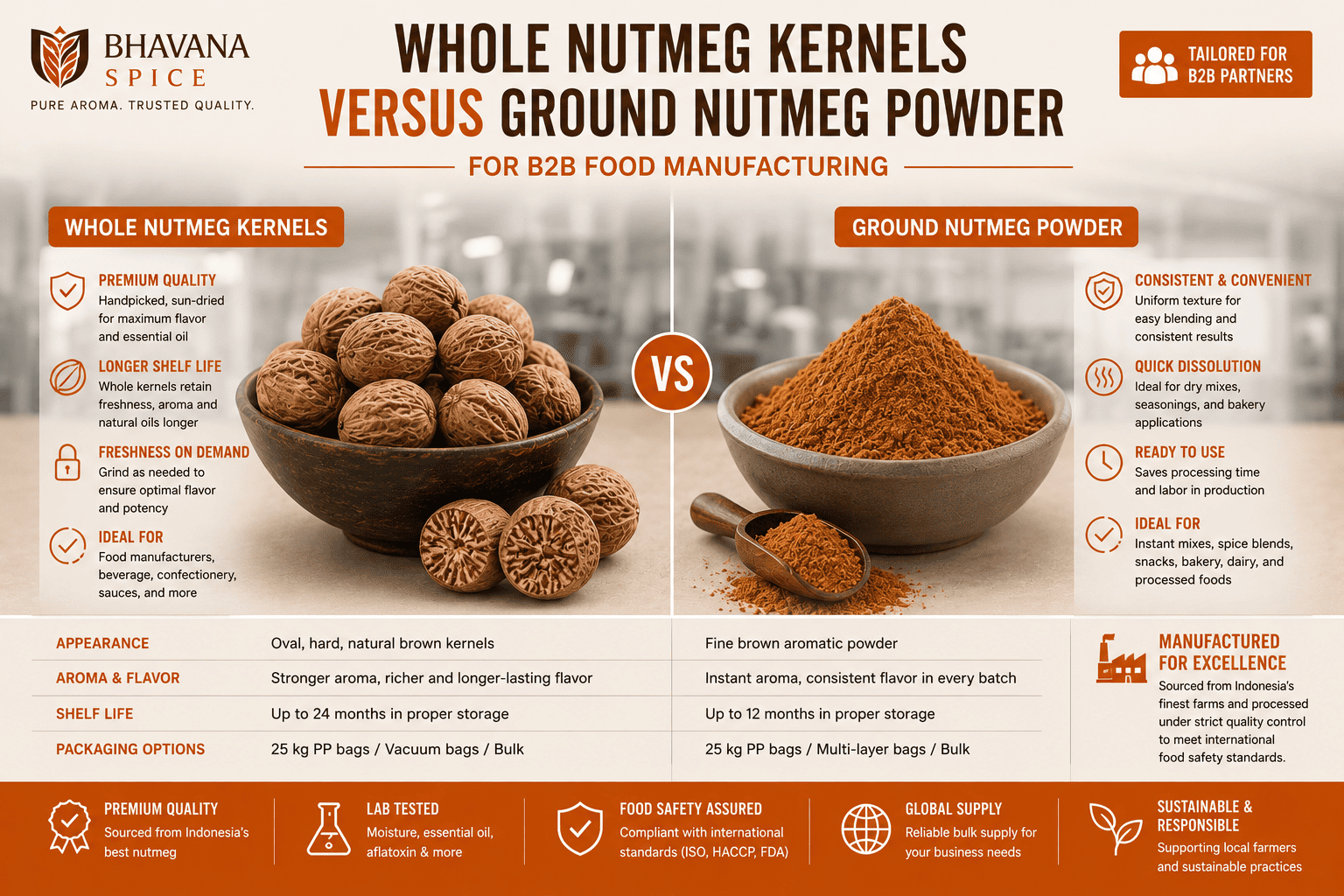
In general, the choice between nutmeg powder vs whole nutmeg comes down to five critical factors: shelf life, volatile oil retention, cost efficiency, production flexibility, and quality control. For instance, the following table summarizes these differences:
| Factor | Whole Nutmeg | Nutmeg Powder |
|---|---|---|
| Shelf life | 24–36 months under proper storage | 6–12 months before significant volatile oil loss |
| Volatile oil retention | Excellent — kernel protects essential oils | Moderate — exposed surface area accelerates oxidation |
| Cost per kilogram | Lower (base commodity price) | Higher (grinding + processing premium) |
| Production flexibility | Requires in-house grinding equipment | Ready to use directly in production |
| Quality control | Full visibility — visual inspection possible | Limited — adulteration risk post-grinding |
| Storage space required | Standard warehouse conditions | Requires nitrogen flushing or vacuum packaging |
Specifically, whole nutmeg maintains its quality profile significantly longer than pre-ground powder because the hard outer shell protects the volatile oils from oxidation and moisture absorption. However, pre-ground nutmeg powder offers convenience and eliminates the need for grinding equipment in the production line.
Shelf Life and Volatile Oil Retention: Whole vs Ground Nutmeg
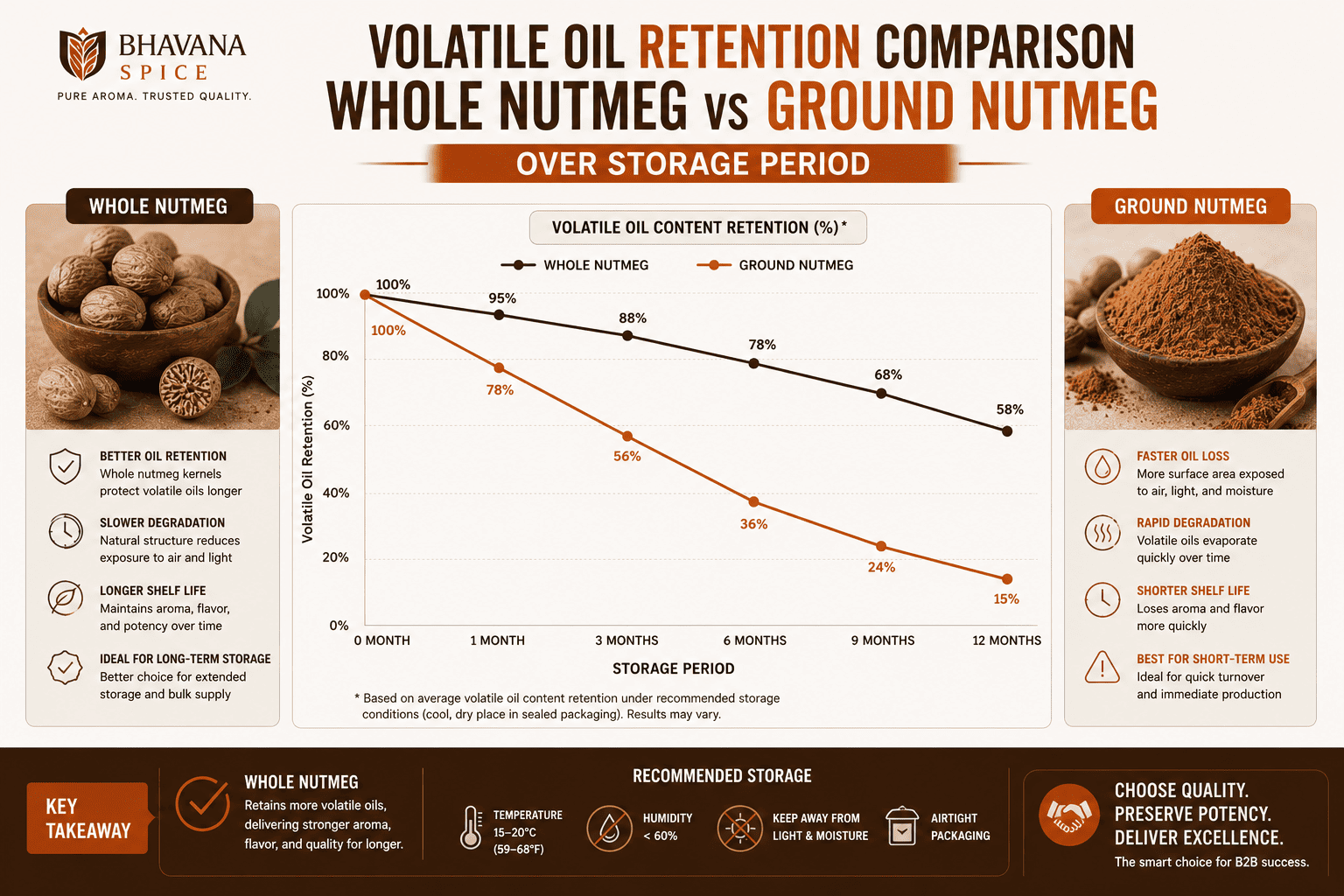
Firstly, in the B2B context, shelf life is often the deciding factor between nutmeg powder vs whole nutmeg. As a rule, whole nutmeg kernels, when stored at temperatures below 25°C and relative humidity below 65%, retain their volatile oil content for 24 to 36 months with minimal degradation. In fact, properly stored whole nutmeg can maintain up to 85% of its original volatile oil content after 24 months.
Conversely, ground nutmeg begins losing volatile oils immediately after grinding. In particular, the exposed surface area allows oxygen to react with the essential oils, causing flavor degradation. Typically, commercially packaged ground nutmeg retains acceptable quality for 6 to 12 months, depending on packaging quality and storage conditions.
Volatile Oil Loss: Whole Nutmeg vs Ground Nutmeg Powder
Specifically, the rate of volatile oil loss differs markedly between the two forms:
| Time After Processing | Whole Nutmeg Oil Retention | Ground Nutmeg Oil Retention |
|---|---|---|
| 0 months (baseline) | 100% | 100% |
| 3 months | 98–99% | 90–95% |
| 6 months | 96–98% | 80–88% |
| 12 months | 92–96% | 65–75% |
| 24 months | 85–92% | 45–55% |
Notably, after 12 months of storage, whole nutmeg retains 92–96% of its original volatile oil content, while ground nutmeg drops to 65–75%. Thus, for manufacturers producing products where nutmeg flavor is a primary note, this difference directly impacts finished product consistency.
Cost Analysis: Nutmeg Powder vs Whole Nutmeg
Furthermore, the cost equation between nutmeg powder vs whole nutmeg involves more than the per-kilogram price. In particular, procurement managers must consider the total cost of ownership, including processing, waste, and storage factors.
Direct Cost Comparison
For starters, whole nutmeg typically costs 15–25% less per kilogram than pre-ground nutmeg. However, in-house grinding adds operational costs:
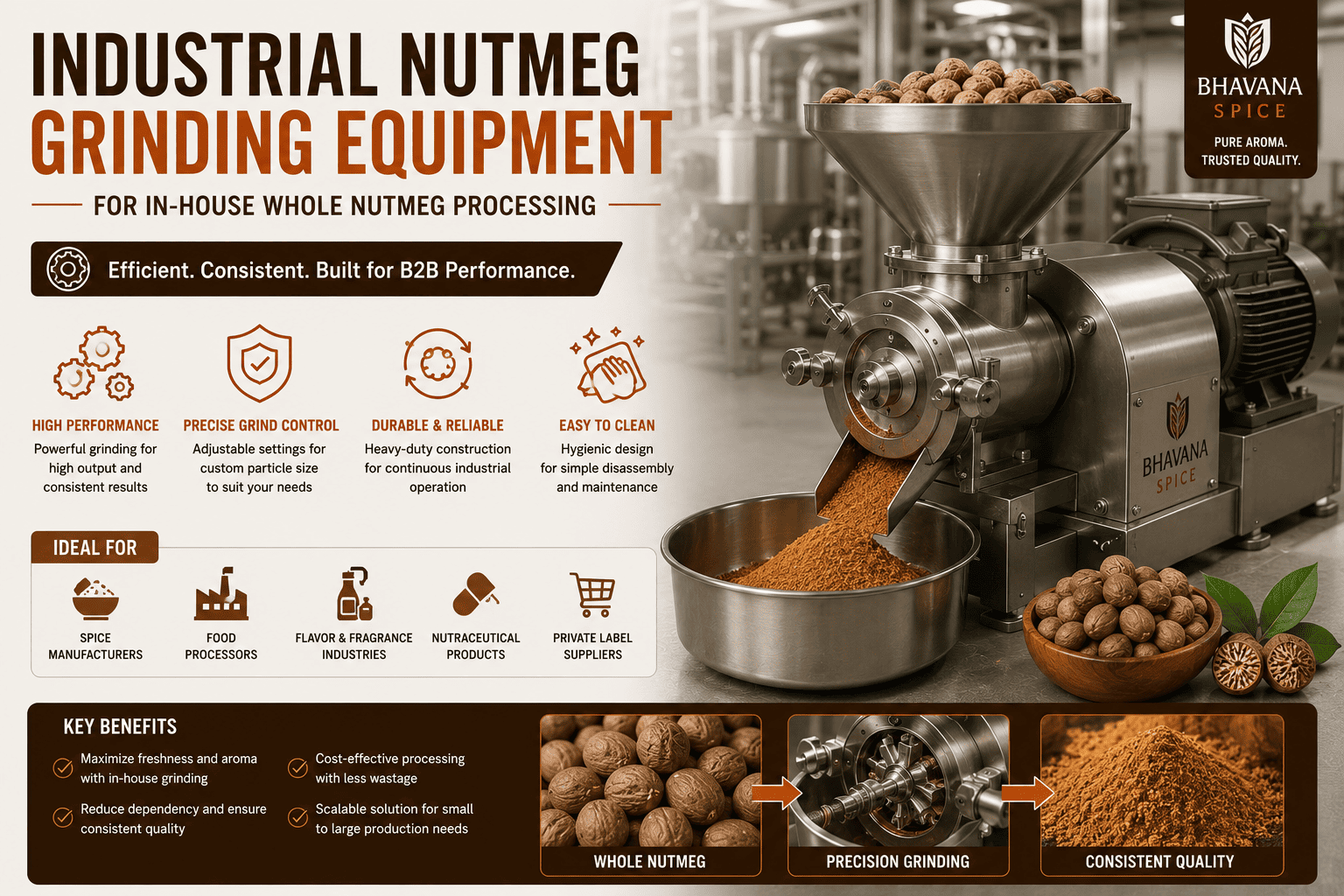
- Equipment investment: Industrial nutmeg grinders range from USD 5,000 to USD 50,000 depending on capacity
- Labor costs: Skilled operators for grinding and sifting
- Yield loss: Grinding typically results in 2–5% material loss through dust and sifting rejects
- Energy costs: Power consumption for grinding motors
Break-Even Analysis
Specifically, the break-even point depends on monthly consumption volume:
| Monthly Volume | Pre-Ground Cost Premium | In-House Grinding Cost | Recommendation |
|---|---|---|---|
| Under 100 kg | 20–25% premium | 30–40% additional cost | Buy pre-ground |
| 100–500 kg | 18–22% premium | 15–25% additional cost | Depends on equipment |
| 500–2,000 kg | 15–20% premium | 10–15% additional cost | In-house grinding |
| Above 2,000 kg | 12–18% premium | 5–10% additional cost | In-house grinding recommended |
Consequently, high-volume processors consuming over 500 kg per month typically achieve cost savings by grinding in-house from whole nutmeg. Meanwhile, smaller producers benefit from purchasing pre-ground nutmeg to avoid equipment and labor overhead.
Application Suitability
Accordingly, the application determines which form of nutmeg powder vs whole nutmeg is more suitable:
When Whole Nutmeg Is Preferred
- Essential oil extraction: For instance, steam distillation requires whole or cracked kernels
- Pharmaceutical applications: In particular, controlled particle size and purity verification are essential
- Long-term storage: Specifically, warehousing for seasonal production cycles
- Direct export to processors: Notably, buyers with established grinding capacity
- Premium retail packaging: For example, whole nutmeg for gourmet market segments
When Pre-Ground Nutmeg Is Preferred
- Spice blends: For instance, ready-to-use formulations for meat seasoning and curry powders
- Bakery and confectionery: In particular, consistent particle size for uniform distribution
- Small-batch production: Moreover, where grinding equipment investment is unjustified
- R&D and pilot plants: For example, small quantities for product development
- Private labeling: Specifically, direct packing into retail or food service containers
Quality Control Considerations for Nutmeg Powder vs Whole Nutmeg
In addition, quality control differs significantly between nutmeg powder vs whole nutmeg.
Adulteration Risk
To begin with, pre-ground nutmeg carries a higher adulteration risk, as noted by the FDA’s guidelines on spice examination and adulteration detection. For example, common adulterants include:
- Nutmeg shell powder (ground shell mixed with kernel powder)
- Other spice powders (cinnamon, allspice used as filler)
- Starch or flour added to increase weight
In contrast, whole nutmeg kernels are virtually impossible to adulterate without visible signs. As a result, buyers can perform visual inspection on every kernel and verify authenticity through physical characteristics such as shape, weight, and surface texture.
Testing Protocols
Furthermore, laboratory testing requirements differ:
- Whole nutmeg: These include moisture content (AOAC 925.40), volatile oil (USP steam distillation), aflatoxin (HPLC), and visual defect inspection
- Ground nutmeg: Additionally, all whole nutmeg tests plus particle size analysis (sieve test), bulk density, color measurement, and adulterant screening (microscopic analysis or DNA barcoding)
Grinding Quality Parameters
Furthermore, for buyers who choose to grind in-house, the following parameters should be specified to the grinder per industry grinding standards for spice processing:
| Parameter | Typical Specification | Impact |
|---|---|---|
| Particle size | 500–1,000 microns (coarse) or 250–500 microns (fine) | Determines dissolution rate and flavor release |
| Temperature during grinding | Below 40°C | Prevents volatile oil evaporation |
| Throughput rate | Consistent with mill capacity | Ensures uniform particle distribution |
| Sifting efficiency | 95% minimum pass rate | Reduces oversize particle rejection |
Packaging Requirements for Ground vs Whole Nutmeg
Additionally, packaging requirements also differ between nutmeg powder vs whole nutmeg:
- Whole nutmeg: Typically shipped in standard polypropylene or jute bags, 25 kg or 50 lb, stacked on pallets. It generally requires cool, dry warehouse conditions but no special atmosphere.
- Ground nutmeg: For optimal preservation, it requires nitrogen-flushed vacuum-sealed packaging to minimize oxidation. Typically packed in multi-layer kraft/aluminum foil/PE bags with oxygen absorbers. As a result, shelf life depends on packaging integrity.
As a result, the packaging cost for ground nutmeg is approximately 30–50% higher per kilogram than whole nutmeg, adding to the total cost difference.
Summary: Decision Framework for B2B Buyers
In conclusion, the choice between nutmeg powder vs whole nutmeg depends on three primary factors:
- Production volume: Specifically, above 500 kg per month favors in-house grinding from whole nutmeg
- Shelf life requirement: Moreover, beyond 12 months requires whole nutmeg or nitrogen-packed ground product
- Application type: Finally, ready-to-use blends favor pre-ground while extraction or long-term storage favors whole
In practice, for most B2B buyers, a hybrid approach works best: source whole nutmeg for long-term inventory and grind in-house for current production needs, while purchasing pre-ground nutmeg for specialty blends or short-run products.
Additionally, for further guidance on nutmeg quality and shipping logistics, see our comprehensive shipping and packing standards guide.
Need a Reliable Supplier for Both Forms?
Finally, Bhavana Spice supplies both whole nutmeg kernels and custom-ground nutmeg powder according to your specification. Above all, our grinding facility can produce various particle sizes with full quality control documentation. Contact our export team to discuss your production requirements and request samples of both forms.