
Mace vs Nutmeg: Key Differences, Uses, and Which One to Buy
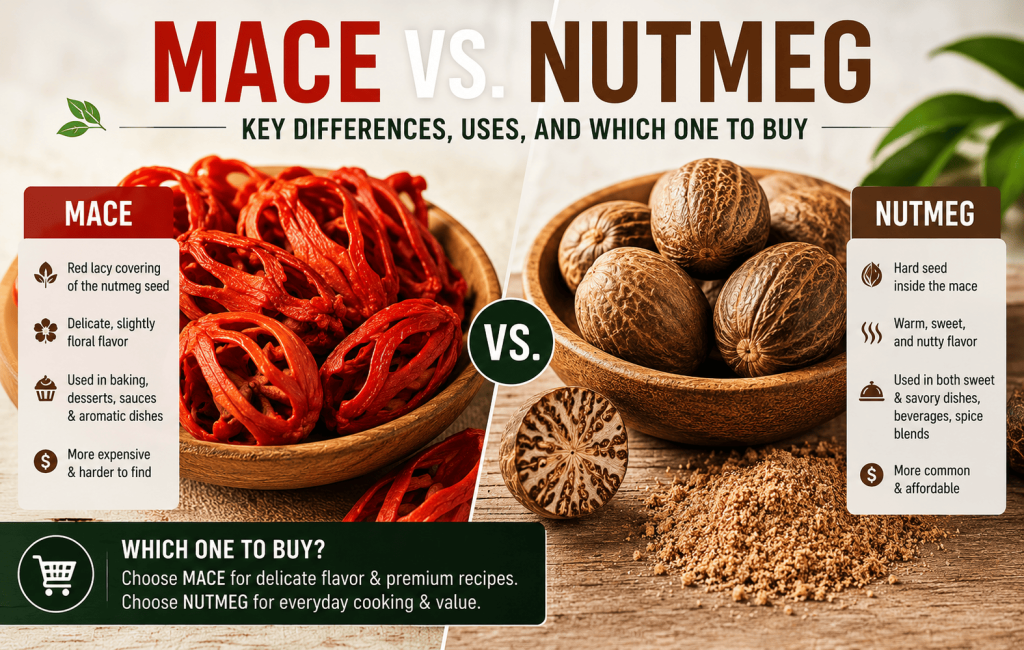
Mace vs Nutmeg: Botanical Differences and B2B Application Guide
For industrial procurement officers and food scientists, the decision between mace vs nutmeg represents far more than a simple ingredient substitution—it is a fundamental strategic choice impacting product formulation, manufacturing costs, and supply chain reliability. Most global buyers treat mace and nutmeg as interchangeable commodities, yet they represent botanically distinct structures with dramatically different flavor profiles, chemical compositions, production yields, and pricing dynamics from the same tree. Specifically, this misunderstanding leads to suboptimal procurement decisions, missed cost optimization opportunities, and operational inefficiencies. Consequently, understanding the precise botanical distinctions is mission-critical for procurement teams seeking to optimize sourcing strategies, improve product quality, and enhance cost competitiveness.
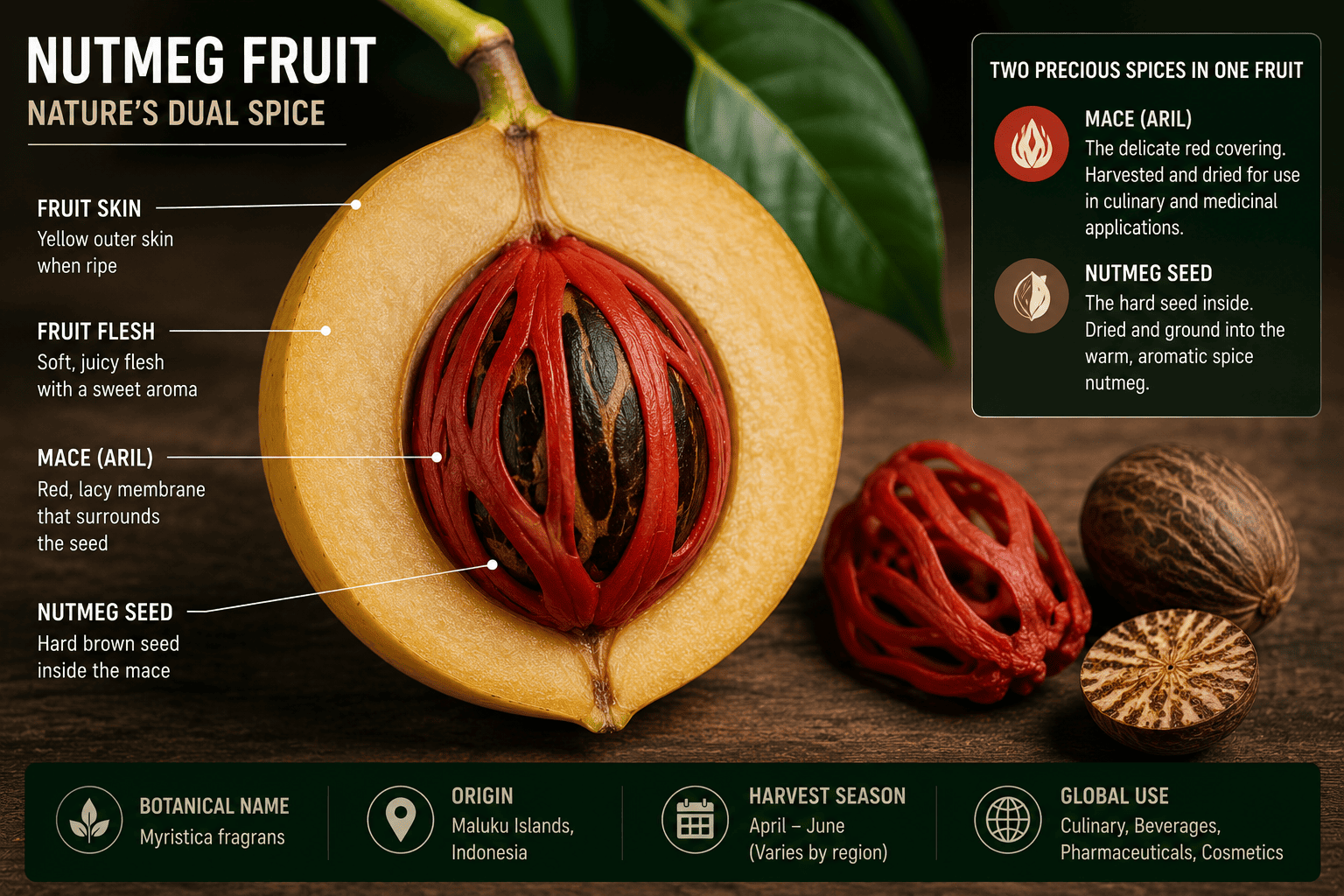
As previously noted, both spices originate from Myristica fragrans, the nutmeg tree native to the Banda Islands of Indonesia. However, they are literally different parts of the fruit—analogous to comparing apple skin to apple seeds. Indeed, the confusion around mace vs nutmeg is entirely understandable for procurement teams unfamiliar with spice botanicals. This guide provides comprehensive technical knowledge enabling procurement teams to make informed sourcing decisions aligned with production line requirements, regulatory compliance, and cost optimization objectives.
1. Mace vs Nutmeg: Same Tree, Two Distinct Products
1.1 Mace vs Nutmeg Tree Structure and Fruit Components
As a tropical evergreen endemic to the Indonesian archipelago, the nutmeg tree (Myristica fragrans) thrives specifically in volcanic soil conditions characterizing the Banda Islands and surrounding regions. Consequently, the tree’s fruit contains multiple valuable commercial components—each harvested and processed separately to create distinct spice products with fundamentally different applications.
Specifically, the tree produces a plum-sized drupe (botanical fruit) containing five distinct structural components:
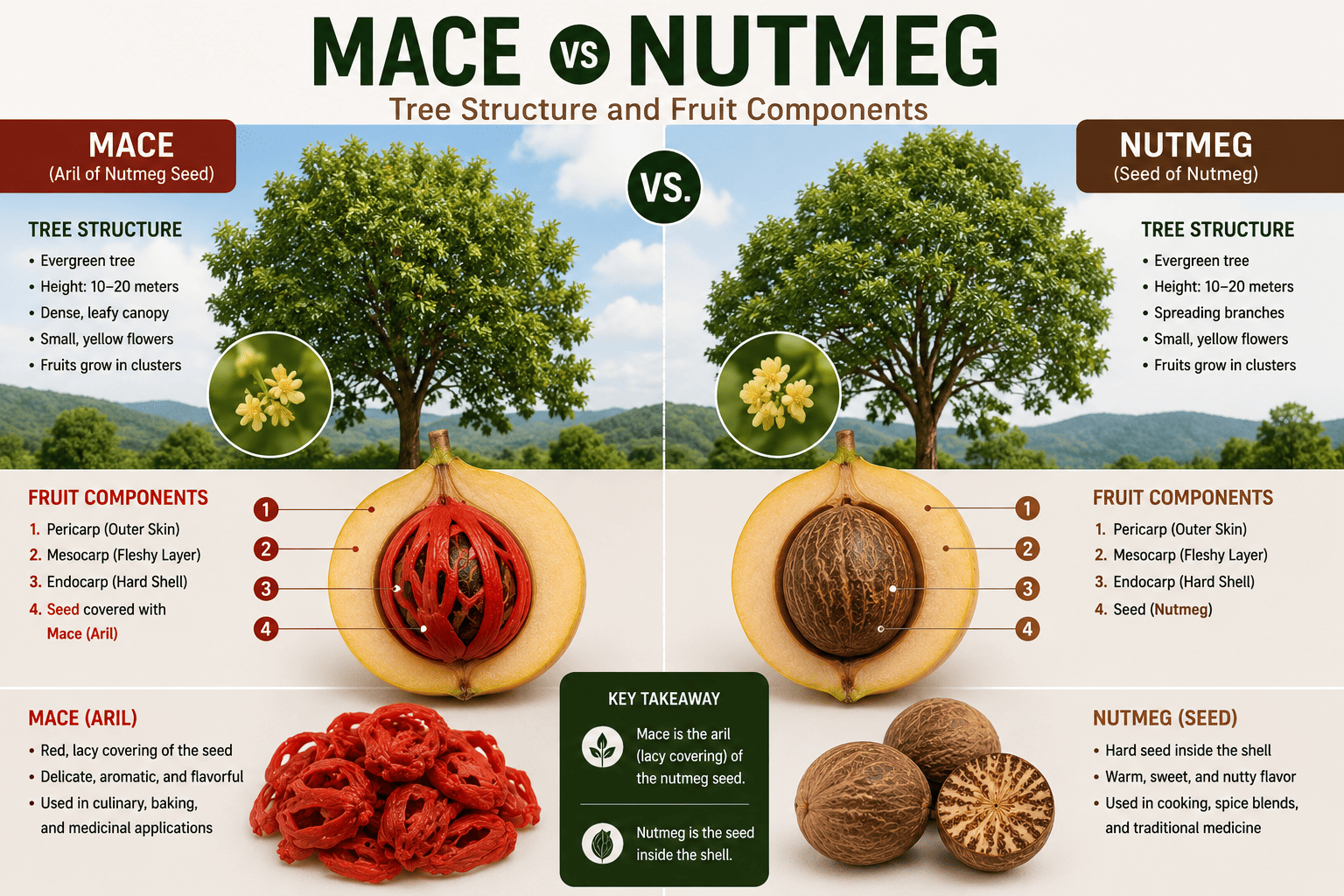
Critical distinction: While both mace and nutmeg originate from the same tree, they are botanically distinct structures requiring separate harvesting protocols, different drying methodologies, and unique quality specifications. As a result, this botanical reality directly impacts procurement strategy, pricing negotiations, and supply chain logistics.
1.2 Mace: The Aril Structure and Harvesting Process
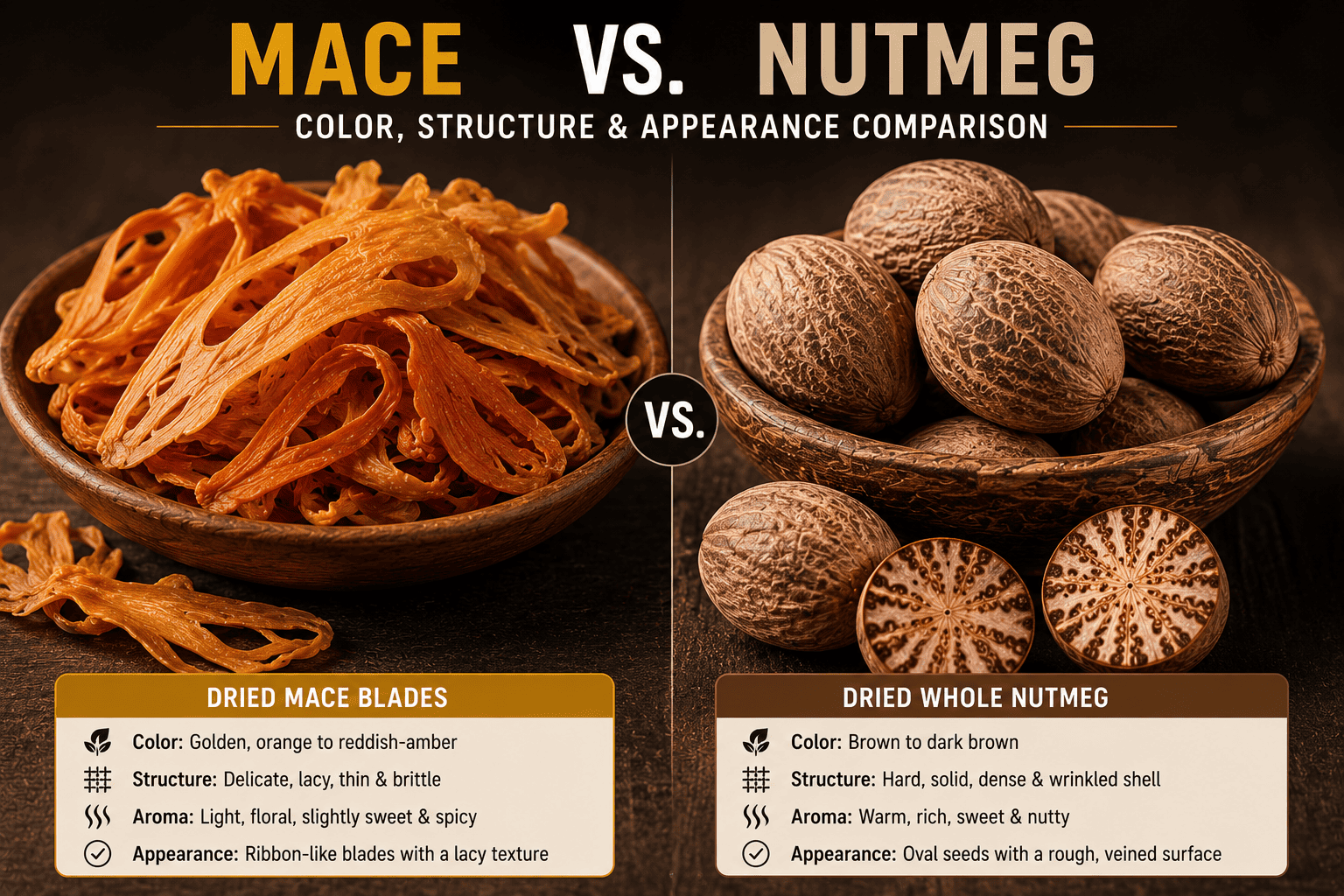
Botanically, mace is the bright-red, weblike structure that envelops the nutmeg seed within the fruit. Upon harvest, this aril appears as a vivid red or scarlet lattice—so distinctive that early European traders called it “muskatnussblüte” (nutmeg flower), though it is botanically an external covering rather than a flower. Specifically, mace is the lacy, branched covering that naturally encases the nutmeg seed, and its appearance is one of the most visually distinctive botanical structures in the global spice trade.
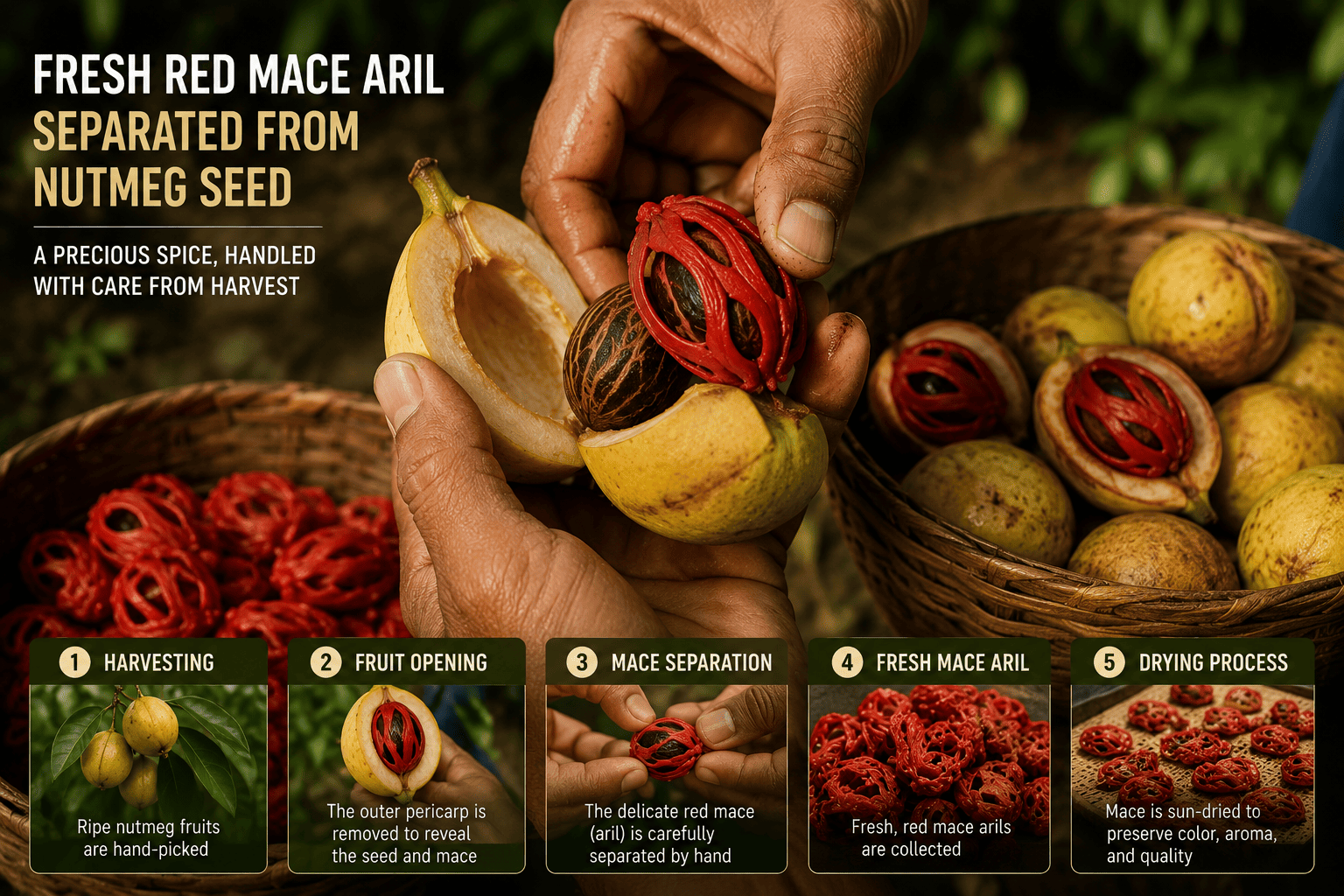
Harvesting and processing mace requires careful labor-intensive protocols:
1. The nutmeg fruit is split or cracked open to expose the mace
2. Mace is carefully separated from the seed to prevent damage to its delicate, lacy structure
3. Fresh mace is immediately sun-dried (or mechanically dried) over 10-14 days
4. The drying process transforms mace from bright red to golden-orange or amber in color
5. Dried mace blades retain their rigid, brittle structure—substantially different from nutmeg’s hard shell
Yield consideration: A single nutmeg tree produces approximately 2,000-4,000 seeds annually. For example, each seed yields roughly 5-10 grams of dried mace. Furthermore, a mature tree produces approximately 10-40 kilograms of dried mace per year, making mace significantly more yield-limited than nutmeg from the same botanical source.
1.3 Nutmeg: The Seed Structure and Processing
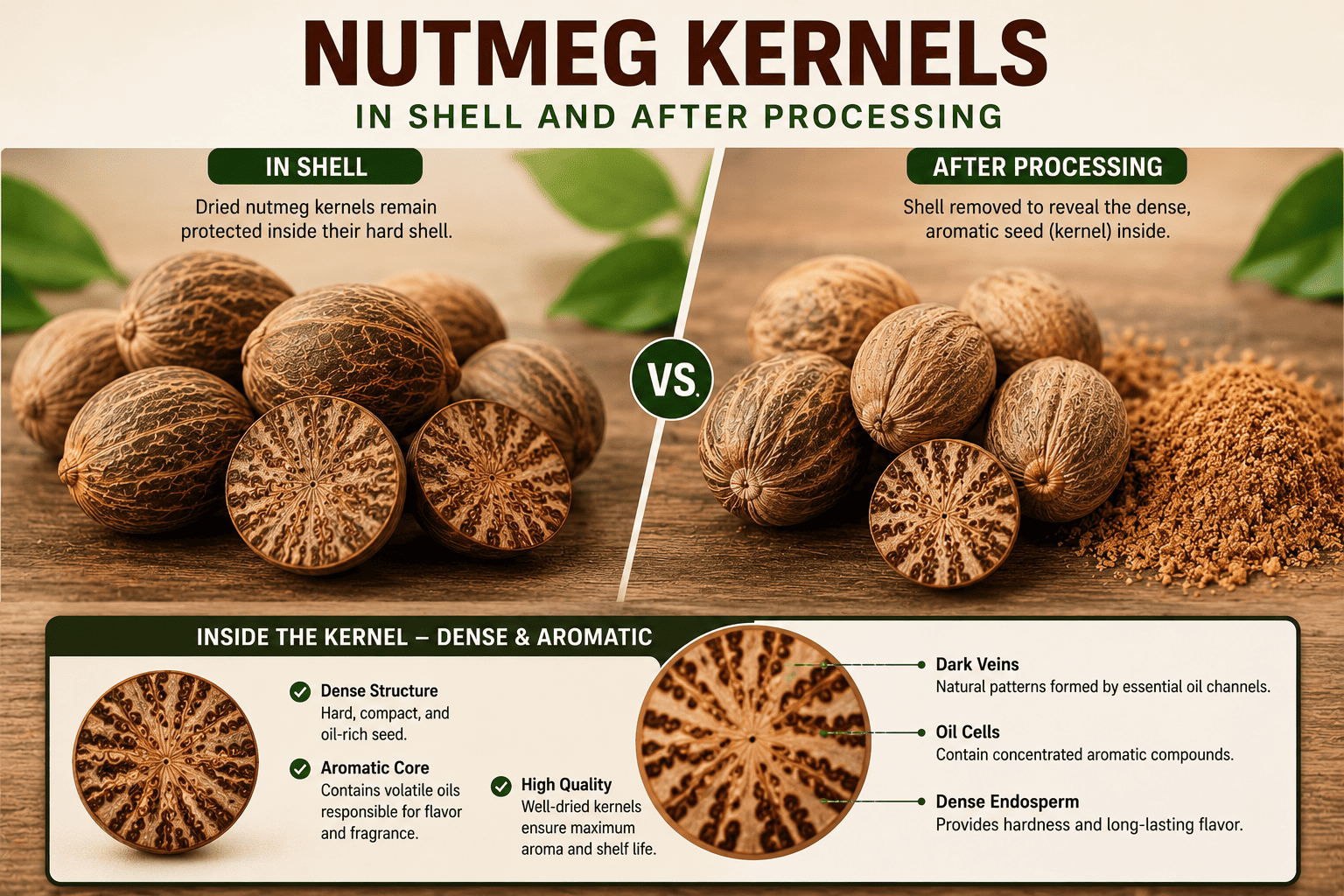
In contrast, nutmeg is the hardened, dried seed of Myristica fragrans. After mace removal, the seed is either sun-dried or mechanically dried until the kernel inside shrinks sufficiently to rattle within its shell—a process requiring 6-8 weeks of sun exposure or 24-48 hours of mechanical drying at controlled temperatures. This extended drying period reflects the seed’s dense internal structure and high fat content.
Processing nutmeg involves distinct sequential steps:
1. Mace is removed to expose the seed in its hard, brown shell
2. Seeds are dried in large outdoor beds or mechanical dryers
3. The drying process reduces seed moisture from ~40% to <10%
4. After drying, seeds are sorted by size and quality into ABCD grades, Sound Shrivels, and BWP
5. Some nutmeg is further processed into powder or extracted for essential oils
Yield advantage: From the same annual production (~2,000-4,000 seeds), dried nutmeg yield is substantially higher than mace. Moreover, a single nutmeg seed produces approximately 8-12 grams of dried nutmeg, resulting in 16-48 kilograms of dried nutmeg per tree annually. Consequently, nutmeg production is 2-3 times higher per tree than mace production—a fundamental fact driving wholesale pricing differentials.
2. Mace vs Nutmeg Flavor Chemistry: Why Chemistry Matters to Procurement
2.1 Mace vs Nutmeg Volatile Oil Composition: Aromatic Differences
The chemical distinction between mace vs nutmeg is profound, despite their botanical proximity. In fact, both contain unique volatile oil profiles, yet their proportions and aromatic compounds differ significantly—directly impacting flavor delivery and end-product quality. Therefore, understanding these chemical distinctions enables procurement teams to specify the exact ingredient optimized for their production requirements.
Mace volatile oil characteristics (the delicate choice):
– Oil content: 7-15% volatile oil (by weight) — notably higher than nutmeg
– Key aromatic compounds:
– Pinene (woody, fresh notes) — 15-25%
– Myrcene (herbal, earthy base) — 5-12%
– Limonene (citrus brightness) — 8-15%
– Sabinene (spicy, warm undertone) — 8-12%
– Eugenol (clove-like sharpness) — 3-8%
– Organoleptic profile: Warm, slightly sweet, with delicate citrus and floral undertones; considerably less pungent than nutmeg
Nutmeg volatile oil characteristics (the bold choice):
– Oil content: 5-8% volatile oil (by weight) — notably lower than mace
– Key aromatic compounds:
– Myrcene (earthy, herbal) — 10-18%
– Pinene (woody) — 8-15%
– Sabinene (warm spice) — 12-20% — markedly elevated vs. mace
– Terpineol (fresh, floral) — 5-10%
– Eugenol (clove-like) — 2-5%
– Organoleptic profile: Warm, deeply spicy, slightly sweet with nutty undertones; considerably more pungent than mace
Practical implication: Despite mace’s higher overall volatile oil content, nutmeg delivers a more intense spice experience due to different proportions of key aromatic compounds—particularly the markedly elevated sabinene content that contributes to the characteristic “warm spice” flavor B2B buyers associate with authentic nutmeg. Hence, this chemical distinction is non-negotiable when specifying ingredient requirements for specific applications.
2.2 Application-Specific Flavor Matching: Selecting the Right Ingredient
Understanding these chemical distinctions is essential for procurement teams evaluating mace vs nutmeg for specific production lines. Ultimately, the choice between these two spices is not arbitrary—it directly impacts final product flavor delivery, consumer satisfaction, and brand differentiation.
Strategic applications for MACE (delicate flavor profile):
– Premium bakery applications: Where delicate spice flavor supports rather than dominates (cakes, pastries, cookies, spiced breads)
– Confectionery blends: Chocolate coating applications requiring subtle spice enhancement without overwhelming cocoa notes
– Savory meat blends: Premium sausages and charcuterie where a lighter spice profile complements rather than overwhelms protein flavors
– Pharmaceutical formulations: Where consistent, mild flavor is regulatory requirement and volatile oil stability is critical
– Cosmetic applications: Where volatile oil retention is critical but pungency must be minimized for user acceptability
In contrast, strategic applications for NUTMEG (intense flavor profile):
– Sausage and processed meat: Where pronounced warm spice is desired signature flavor and cost optimization is important
– Sauce and gravy bases: Where spice intensity masks other flavor notes intentionally (tomato bases, stock formulations)
– Beverage formulations: Coffee, tea, and warm drink blends requiring spice dominance and extended shelf-life stability
– Pharmaceutical preparations: Where traditional spice authenticity and familiar “warm” character are expected by consumers
– Essential oil extraction: Where higher yield per unit weight is economically favorable and botanical authenticity is valued
3. Mace vs Nutmeg Production Yields and Sourcing Economics
3.1 Mace vs Nutmeg Yield Differential: Why Mace Commands Premium Pricing
Notably, the yield differential between mace and nutmeg directly impacts procurement costs and sourcing strategy. Understanding these economics is essential for cost-conscious procurement teams evaluating long-term sourcing contracts and supply agreements.
Annual production from a single mature nutmeg tree:
| Product | Estimated Annual Yield | Estimated Global Production (Tons) | Price Range (USD/kg) |
|---|---|---|---|
| Nutmeg (whole, dried) | 16-48 kg | 90,000-120,000 | $8-18 |
| Mace (whole blades) | 10-40 kg | 8,000-12,000 | $22-45 |
| Mace (ground powder) | 9-36 kg | 3,000-5,000 | $28-55 |
Key observation: Mace production globally represents approximately 8-10% of nutmeg production by volume, yet commands 2.5-3x premium pricing. Notably, this pricing structure reflects multiple economic factors:
- Harvest constraints: Mace must be manually separated from seeds—labor-intensive process
- Yield limitations: Approximately 1/3 to 1/2 the yield of nutmeg from equivalent production
- Preservation difficulty: Mace’s delicate structure makes it prone to damage during processing and transport
- Market demand concentration: Primarily specialized food manufacturers and pharmaceutical sectors rather than mass-market consumers
3.2 Impact on B2B Sourcing Strategy
For procurement officers managing cost optimization objectives, the yield differential creates strategic sourcing decisions. Specifically, the following scenarios illustrate the trade-offs:
Scenario A: Nutmeg-Dependent Production
– Large-scale food manufacturers (sausage production, sauce bases, confectionery) typically source bulk nutmeg
– Direct Indonesian sourcing through dedicated exporters reduces costs by 15-25% compared to commodity exchanges
– Multi-year supply agreements lock pricing and ensure consistent grade quality
Mace-Dependent Production: Scenario B
– Pharmaceutical and specialty cosmetic manufacturers typically purchase mace at premium prices
– Sourcing reliability becomes critical—mace supply volatility can disrupt production schedules
– Co-sourcing mace with nutmeg (from same supplier) improves negotiating leverage and shipment consolidation
Dual-Ingredient Production: Scenario C
– Food manufacturers requiring both mace and nutmeg (e.g., processed meat blends, spice mixes) benefit from consolidated sourcing
– Sourcing both ingredients from the same exporter enables:
– Single phytosanitary certificate and customs clearance
– Consolidated shipping (reduces freight per unit cost)
– Combined volume discounts (typically 5-12% reduction)
– Unified quality assurance protocols
4. Mace vs Nutmeg Processing Methods and Quality Retention
4.1 Sun-Drying vs. Mechanical Drying: Mace-Specific Considerations
Furthermore, the drying method profoundly affects volatile oil retention in mace—a factor directly influencing final product flavor and marketability.
Sun-Drying Process (Traditional Indonesian Method):
– Duration: 10-14 days weather-dependent
– Volatile oil retention: 85-92% of original volatile oil preserved
– Quality indicators: Golden-amber color, flexible yet brittle texture, intact lacy structure
– Advantages:
– Minimal energy costs
– Preferred by artisanal pharmaceutical producers
– Aligns with organic certification requirements
– Disadvantages:
– Weather-dependent (delays during monsoon season)
– Inconsistent moisture levels (6-14% vs. target <10%)
– Microbial contamination risk from ground contact
Mechanical Drying (Modern Food-Grade Method):
– Duration: 24-48 hours at controlled temperature (50-65°C)
– Volatile oil retention: 78-88% of original volatile oil preserved
– Quality indicators: Consistent amber color, predictable brittleness, uniform moisture <8%
– Advantages:
– Rapid processing enables higher throughput
– Consistent moisture and quality standards
– Reduced microbial contamination risk
– Meets HACCP and ISO 22000 requirements
– Disadvantages:
– Higher energy costs (~$2-5 per kilogram mace)
– Slight additional volatile oil loss compared to sun-drying
B2B Procurement Implication: For pharmaceutical and cosmetic applications requiring <10% moisture and consistent volatile oil content, mechanical drying is non-negotiable. However, for specialty food applications, sun-dried mace may offer authentic flavor profiles acceptable to consumers willing to pay premium prices.
4.2 Vacuum-Sealed Packing: Preserving Volatile Oils Post-Harvest
After drying, mace’s delicate volatile oils remain vulnerable to oxidation during transport and storage. As a result, procurement teams specify packaging methods to extend shelf life and preserve aromatic qualities.
Standard jute bag storage:
– Volatile oil degradation: 8-12% per 6 months under ambient conditions
– Shelf life at ambient temperature: 12-18 months before flavor degradation becomes apparent
– Cost: $0.15-0.25 per kilogram
Vacuum-sealed foil packet storage:
– Volatile oil degradation: <2% per 12 months at ambient temperature
– Shelf life at ambient temperature: 24-36+ months with minimal flavor loss
– Cost: $0.40-0.65 per kilogram
Vacuum-sealed with inert gas (nitrogen-flushed):
– Volatile oil degradation: <1% per 12 months
– Shelf life at ambient temperature: 36-48+ months
– Cost: $0.60-1.00 per kilogram
Procurement recommendation: For long-distance sea freight (30-45 days in transit), vacuum-sealed foil packaging is cost-effective insurance against volatile oil loss. Moreover, the additional packaging cost ($0.25-0.40/kg) is often recouped through extended shelf life and reduced complaints from end-use manufacturers.
5. Mace vs Nutmeg B2B Applications and Industrial Use Cases
5.1 Mace vs Nutmeg in Meat Processing and Charcuterie
In particular, mace’s delicate flavor profile makes it valuable in processed meat formulations where spice should enhance rather than dominate.
Premium sausage applications:
– Ingredient concentration: 1.5-3.5 grams mace per kilogram sausage meat
– Flavor contribution: Warm base note without overwhelming meat flavor
– Regional preference: Strong demand in German, Austrian, and French charcuterie sectors
– Premium positioning: Mace-based sausages command 8-15% price premium over nutmeg-based alternatives
Example formulation (for 10kg batch):
– Ground pork: 9,200g (92%)
– Sea salt: 180g (1.8%)
– Ground mace: 20g (0.2%)
– Ground black pepper: 30g (0.3%)
– Garlic powder: 10g (0.1%)
– Curing salts (if applicable): 50g (0.5%)
– Ice water: 510g (5.1%)
Production consideration: Mace’s delicate structure requires careful grinding to preserve volatile oil integrity. Excessive grinding generates heat, causing volatile oil evaporation and flavor degradation. Consequently, procurement teams should specify low-temperature grinding for mace powder (product temperature remains <40°C during grinding).
5.2 Mace vs Nutmeg in Industrial Sauce and Seasoning Bases
On the other hand, nutmeg’s pronounced spice character positions it as the preferred choice for sauce bases, gravies, and bulk seasoning blends where spice intensity is desired.
Commercial applications:
– Tomato sauce bases: 0.8-2.0 grams nutmeg per kilogram sauce
– Gravy and stock bases: 1.2-2.8 grams nutmeg per kilogram base
– Meat seasoning blends: 2.0-4.5 grams nutmeg per kilogram blend
– Vegetable and curry blends: 1.5-3.5 grams nutmeg per kilogram
Economic advantage: Nutmeg’s higher production yield (16-48 kg per tree annually vs. 10-40 kg mace) and lower unit cost ($8-18/kg vs. $22-45/kg mace) make it standard choice for cost-sensitive bulk ingredients. Consequently, bulk buyers typically default to nutmeg for large-volume formulations where budget constraints take priority.
Quality consideration: Industrial sauce bases require consistent nutmeg grading. Therefore, procurement teams should specify:
– Grade A or ABCD whole nutmegs only (excludes damaged, shriveled, or defective seeds)
– Moisture content: 8-10% (ensures consistent extraction yield)
– Foreign matter: <0.5% (regulatory compliance)
– Defects: <2% (damaged or moldy seeds)
5.3 Mace vs Nutmeg in Confectionery and Bakery Formulations
Similarly, mace’s premium positioning and delicate flavor profile make it valuable in high-end confectionery applications.
Chocolate coating applications:
– Mace concentration: 0.5-1.5 grams per kilogram chocolate
– Flavor contribution: Subtle warmth without clove-like sharpness
– Pairing recommendation: Combines well with dark chocolate (60-72% cacao) and milk chocolate (40-50% cacao)
Spice cake and cookie formulations:
– Mace powder concentration: 0.8-2.0 grams per kilogram dough
– Traditional use: Nutmeg cakes, gingerbread, spiced cookies
– Flavor advantage: Lighter spice profile suitable for premium/artisanal positioning
Industry insight: Bakery manufacturers increasingly differentiate products through ingredient transparency. For instance, packaging labeled “mace” rather than generic “spices” signals premium quality and justifies 12-20% price premiums to end consumers.
6. Mace vs Nutmeg Regulatory and Compliance Considerations
6.1 FDA and EU Requirements for Mace and Nutmeg
Both mace and nutmeg fall under FDA’s Generally Recognized as Safe (GRAS) designation, yet specific regulatory requirements apply to each. In addition, distinct standards exist across different regulatory jurisdictions:
FDA Requirements (United States):
– Moisture content: <12% (nutmeg), <13% (mace)
– Foreign matter: <2%
– Insect fragments: <8 per 25g sample (spore limit)
– Ash content: <8% (indicates mineral contamination)
– Acid-insoluble ash: <1.5% (indicates added dirt or mineral fillers)
EU Requirements (European Union):
– Moisture content: <12% (both mace and nutmeg)
– Volatile oil content (minimum):
– Nutmeg: 5.0% (GC-MS determination)
– Mace: 7.0% (GC-MS determination)
– Foreign matter: <1% (stricter than FDA)
– Mycotoxins: Aflatoxin B1 <5 ppb (parts per billion); total aflatoxins <10 ppb
Procurement implication: EU compliance requires higher test standards for volatile oil retention. As a result, procurement teams sourcing for European markets should specify mechanical drying and vacuum-sealed packaging—ensuring volatile oil content meets 7.0% minimum threshold post-shipment.
6.2 Organic and Fair-Trade Certification Impact
Increasing consumer demand for certified organic and fair-trade spices influences procurement strategies and pricing structures. Furthermore, certification requirements vary significantly between markets:
Organic certification impact:
– Premium pricing: +25-40% above conventional products
– Sourcing requirement: Must verify farmer compliance with certified organic protocols for past 3+ years
– Traceability requirement: Complete farm-to-processor documentation
– Processing constraint: Sun-drying mandatory (mechanical drying not permitted under some organic standards)
Fair-trade certification impact:
– Premium pricing: +15-30% above conventional products
– Farmer payment guarantee: Minimum price floor ensures farmer income stability
– Community investment: Portion of premium supports farmer community education and infrastructure
– Procurement advantage: Fair-trade certified sourcing aligns with corporate sustainability objectives and marketing positioning
Strategic recommendation: For manufacturers targeting premium market segments (organic consumer brands, ethical sourcing narratives), dual certification (organic + fair-trade) justifies pricing premium and differentiates products in competitive markets.
7. Mace vs Nutmeg Sourcing Strategy and Procurement Best Practices
7.1 Direct Sourcing vs. Commodity Exchange: Cost-Benefit Analysis
Procurement teams must evaluate whether to source mace and nutmeg directly from Indonesian exporters or through commodity exchanges. In particular, the cost-benefit analysis depends on order volume, lead time requirements, and quality specifications:
Direct Sourcing from Indonesian Exporter (Recommended for B2B):
| Advantage | Disadvantage |
|---|---|
| 15-25% cost reduction vs. commodity exchange pricing | Minimum order quantity typically 5-10 MT (metric tons) |
| Direct quality communication and customization | Requires longer lead time (45-60 days vs. 7-14 days) |
| Long-term relationship enables volume discounts | Payment terms typically 50% advance, 50% on shipment |
| Single point of contact simplifies quality assurance | Currency exchange risk (USD/IDR volatility) |
| Consolidated mace+nutmeg sourcing reduces freight costs | Requires due diligence on exporter HACCP/ISO certification |
Commodity Exchange (ICE Futures, CBOT for nutmeg):
| Advantage | Disadvantage |
|---|---|
| Immediate fulfillment (delivery within 7-14 days) | 20-30% premium pricing vs. direct sourcing |
| Standard contract specs reduce negotiation burden | Limited customization options |
| Reduced currency exposure (USD pricing) | Mace rarely available on commodity exchanges |
| Transparent pricing based on futures market | Inventory costs (storage fees accumulate) |
| No minimum order quantity requirement | Quality variability (no direct supplier relationship) |
Procurement recommendation: Direct sourcing is optimal for established manufacturers with predictable, multi-ton annual requirements. In contrast, commodity exchange sourcing suits manufacturers requiring smaller quantities or facing unpredictable demand spikes.
7.2 Quality Assurance: Testing Protocols and Specifications
Procurement teams should establish testing protocols ensuring consistent quality across shipments. For instance, the following testing framework covers critical quality parameters:
Recommended testing protocol (upon receipt):
- Visual inspection: Color consistency, mold/contamination signs
- Moisture analysis: Karl Fischer titration (ISO 939 standard)
- Volatile oil content: Gas chromatography-mass spectrometry (GC-MS) per ISO 11050
- Microbial testing:
- Total aerobic bacteria: <10^4 CFU/g
- Yeast/mold: <10^3 CFU/g
- Pathogens: Salmonella, E. coli negative
- Heavy metals: Lead (<0.1 ppm), Cadmium (<0.1 ppm), Arsenic (<0.3 ppm)
- Aflatoxin testing: B1 and total (if EU compliance required)
Cost estimate: Comprehensive quality testing approximately $150-250 per shipment (assuming single supplier with routine shipments). Nevertheless, this investment is justified by:
– Prevention of production downtime from contaminated ingredients
– Regulatory compliance avoidance of fines
– Customer complaint prevention
– Insurance against liability claims
8. Mace vs Nutmeg: Conclusion and Procurement Recommendations
Key Takeaways
-
Botanical distinction matters: Understanding mace vs nutmeg starts with recognizing that mace (aril) and nutmeg (seed) represent different parts of Myristica fragrans, requiring distinct processing methods and sourcing strategies
-
Flavor profiles differ significantly: Mace delivers delicate, citrus-forward spice suitable for premium applications; nutmeg provides pronounced warmth ideal for bulk ingredients
-
Production yield differential impacts economics: Mace yields 1/3 to 1/2 the volume of nutmeg from equivalent trees, resulting in 2.5-3x higher unit costs
-
Processing method preserves quality: Mechanical drying and vacuum-sealed packaging optimize volatile oil retention for long-distance sea freight
-
Compliance requirements vary by market: EU standards require higher volatile oil minimums than FDA specifications; direct sourcing enables compliance customization
-
Co-sourcing optimizes procurement: Sourcing both mace and nutmeg from single Indonesian exporter enables shipping consolidation and volume discounts
Procurement Action Items
For immediate implementation:
- [ ] Audit current mace/nutmeg sourcing against the comparative yield and cost analysis above
- [ ] Evaluate whether dual-ingredient sourcing from single supplier would reduce per-unit freight costs
- [ ] Establish quality testing protocol including GC-MS volatile oil verification and microbial testing
- [ ] Request Certificates of Analysis from current suppliers confirming moisture, volatile oil content, and compliance standards
- [ ] For EU-market manufacturers: verify mechanical drying + vacuum-sealed packaging specifications with suppliers
B2B Inquiry & Sourcing
For procurement teams ready to optimize mace and nutmeg sourcing with an experienced Indonesian exporter, Bhavana Spice specializes in premium-grade mace and nutmeg direct from volcanic soil estates in the Banda Islands. Additionally, our direct-source model eliminates commodity exchange markups while ensuring traceability and compliance documentation for international buyers.
To request detailed product specifications, discuss Full Container Load (FCL) pricing, or arrange for physical evaluation samples to be sent to your QA laboratory, contact our B2B export division directly:
- Email: [email protected] (Technical sheets and spec documents dispatched within 24 business hours)
- WhatsApp B2B Helpline: +62 822-3332-2034 (Direct procurement consultations, stock availability, and logistics updates)
- Head Office & Export Coordination:
Modinan RT 007/RW 021, Banyuraden, Gamping, Sleman, DIY – Indonesia
Our team is ready to provide QA-approved Product Specification Sheets, gas chromatography profiles, and physical evaluation samples directly to your manufacturing facility worldwide.