
Mace Grades and Quality Standards: A Technical Guide for B2B Mace Importers
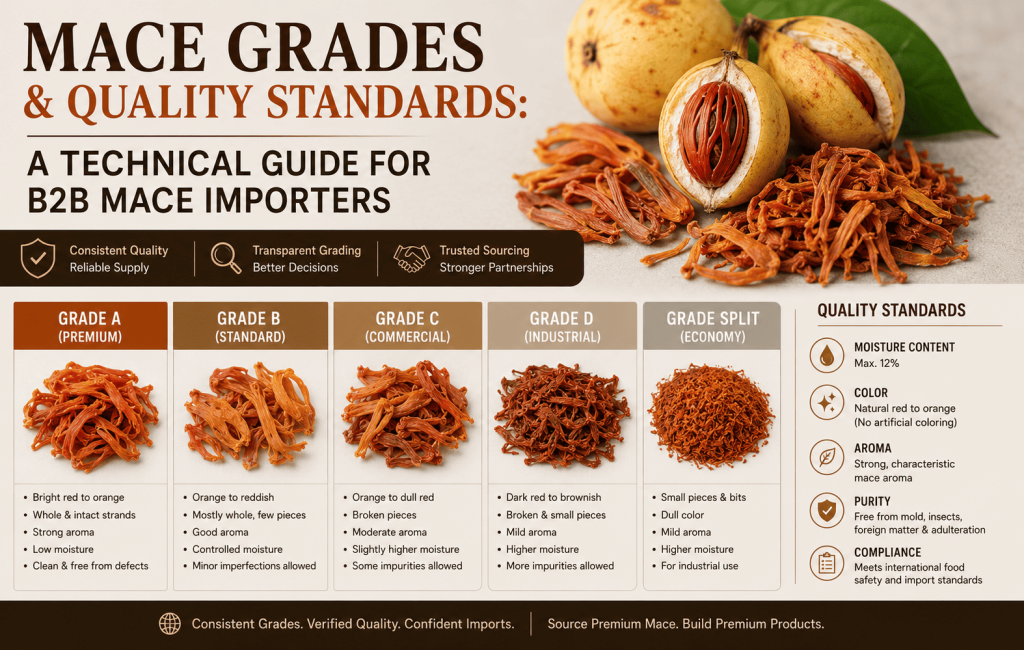
Mace Grades and Quality Standards: A Technical Guide for B2B Mace Importers
Generally, for B2B importers and procurement specialists, understanding mace grades and quality standards is essential for making informed purchasing decisions. Specifically, mace — the crimson aril surrounding the nutmeg kernel — is a premium spice with distinct quality parameters that differ significantly from nutmeg. Consequently, knowing how to evaluate mace quality ensures you receive the correct grade for your application and avoid costly specification mismatches.
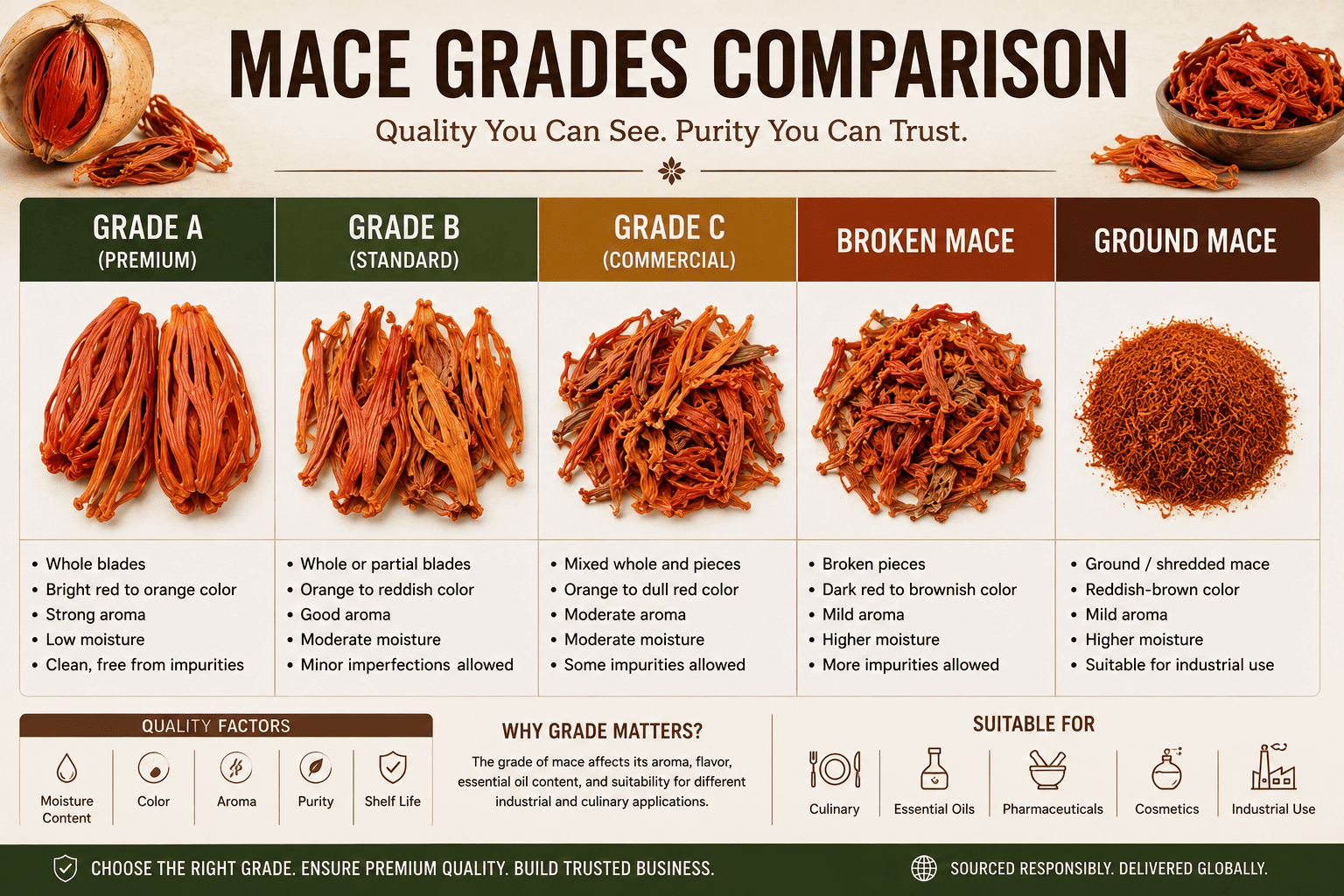
What Are Mace Grades?
Firstly, mace grades are quality classifications based on physical characteristics, volatile oil content, color, and purity. Additionally, unlike nutmeg, which is graded primarily by size and weight, mace grading focuses on blade integrity, color uniformity, and aroma intensity.
Primary Mace Grade Classifications
In general, the most widely used mace grades in international trade are:
| Grade | Description | Typical Volatile Oil | Color | Common Use |
|---|---|---|---|---|
| Grade A | Typically whole mace blades, intact, deep orange-red | 10–15% | Specifically bright orange-red to crimson | For instance, premium retail, gourmet, pharma |
| Grade B | Usually broken mace blades, some discoloration | 8–12% | Typically orange to light brown | Typically for industrial spice blends, bakery |
| Grade C | Generally ground mace, mixed grades, lower oil | 5–10% | Generally yellow-brown to brown | Generally for mass-market blends, extracts |
| Grade D | Essentially fines and sifting rejects, lowest quality | Under 5% | Pale brown | Usually for essential oil distillation |
Specifically, Grade A whole mace commands the highest price premium, often 30–50% above Grade B, due to its superior volatile oil content and visual appeal.
Quality Parameters for Mace Grading
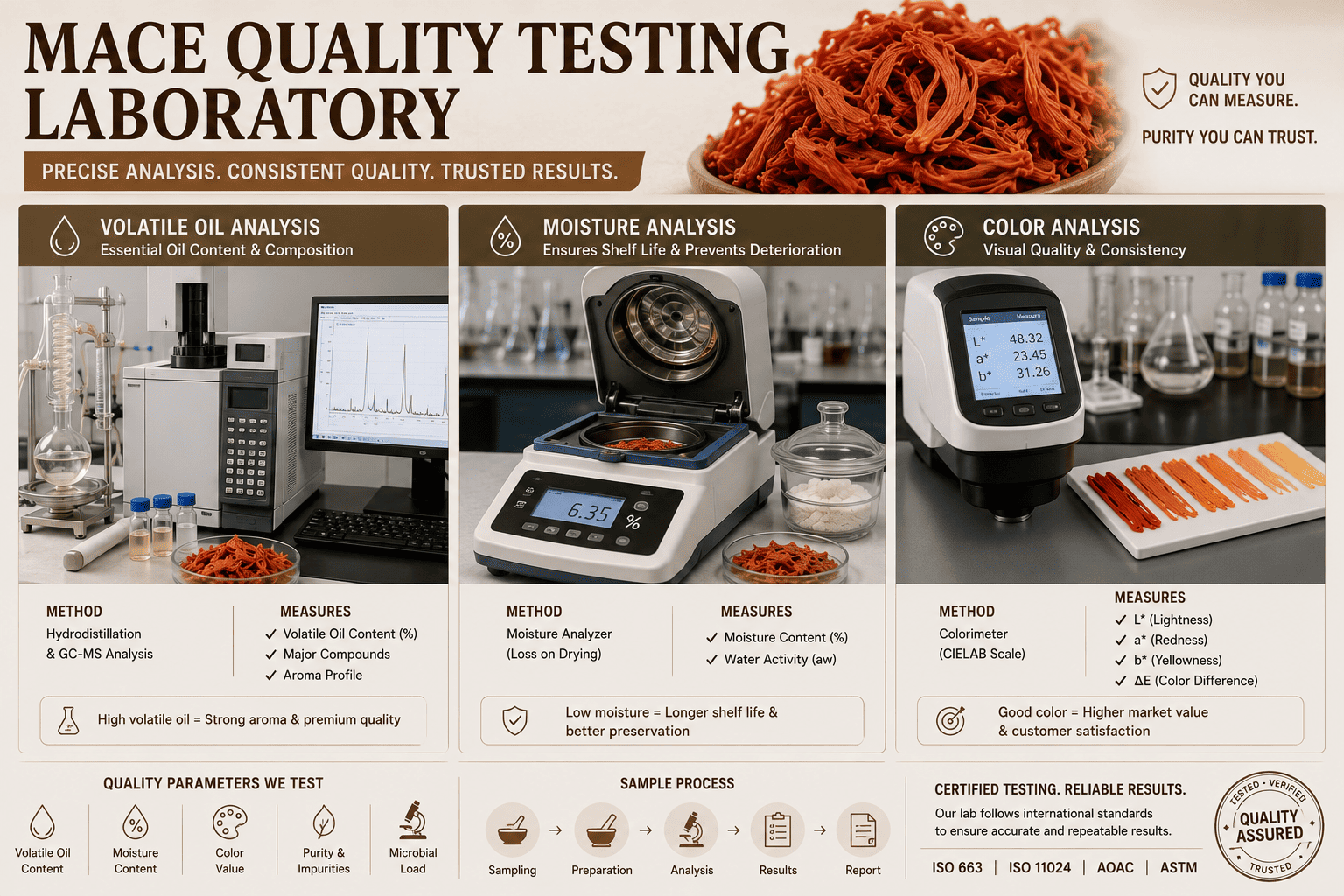
Furthermore, several measurable parameters determine mace grades in laboratory testing:
Volatile Oil Content by Mace Grade
Notably, volatile oil content is the most critical quality indicator for mace. In particular, the oil contains the aromatic compounds that give mace its distinctive warm, sweet flavor.
| Grade | Minimum Volatile Oil | Premium Quality | Testing Method |
|---|---|---|---|
| Grade A | 10% | 12–15% | Steam distillation (USP) |
| Grade B | 8% | 10–12% | Steam distillation (USP) |
| Grade C | 5% | 7–10% | Steam distillation (USP) |
| Grade D | 2% | 3–5% | Steam distillation (USP) |
As a result, for B2B buyers, specifying the minimum volatile oil content in purchase contracts is recommended practice to ensure consistent quality across shipments.
Moisture Content in Mace Grades
Similarly, moisture content affects both quality and shelf life in mace grades:
- Optimal moisture: Typically 6–8%
- Maximum acceptable: In general, 10%
- Above 10%: Moreover, mold and aflatoxin risk increases significantly
- Below 5%: Also, mace blades become brittle and prone to breakage
For reference, the ASTA (American Spice Trade Association) provides standard moisture specifications for mace, with the maximum allowable moisture set at 10% for all grades.
Mace Grades Color and Appearance
Thus, color is a visual indicator of mace grades quality:
- Grade A: For example, deep orange-red to crimson, uniform color across all blades
- Grade B: Moreover, orange to light brown, some variation acceptable
- Grade C: In addition, yellow-brown, typically ground so color blending is possible
- Grade D: Finally, pale brown, indicating lower volatile oil content
In addition, color fading during storage suggests oxidation or light exposure, which reduces quality. As a result, buyers should request recent production dates to ensure color freshness.
Mace Blade Size and Integrity by Grade
In addition, blade size and integrity differentiate mace grades in the whole spice trade:
| Size Classification | Blade Length | Blade Width | Grade Typically Assigned |
|---|---|---|---|
| Extra large | Above 4 cm | Above 1.5 cm | Grade A |
| Large | 3–4 cm | 1–1.5 cm | Grade A |
| Medium | 2–3 cm | 0.8–1 cm | Grade A–B |
| Small | 1–2 cm | Under 0.8 cm | Grade B |
| Broken | Various | Various | Grade B–C |
| Fines | Under 0.5 cm | N/A | Grade D |
Specifically, whole blades at Grade A level must have at least 90% intact blades with minimal breakage. In comparison, broken mace is typically classified as Grade B, even if its volatile oil content matches Grade A specifications.
Purity and Adulteration Detection in Mace Grades
Moreover, purity testing is essential when verifying mace grades. For example, common adulterants and contaminants include:
- Nutmeg shell fragments: For instance, similar color but different texture and lower oil content
- Sago or tapioca starch: Moreover, added to ground mace to increase weight
- Turmeric powder: Also, used to enhance color in lower grades
- Artificial colors: In particular, added to mimic Grade A appearance in lower grades
Mace Adulteration Detection Methods
| Adulterant | Detection Method | Observation |
|---|---|---|
| Nutmeg shell | For instance, microscopic analysis | Such as irregular cell structure vs mace |
| Starch addition | Iodine test | Notably, blue-black color change |
| Turmeric | Curcumin test | Specifically, orange-red with borax solution |
| Artificial colors | Alcohol extraction | Finally, non-natural color in solution |
Thus, because of these adulteration risks, laboratory testing should be part of every B2B mace procurement process.
International Mace Grades Standards and Compliance
Similarly, mace grades must comply with international food safety standards for import:
| Standard | Requirement | Governing Body |
|---|---|---|
| Maximum aflatoxin | 5 ppb total, 2 ppb B1 | EU Regulation 1881/2006 |
| Maximum moisture | 10% | ASTA/ESA |
| Pesticide residues | Specifically, varies by compound | EU/EPA/FSSAI |
| Microbial limits | Notably, salmonella absent in 25g | ISO 6579 |
| Foreign matter | For example, maximum 1% by weight | ASTA Cleanliness Specs |
Notably, the FAO food control system guidelines provide further reference for compliance requirements in spice imports.
How to Specify Mace Grades in Purchase Contracts
In conclusion, procurement managers should include the following specifications when purchasing mace:
- Grade: Firstly, specify Grade A, B, C, or D with clear definitions
- Volatile oil: Second, include minimum percentage by steam distillation
- Moisture: Next, set maximum 10% (lower if long storage expected)
- Blade integrity: Then, require minimum 90% intact for whole grades
- Color: Also, reference to standard color chart
- Aflatoxin limits: Moreover, specify EU or destination country standards
- Packaging: Finally, include required packaging type and labeling
Furthermore, for further guidance on mace sourcing from Indonesia, see our wholesale nutmeg and mace grades guide.
Source Premium Mace from Bhavana Spice
To conclude, Bhavana Spice supplies all mace grades with full quality documentation, including volatile oil analysis, aflatoxin testing, and moisture content certificates. For more information and to request mace samples:
Email: [email protected]
WhatsApp B2B Helpline: +62 822-3332-2034
Head Office & Export Coordination: Modinan RT 007/RW 021, Banyuraden, Gamping, Sleman, DIY – Indonesia