
Wholesale Nutmeg Pricing: Understanding Market Factors and Price Drivers for B2B Importers
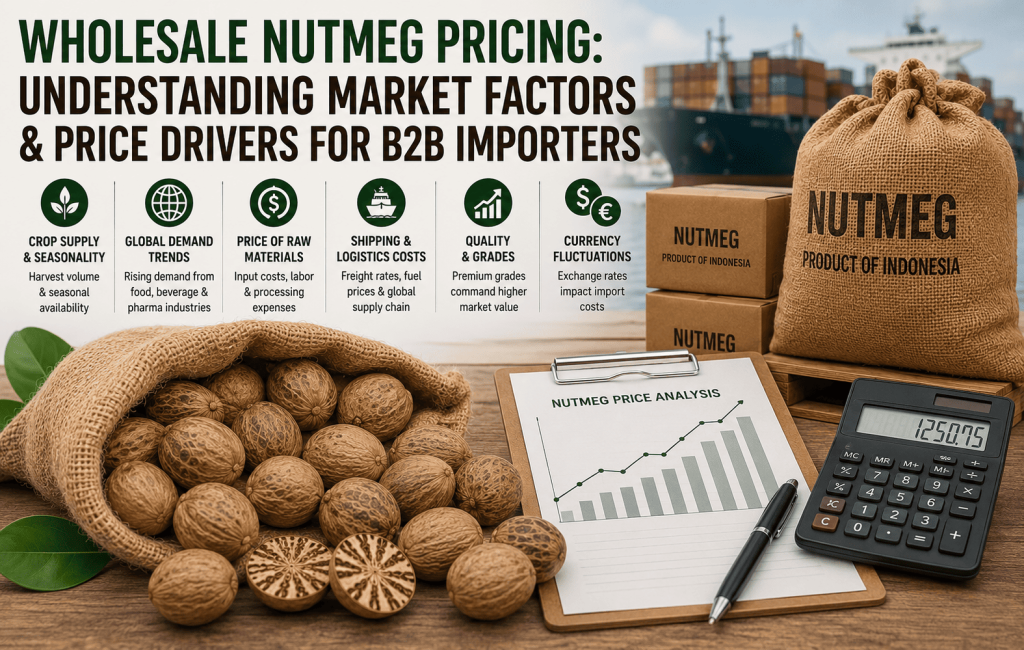
In the complex world of B2B spice procurement, understanding wholesale nutmeg pricing is mission-critical for importers managing tight margins and long supply chains. Nutmeg prices fluctuate based on harvest cycles, climate conditions, currency exchange rates, regulatory compliance costs, and competitive dynamics across producer nations. This comprehensive guide demystifies the factors that drive wholesale nutmeg pricing globally—helping procurement managers, QA specialists, and sourcing teams make data-driven purchasing decisions while securing the best value for their bulk orders.
1. The Fundamentals of Wholesale Nutmeg Pricing
1.1 What Determines Wholesale Nutmeg Cost?
Notably, wholesale nutmeg pricing is not arbitrary. Specifically, each price point reflects a combination of agricultural, logistical, regulatory, and market factors that cascade from Indonesian farms to international buyers. Notably, the Indonesian nutmeg market supplies over 75% of global demand—making price movements in Banda Islands farming directly impact worldwide procurement budgets.
Key factors shaping pricing include:
- Harvest quality and yield — Annual rainfall, soil conditions, and farmer expertise determine nutmeg output per hectare
- Grade segregation costs — Manual sorting into ABCD, SS, and BWP grades requires labor and quality control infrastructure
- Export compliance — Laboratory testing (moisture, contamination, COA), phytosanitary certificates, and regulatory audits add per-unit costs
- Global supply/demand — Shortage years (drought, crop disease) spike prices; abundant harvests create buyer discounts
- Currency exchange rates — USD/IDR fluctuations directly impact export pricing competitiveness
- Freight logistics — Sea freight rates, port handling, and container surcharges accumulate in final cost
- Competitive producer dynamics — Indian, Sri Lankan, and Vietnamese producers influence pricing competitiveness
1.2 Primary Keyword: “Wholesale Nutmeg Pricing” in Procurement Strategy
Notably, understanding wholesale nutmeg pricing helps procurement teams negotiate better contracts, forecast annual spend, and hedge against price volatility. Furthermore, buyers who grasp pricing dynamics gain negotiating leverage with suppliers and avoid overpaying during shortage periods. In essence, mastering pricing mechanics directly translates to cost savings and operational efficiency. Therefore, invest time understanding these core concepts.
2. Nutmeg Grade Tiers and Their Price Differentiation
2.1 ABCD Grades — Premium Wholesale Pricing
Notably, the A, B, C, and D grade system categorizes nutmeg by kernel size and appearance quality. Notably, ABCD grades command the highest wholesale prices because they meet strict specifications for food manufacturing, pharmaceutical applications, and retail spice brands. Certainly, these premium grades represent the top quality tier available in global markets.
ABCD Grade Pricing Characteristics:
– Ideal nutmeg kernel diameter: 20–25 mm
– Price premium: +30% to +50% above lower grades
– Market segment: Premium food manufacturers, pharmaceutical processors, specialty spice retailers
– Quality requirement: Moisture content <9%, density 0.95–1.05 g/cm³, no visible defects
– Storage stability: Maintains volatile oil content (6–15%) for 18+ months
2.2 Sound Shriveled (SS) Grade — Mid-Range Wholesale Cost
In particular, SS grades represent smaller or slightly shriveled kernels that exceed basic safety thresholds but lack ABCD visual uniformity. Consequently, SS grade pricing sits between ABCD and BWP, offering cost-conscious importers meaningful savings without sacrificing quality standards. Additionally, SS grades represent a practical compromise for many industrial applications. In fact, many processors find the price-quality balance ideal for their operations.
SS Grade Pricing Profile:
– Ideal nutmeg kernel diameter: 15–20 mm
– Price discount: 15–25% below ABCD prices
– Market segment: Industrial food blending, mass-market spice mixes, ingredient suppliers
– Quality requirement: Moisture <10%, density 0.90–1.00 g/cm³, minor shriveling permitted
– Application: Suitable for ground nutmeg, spiced sauces, meat processing blends
2.3 Broken & Wormy Pieces (BWP) — Entry-Level Wholesale Rates
Moreover, BWP grades comprise kernel fragments, minor damage, and small whole pieces. Notably, BWP pricing offers the lowest wholesale cost, making it economical for large-volume processors who can use fractional kernels in grinding operations. Certainly, this grade tier maximizes value for cost-sensitive manufacturers. Moreover, BWP enables full kernel utilization in modern grinding equipment.
BWP Grade Pricing Structure:
– Kernel composition: >50% whole pieces, remainder broken fragments
– Price savings: 40–60% discount from ABCD baseline
– Market segment: Bulk spice blenders, nutmeg extract producers, food stabilizer manufacturers
– Quality requirement: Moisture <11%, no mold/aflatoxin (strict pathogen tests mandatory)
– Yield efficiency: Broken pieces enable full kernel utilization in grinding lines
3. Seasonal Price Fluctuations and Harvest Cycles
3.1 Indonesian Nutmeg Harvest Calendar and Pricing Seasons
In fact, Indonesia’s nutmeg-growing regions (Banda Islands, Lampung, Aceh) follow distinct harvest patterns that create predictable pricing cycles. Notably, understanding these seasonal windows enables strategic buyers to time purchases and negotiate better wholesale rates. Furthermore, seasonal awareness directly impacts procurement budgets and supply chain planning. In fact, timing matters enormously in spice sourcing.

Seasonal Pricing Timeline:
-
Notably, January–March (Post-Harvest Peak Supply) — High inventory from preceding year’s harvest drives prices down 10–15% as suppliers clear storage facilities.
-
Notably, April–June (Mid-Year Transition) — Supply stabilizes at moderate levels; prices hover near annual averages; fewer supply shocks enable competitive bidding.
-
Notably, July–September (Pre-Harvest Tightening) — Approaching harvest season yet new crop not yet available; prices rise 8–12% due to depleting old stock; smart buyers accelerate orders before premium season.
-
Notably, October–December (New Harvest Arrival) — Fresh crop enters market; initial pricing discounts 5–8% as new supply floods auction centers; prices gradually firm as harvest ends.
3.2 Climate and Weather Impact on Annual Pricing Volatility
Consequently, weather patterns in Indonesia dramatically impact wholesale nutmeg pricing. El Niño years bring drought conditions that stress nutmeg trees, reducing yields and spiking prices globally. Conversely, La Niña years bring excess rainfall that elevates mold risk and adds sorting costs. In particular, climate monitoring enables proactive sourcing strategies. Additionally, understanding these cycles helps predict annual pricing trends accurately.
Climate Scenarios and Price Impact:
- Drought years (2015, 2023): Yield drops 30–40%; prices spike +25% to +35%
- Excess rainfall years (2017, 2020): Mold risk increases; quality testing costs rise +8–12%; prices firm 5–10%
- Normal weather years (2018, 2021): Price stability within ±8% of baseline
4. Global Supply Dynamics and Competitive Pricing
4.1 Indonesia’s Market Share and Price Leadership
In fact, Indonesia’s dominance—controlling 75%+ of global nutmeg supply—positions the nation as the price-setter for wholesale markets worldwide. Notably, Indonesian exporter pricing directly influences quotes from competing Indian, Sri Lankan, and Vietnamese producers.
Indonesia’s Pricing Leverage:
- Largest producing nation: ~15,000–18,000 metric tons annually
- Primary growing region: Banda Islands (historical home of nutmeg cultivation)
- Export consistency: Year-round supply capability (vs. seasonal producers)
- Quality reputation: Known for volatile oil-rich kernels superior to competitors
- Price benchmark: Indonesian ABCD prices set the global floor for premium grade procurement
4.2 Competitive Producer Pricing: India, Sri Lanka, Vietnam
Notably, competing producers influence wholesale nutmeg pricing indirectly through supply availability and quality positioning. Consequently, savvy buyers source from multiple nations to negotiate better rates and hedge supply risk.
Competitive Price Analysis:
| Producer | Market Share | ABCD Grade Price* | SS Grade Price* | Quality Positioning | Competitive Advantage |
|---|---|---|---|---|---|
| Indonesia | 75% | $8.50–10.50 | $6.50–8.00 | Premium, volatile oil-rich | Price leadership, consistency |
| India (Kerala) | 15% | $9.00–11.00 | $7.00–8.50 | Standard, lower oil content | Established supply chain |
| Sri Lanka | 6% | $9.50–11.50 | $7.50–9.00 | High oil content, specialty | Organic certification path |
| Vietnam | 4% | $8.00–9.50 | $6.00–7.50 | Cost-competitive, emerging | Fast-growing exports |
*Approximate wholesale prices (USD/kg) as of early 2024; subject to currency fluctuations and seasonal variation.
5. Regulatory Compliance Costs and Their Impact on Wholesale Pricing
5.1 Export Certification and Laboratory Testing Premiums
Notably, regulatory compliance adds measurable costs to nutmeg pricing. Specifically, exporters must conduct laboratory analysis (moisture, density, aflatoxin, pesticide residues) and obtain phytosanitary certificates—costs that cascade into wholesale pricing. Furthermore, these mandatory tests ensure buyer safety and regulatory compliance. Consequently, certification premiums reflect real risk mitigation value.
Regulatory Cost Components (per shipment):
- Laboratory testing (COA): $150–300 per batch (moisture, oil content, microbiology, heavy metals)
- Phytosanitary certificate: $25–50 per shipment
- FDA registration: $1,000–2,000 annually (amortized per unit)
- ISO 22000/HACCP certification: $5,000–10,000 setup (amortized per unit)
- Total regulatory overhead: +2–4% premium per unit for fully compliant export-grade nutmeg
5.2 EU and FDA Compliance Pricing Premiums
Specifically, European Union and U.S. FDA buyers demand stricter compliance testing—triggering premium pricing for certified shipments. Notably, importers targeting these markets must factor in compliance costs when comparing wholesale quotes. Above all, ISO 22000 and HACCP certifications are essential for these regions. In fact, regulatory investment pays dividends through market access expansion.
Compliance Tier Pricing:
- Basic Compliance (Southeast Asia domestic): Baseline ABCD $8.50/kg
- Standard Export (HACCP, basic FDA): +$0.80–1.20/kg premium = $9.30–9.70/kg
- Premium Certified (EU/FDA, organic, traceability): +$1.50–2.50/kg premium = $10.00–11.00/kg
- Ultra-Premium (Fair Trade, Organic, Full Traceability): +$2.50–4.00/kg premium = $11.00–12.50/kg
6. Currency Exchange Rates and Global Market Dynamics
6.1 USD/IDR Fluctuations and Wholesale Pricing
Consequently, Indonesian nutmeg exporters quote prices in USD, making currency exchange rates a critical pricing variable. Notably, IDR depreciation increases exporter profit margins (more IDR per dollar received), enabling competitive pricing. Conversely, IDR appreciation squeezes margins, forcing exporters to raise USD prices.
Exchange Rate Scenarios (2023–2024):
- USD/IDR 13,000–14,000 (IDR weak): Exporters increase price competitiveness; wholesale prices decline 3–5%
- USD/IDR 15,000–16,000 (IDR moderate): Normal pricing baseline
- USD/IDR 17,000+ (IDR strong): Exporters raise prices to maintain IDR margin; wholesale prices rise 4–7%
6.2 Global Economic Conditions and Demand Elasticity
Notably, broader macroeconomic conditions affect wholesale nutmeg pricing. In recessionary periods, food manufacturers reduce spice procurement, causing oversupply and price declines. Conversely, economic expansion drives demand, firming prices.
Economic Scenario Pricing Impact:
- Global recession: -10% to -15% price decline
- Moderate growth: ±5% pricing stability
- Strong expansion: +8% to +12% price increase
7. Container Economics: Minimum Orders and Bulk Pricing Tiers
7.1 Wholesale Pricing Brackets by Order Volume
Notably, wholesale nutmeg pricing follows strict volume-based tier structures. Notably, larger orders unlock better per-unit pricing through reduced logistics overhead and supplier discounts.
Volume Tier Pricing Structure:
- Small Order (500–1,000 kg): Premium pricing tier
- Base price: ABCD $10.50/kg (per-unit logistics overhead ~$0.80)
- Volume discount: None
-
Typical buyer: Specialty retailers, small blenders
-
Moreover, Standard Order (1,000–5,000 kg): Volume discount tier
- Base price: ABCD $10.00/kg (volume discount -$0.50)
- Discount range: 3–5%
-
Typical buyer: Mid-sized food manufacturers
-
Furthermore, Large Order (5,000–20,000 kg): Container minimum tier
- Base price: ABCD $9.50/kg (shipping efficiency)
- Discount range: 5–10%
-
Typical buyer: Regional food processors, ingredient distributors
-
Additionally, Bulk Contract (20,000+ kg): Strategic partnership tier
- Base price: ABCD $8.50–9.00/kg (maximum economies of scale)
- Discount range: 10–20%
- Typical buyer: Large multinational manufacturers, major spice traders
7.2 Container Loading Economics and Pricing Calculations
Notably, understanding container logistics helps procurement managers calculate true wholesale cost. Specifically, a 20-foot container holds approximately 18–20 metric tons of bagged nutmeg—enabling cost breakdowns at the per-kilogram level.
Container Logistics Cost Analysis:
- Nutmeg cost (ABCD, 18 MT): 18,000 kg × $9.50/kg = $171,000
- Sea freight (20-ft FCL): $1,200–1,800 (current 2024 rates)
- Port handling/documentation: $300–500
- Insurance: $400–800
- Total logistics overhead: ~$2,000–3,000 per container
- Per-unit logistics cost: $2,000 ÷ 18,000 kg = $0.11/kg
- Delivered cost: $9.50 + $0.11 = ~$9.61/kg (all-in wholesale)
8. Futures Markets and Price Hedging Strategies
8.1 Nutmeg Commodity Exchange Pricing (ICE, CBOT)
Notably, nutmeg futures contracts trade on international commodity exchanges—enabling price discovery and hedging strategies for large-scale importers.
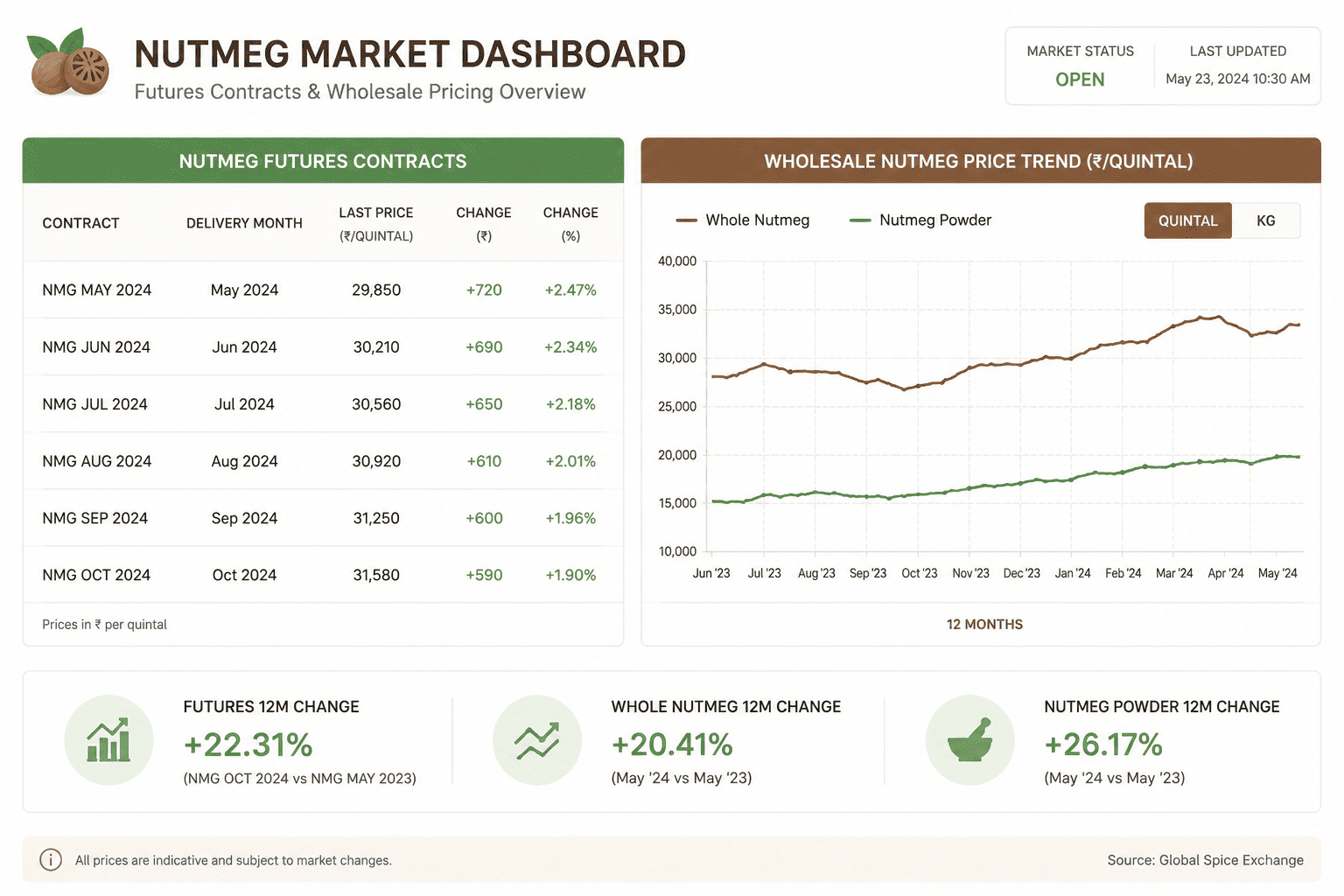
Key Commodity Exchanges:
- ICE (Intercontinental Exchange): Spice futures contracts; nutmeg listed as adjunct commodity
- CBOT (Chicago Board of Trade): Agricultural commodities; specialty spice contracts emerging
- Singapore Commodity Exchange (SGX): Asia-Pacific spice futures; direct nutmeg pricing benchmarks
8.2 Forward Contracts and Price Locking
Notably, large buyers use forward contracts to lock wholesale nutmeg pricing 6–12 months ahead—eliminating price volatility risk. Notably, this strategy requires minimum order volumes (10,000+ kg) and direct exporter relationships. Furthermore, forward contracting provides budget certainty and operational predictability. On the other hand, spot purchasing offers flexibility but carries price risk.
Forward Contract Pricing Strategy:
- Spot purchase: Current market price (subject to immediate price changes)
- 3-month forward: Price locked 5–8% premium to hedge seller risk
- 6-month forward: Price locked 8–12% premium for extended certainty
- 12-month forward: Price locked 12–18% premium for full-year budget predictability
9. Future Wholesale Nutmeg Pricing Projections and Market Outlook
9.1 2024–2026 Price Forecasts and Scenario Analysis
Notably, several macro factors will influence wholesale nutmeg pricing over the next 24–36 months. Notably, understanding these drivers enables procurement teams to forecast costs and make strategic sourcing decisions. Furthermore, awareness of multiple scenarios helps build resilient supply chains. In fact, scenario planning mitigates risk across all market conditions.
Bullish Pricing Scenario (Higher Prices):
- Indonesian political risk: Changing export policies could reduce supply 5–10%
- Global inflation: Wage costs, fertilizer, and fuel could spike prices +8–12%
- Climate uncertainty: Drought patterns unpredictable; supply shortages likely
- Projected pricing: ABCD $10.50–12.00/kg by 2026
- Procurement impact: Budget planning requires 15–20% price increase cushion
Bearish Pricing Scenario (Lower Prices):
- Market expansion: Vietnamese and Indian producers gain market share
- Technological yield improvements: Precision agriculture increases output 15–20%
- Economic slowdown: Reduced food manufacturing demand softens prices
- Projected pricing: ABCD $7.50–8.50/kg by 2026
- Procurement impact: Opportunistic ordering possible; oversupply likely
Base Case Scenario (Modest Growth):
- Balanced supply/demand: Indonesian supply stable; emerging competitors grow moderately
- Climate normalization: Neutral weather patterns; regular harvest cycles
- Stable global conditions: Inflation moderate; economic growth positive
- Projected pricing: ABCD $9.00–10.00/kg by 2026
- Procurement impact: Flat budgeting appropriate; cost increases 2–3% annually
10. Strategic Recommendations for B2B Nutmeg Buyers
10.1 Sourcing Strategy Framework: Price vs. Quality
Notably, procurement managers must balance wholesale nutmeg pricing against quality requirements specific to their manufacturing processes. Notably, lowest price doesn’t always yield lowest total cost of ownership. Moreover, hidden costs often emerge from poor-quality sourcing decisions. However, premium pricing doesn’t guarantee superior results either.
Quality-Based Sourcing Decisions:
| Quality Tier | Price Point | Use Case | Risk Factor | Total Cost Strategy |
|---|---|---|---|---|
| ABCD Premium | $10.50–11.50/kg | Pharmaceutical, premium retail | Low (uniform product) | Higher per-unit cost justified by 0% rejection rate |
| SS Standard | $8.00–9.00/kg | Food manufacturing blends | Medium (size variation) | Best value for cost-sensitive operations with tolerant specs |
| BWP Bulk | $5.50–6.50/kg | Grinding/extraction | High (fragment handling) | Lowest cost option; risk of lower yield if equipment inadequate |
10.2 Procurement Best Practices
Consequently, savvy importers employ these tactics to secure optimal wholesale nutmeg pricing:
- Establish long-term partnerships: Notably, negotiate annual contracts with 10–15% volume discounts vs. spot purchases
- Time seasonal purchases: Furthermore, buy heavily during January–March peak supply for 10–15% savings
- Diversify suppliers: In addition, source from Indonesia, India, and Sri Lanka to create competitive tension
- Forward contract 6 months: Meanwhile, lock 50% of annual needs 6 months ahead to hedge volatility
- Quality audit upfront: Similarly, conduct sample testing before committing large volumes to avoid rejection costs
- Negotiate payment terms: Additionally, extend terms to 60–90 days to improve cash flow vs. spot payment
- Monitor commodity futures: Furthermore, track ICE and CBOT prices to spot early market trend shifts
11. Contact Bhavana Spice for Wholesale Nutmeg Pricing and Custom Quotes
Notably, Understanding wholesale nutmeg pricing is essential, but experienced guidance is invaluable. Consequently, Bhavana Spice provides customized wholesale pricing analysis, volume-based quotes, and strategic sourcing partnerships specifically designed for B2B importers navigating global spice markets.
Our B2B Pricing Expertise:
- Real-time pricing data: Current ABCD/SS/BWP wholesale costs for all Indonesian grades
- Volume-based quotes: Transparent pricing for orders 500 kg → 50,000+ MT
- Compliance-certified shipments: EU/FDA/ISO 22000 certified supply with clear regulatory cost transparency
- Forward contracts: 6–12 month pricing agreements with locked-in rates and volume guarantees
- Market analysis: Quarterly reports tracking seasonal trends, currency impacts, and competitive dynamics
- Sourcing optimization: Custom strategies balancing cost, quality, and supply security
Get Your Customized Wholesale Nutmeg Pricing Quote:
- Email: [email protected] (Detailed quote response within 24 hours)
- WhatsApp: +62 822-3332-2034 (Instant pricing discussion with sourcing specialists)
- Office: Modinan RT 007/RW 021, Banyuraden, Gamping, Sleman, DIY – Indonesia
Why Bhavana Spice for Your Wholesale Nutmeg Needs:
- Direct exporter advantage: No intermediary markups; pricing reflects true production costs
- Transparent cost breakdown: All regulatory, logistics, and quality testing costs clearly itemized
- Flexible volume options: From trial orders (500 kg) to strategic long-term contracts (20,000+ kg annually)
- Quality assurance: Every shipment includes Certificate of Analysis with full pathogen and contamination testing
- Compliance-ready: ISO 22000, HACCP, organic certification, fair trade options available
Conclusion: Making Informed Wholesale Nutmeg Pricing Decisions
Notably, Wholesale nutmeg pricing is not a mystery—it’s a science. Notably, the factors driving prices—seasonal harvest cycles, global supply dynamics, regulatory compliance costs, currency fluctuations, and competitive positioning—are measurable and predictable. Consequently, B2B importers armed with this knowledge can negotiate confidently, forecast budgets accurately, and secure optimal value in their nutmeg sourcing strategy. Furthermore, integrating pricing knowledge with quality awareness creates sustainable competitive advantage. In essence, strategic sourcing combines science with market discipline.
Notably, the most sophisticated buyers combine price awareness with quality requirements—understanding that lowest cost sometimes masks hidden risks (rejection due to contamination, inefficient grinding from fragmented kernels, or supply instability). Therefore, building relationships with reliable exporters who provide transparent pricing, consistent quality, and flexible volume options—like Bhavana Spice—delivers long-term value that exceeds short-term price arbitrage.
Ready to transform your wholesale nutmeg sourcing? Contact Bhavana Spice today for transparent pricing, expert guidance, and customized solutions tailored to your manufacturing requirements and budget objectives.